Visiting Morocco after 30+ years: was it a good idea?
We spent 3 months visiting Morocco on a road trip during winter – and didn’t see all of the country. For Yasha it was her first time in Morocco, or any Arab country. I was visiting Morocco for the second time; my first time was sometime in the mid-80s. Yes, that’s well over 30 years ago, and many things have changed dramatically; but others, not much at all.
Recently I visited Morocco as a tourist for the second time in 30+ years. Here are my observations of the changes in this beautiful North-African nation.
In the mid-80s (I wish I could remember the exact year my then girlfriend reminded me: it was in February and March 1982, so even longer ago!), I also travelled through Morocco in a converted van-shaped truck camper, very similar to our Bertita: a Mercedes 608D. So my experiences are easy to compare because they were both road trips.

An old Mercedes T2 508D van. This is very similar to mine: same colour, I used to have a second side door with window, only mine was a 6-ton 608D and a little newer.
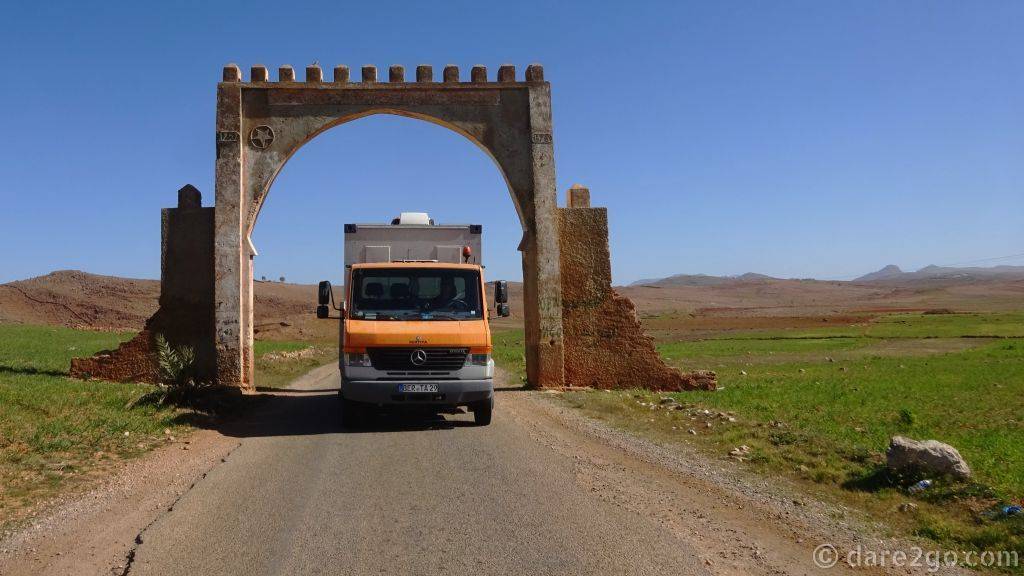
Our current truck Bertita driving through an old gate in the middle of the Moroccan country side.
Some things have changed for the better but, as a second time visitor, I also missed quite a few of the sights and encounters I had loved so much during my previous visit. Our time in Morocco was cut short, due to a vehicle accident , and we didn’t get to visit all of the places on our list.
What you will find in this article:
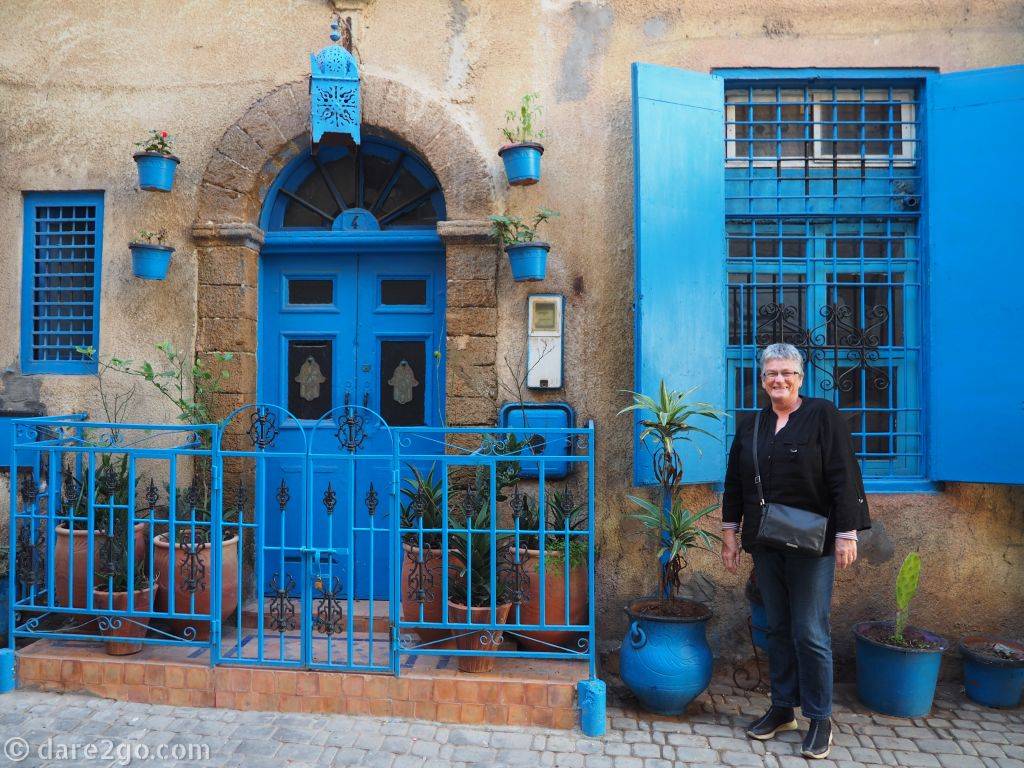
It was Yasha’s first time in Morocco and she often commented that it felt really ‘foreign’ compared to anywhere in Europe.
So, do we want to return to Morocco?
You’ll find our answer at the end of the post.
Morocco is much more crowded now
This was my first impression, once we left the port of Tanger Med and drove southwards. I didn’t remember Morocco being so densely populated. In the North of the country it is even more obvious, because this area receives more rain and is more fertile. But a quick check on the Internet confirmed the fact: whereas Morocco had a population of just over 22 million in 1985, it has now grown to over 36 million people.
New houses everywhere in Morocco – and they are very different
What stands out to me is that all major towns and cities have grown exponentially. This is not a real surprise if you look at the population figures. But I also noticed changes in building style.
First of all: today, every town of any size is surrounded by apartment buildings. Apartment living is not the traditional Arab style of housing. Old towns were often built almost on top of each other, with only narrow laneways between the buildings. Each extended family would occupy their own group of dwellings.
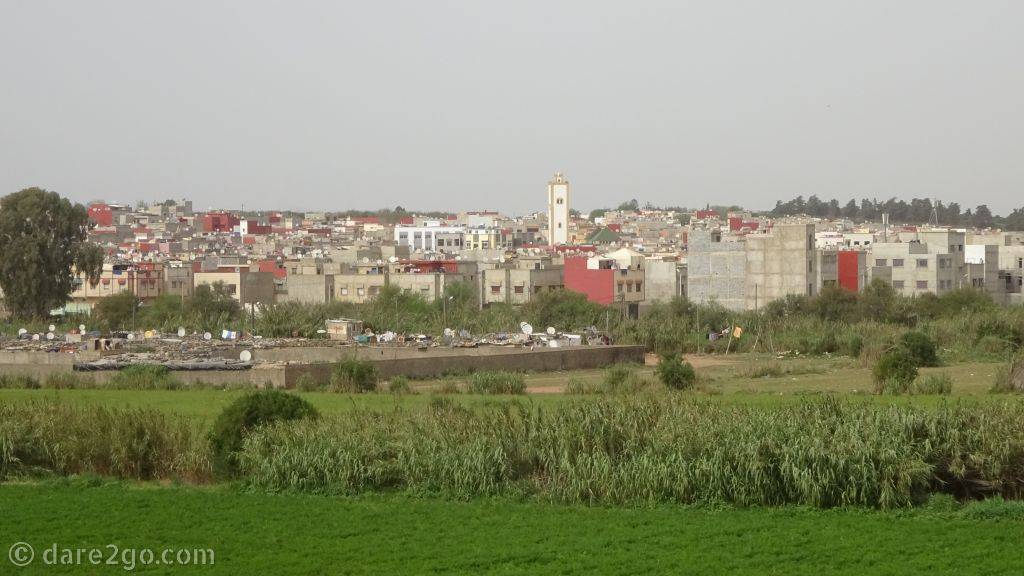
Not an unusual sight in the north of Morocco: in the foreground a slum-like settlement of economic migrants, in the background the urban sprawl of newly built apartment houses – most not quite finished.
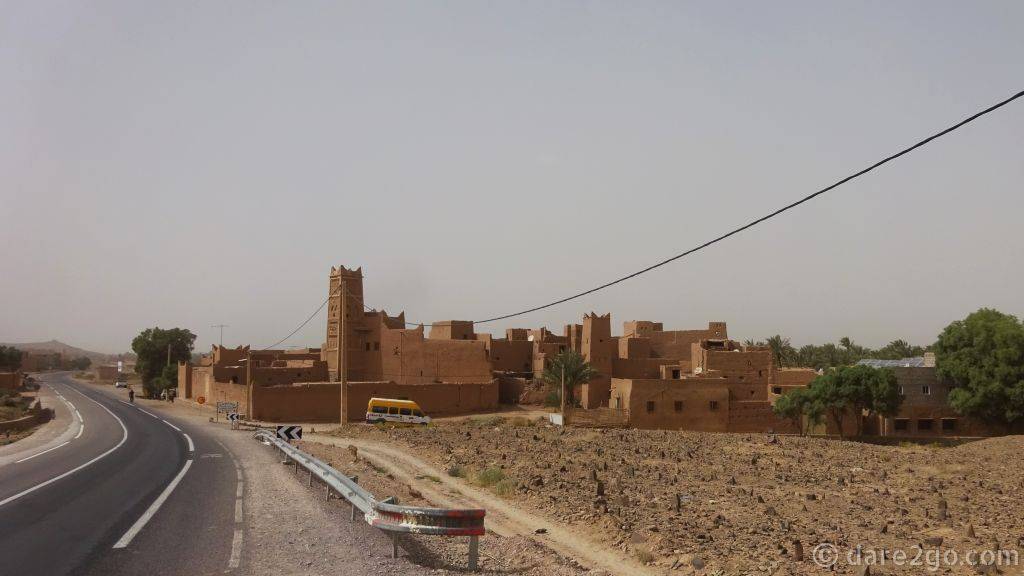
An old mud house village (a kasbah) north of Zagora in the far east of Morocco.
And, of course, the windows: on modern buildings they face outwards! Traditional Moroccan houses were built around a courtyard (or several courtyards), with most windows facing this private family yard. That may have had something to do with traditional role of women in a Muslim society; that they were hidden away inside the house. Or, perhaps with the fact that such dwellings were more secure.
In town centres, you can still find some traditional buildings amongst the new construction. Otherwise, you should visit one of the old Kasbahs, to get an idea about the inward facing style of buildings, with few openings to the outside.
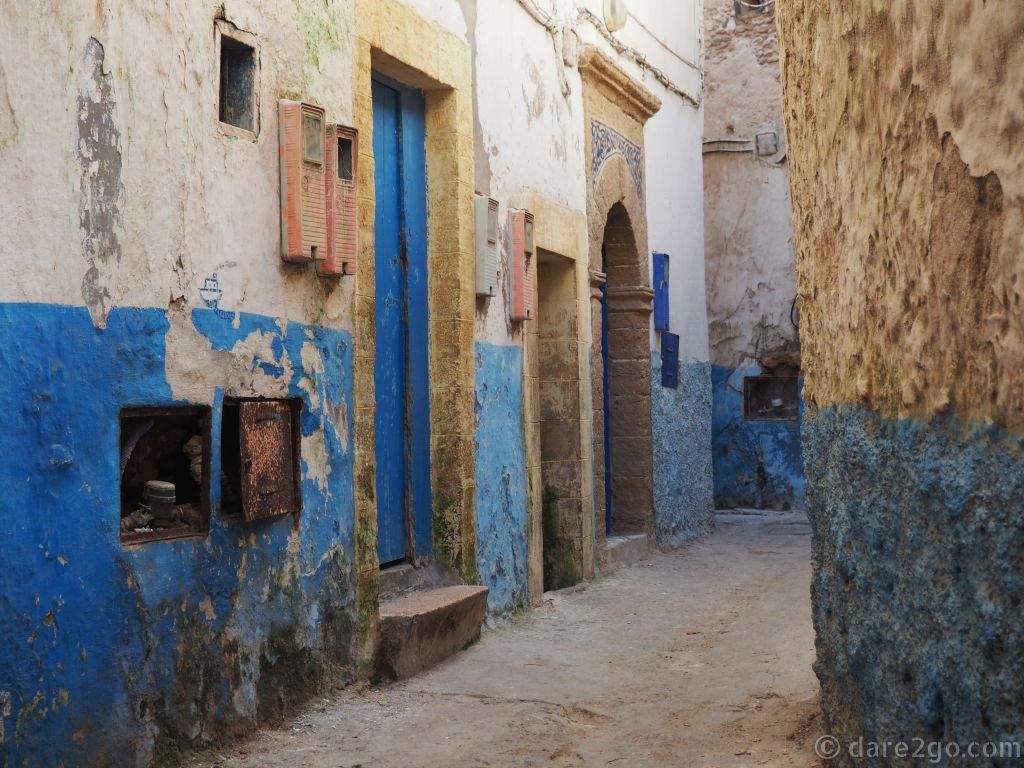
Some old houses in Essaouira, where the blue painted render slowly crumbles off.
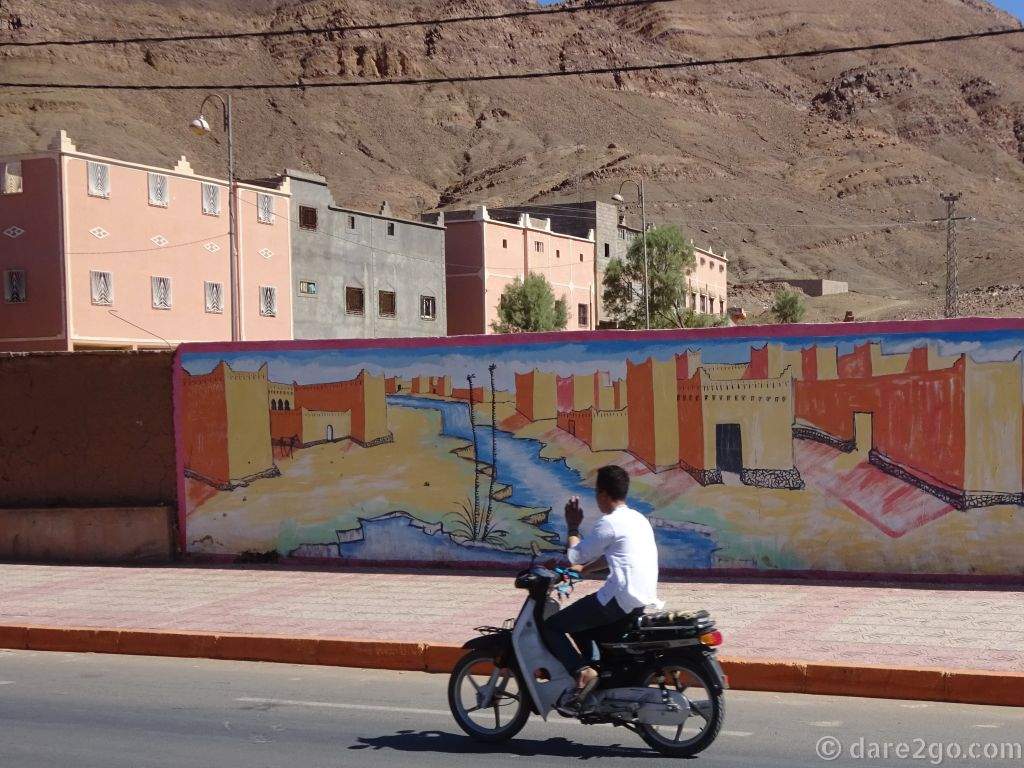
That’s where traditional houses seem to survive: in paintings, here on a wall in front of modern apartment buildings.
The building boom is accentuated by a wave of new houses. These are built by Moroccans, who work in foreign countries, mostly in the EU, and send money home to have their “Arabic Dream Palace” constructed. They always stand out by their very elaborate decorations. And none of them are any smaller than at least three storeys. During our road trip, we constantly commented on these, and photographed a few – here are 2 examples:
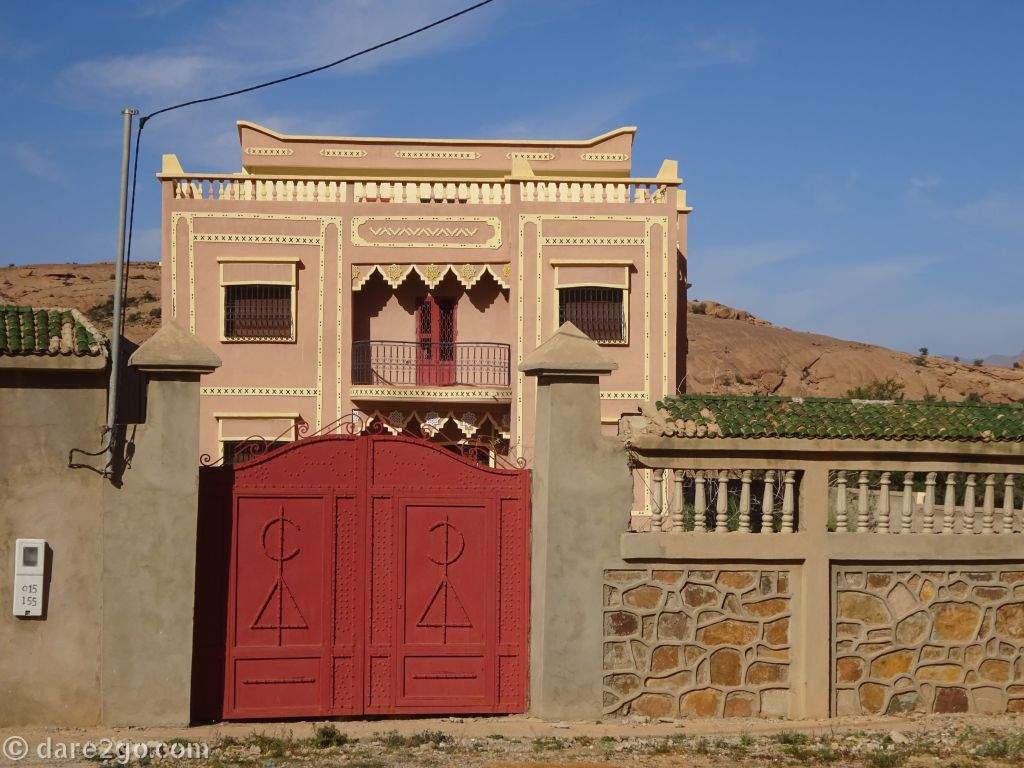
A richly decorated new house near Tafraoute, Morocco. Often these are built for people who work in Europe and send money home for their “dream home”.
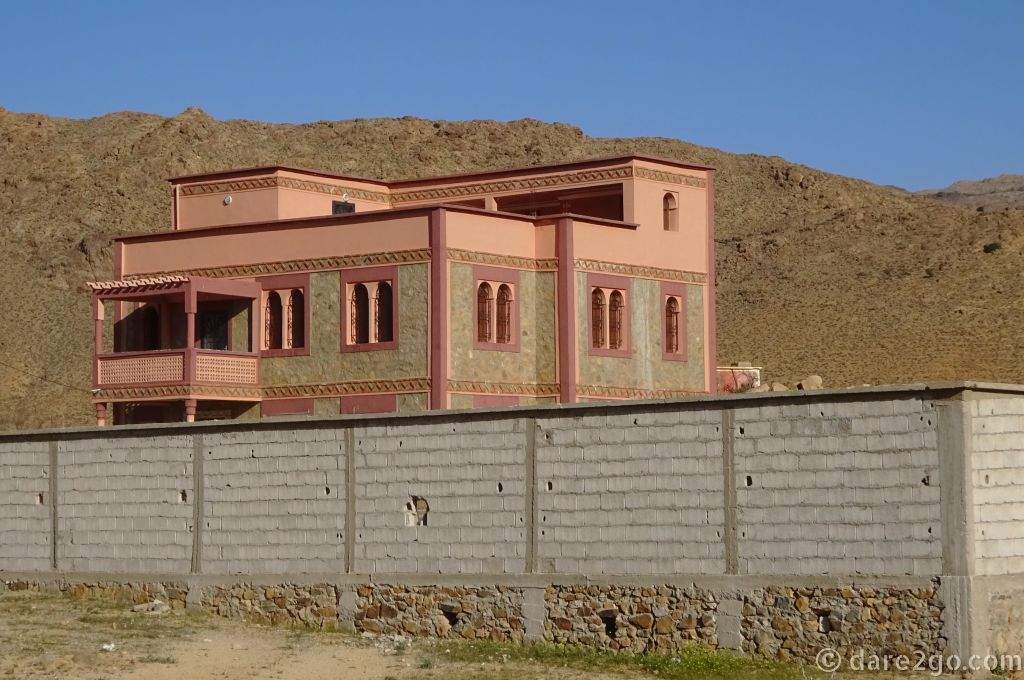
Another richly decorated new house in Morocco. Often these are built for people who work in Europe. If you look closely they often aren’t finished either, with window glass and interior fit-out still missing.
Traffic in Morocco has also increased exponentially
I guess this fact applies in any country around the world, but in some developing countries we have visited, it really stands out: people become wealthier and therefore buy more cars. Currently, traffic in cities in Morocco is rather chaotic, with long traffic jams, lack of parking, and all the other typical negative effects of increased private vehicle ownership.

This was our first real traffic jam in Morocco, just outside Casablanca. Note: the road is two lanes only but everybody tries to squeeze past on the dirt edge – until a deep pothole comes. Then they expect the vehicle next to them to let them in line…
In the 1980s, I drove through Casablanca and there was hardly a private car on the road – now the traffic is bumper to bumper. I also drove right into Essaouira and Marrakesh. In Essaouira I parked really close to the old port, and our van was basically the only private vehicle around. I took friends to their guesthouse in Marrakesh, and I drove right into the Jemaa el-Fnaa square to park in front of their accommodation. Today that square is closed to all but delivery vehicles, a rule that is strongly policed.
But, out in the countryside it’s a different story, especially in the South of Morocco. Sometimes we wouldn’t see a single vehicle for hours. I also commented frequently on the lack of semi-trailers in the south; come north and you share the road with plenty of them (though less than in South America).
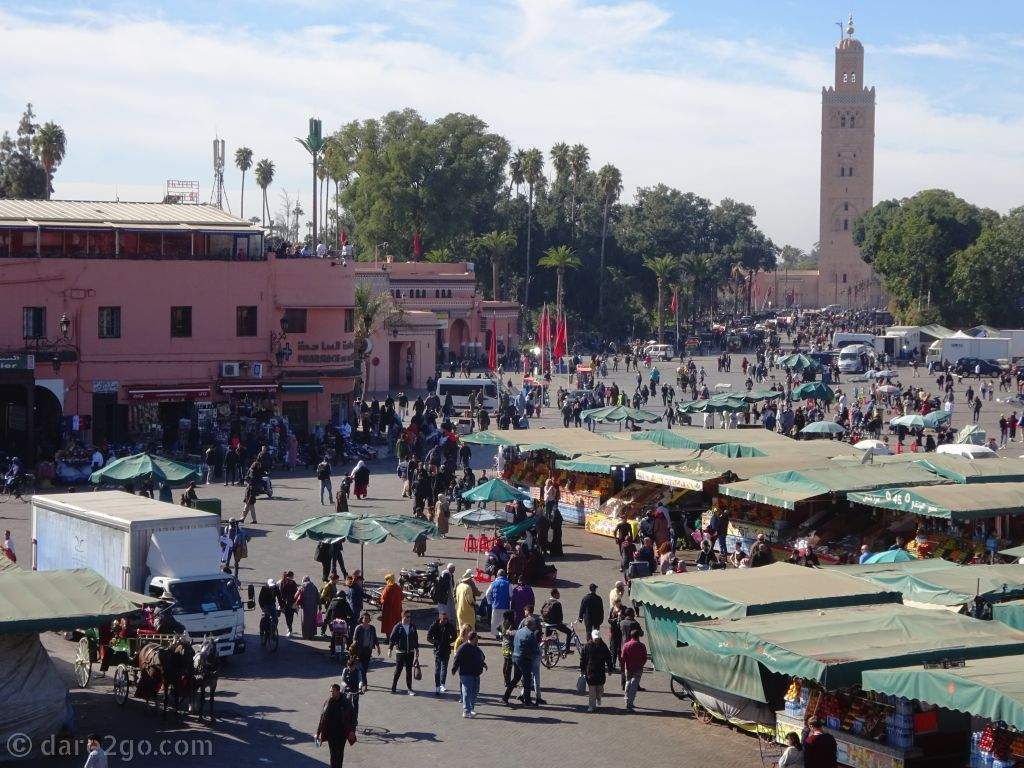
Photographed from a 2nd floor coffee house: The busy Jemaa-el-Fnaa square in Marrakesh. At night this is full of stalls.
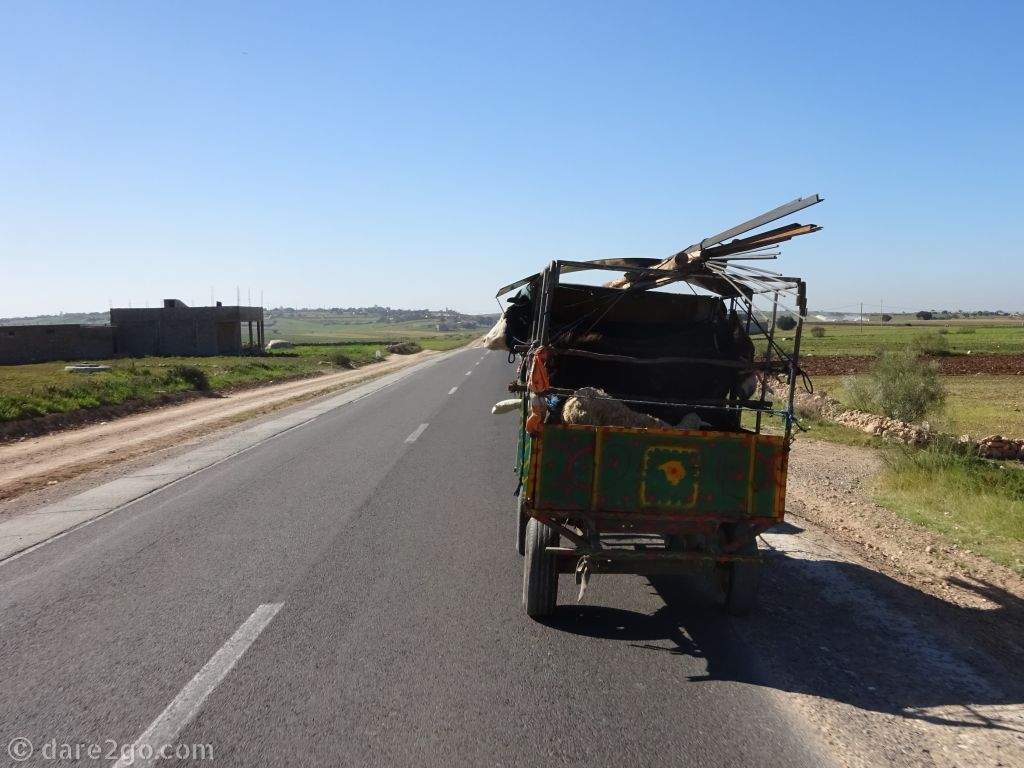
A typical road hazard in some regions of Morocco: a large horse drawn cart, loaded with a cow, a donkey (look closely), some sheep, and steel bars tied to the roof, returns home from a market.
The vehicles on Moroccan roads
Well, it hasn’t changed that much since the mid 1980s. You still see plenty of old cars – but nothing as run-down as some of the cars in rural Argentina or Bolivia. Old Mercedes remain a favourite, especially the old ‘Bremer’ vans in all states of (dis-)repair. These serve, day in day out, as public transport in most regions. You hardly see any more recent Sprinter vans taking their place, and we wondered why. If at all, then old Ford Transit vans are the only alternative being used.
That’s not to say that you don’t meet new cars on the road – but moreso in the cities. Morocco now assembles quite a number of French models. Mini-vans are the preferred option of the locals. Cars like the Peugeot Partner, Citroen Berlingo, Renault Kangoo and of course the Dacia Lodgy, which is very popular as a taxi. Most trucks are now Japanese, with the odd small Chinese delivery truck to be seen.
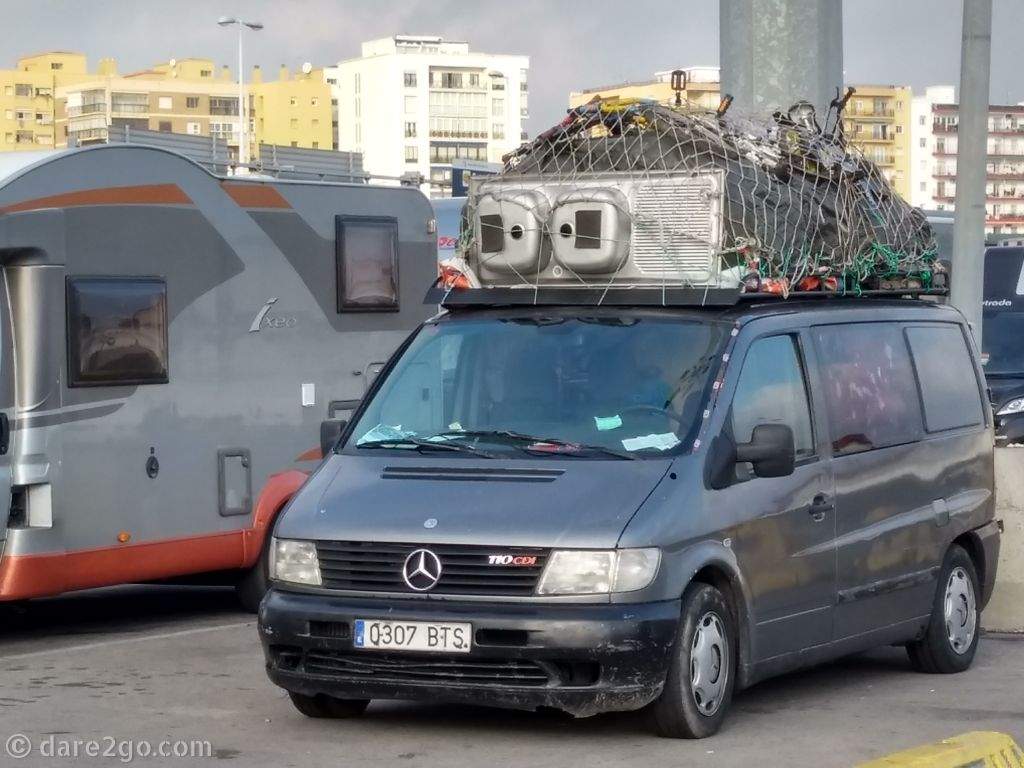
One thing that hasn’t changed much, is vehicles often loaded up to way beyond their capacity. You’ll see them coming off the ferry, where every Moroccan visiting from his workplace in Europe, seems to bring home everything – including the kitchen sink (or two or three). But from small delivery vans to hay trucks, all vehicles in Morocco are usually stacked really high.
Please click thumbnails below for a larger photo with description.
-
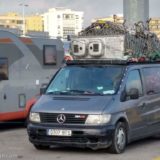
- A van of a returning Moroccan at the port of Algeciras, the roofrack packed high with various things – including a kitchen sink!
-
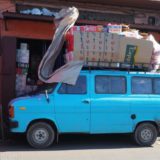
- A blue Ford Transit, with the roof rack stacked really high. This van must be nearly 30 years old – still in daily use.

-
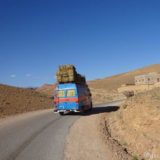
- An old Mercedes Bremer as local transport. On the roof hay bales, some sheep in front of the hay, and passengers inside.
-
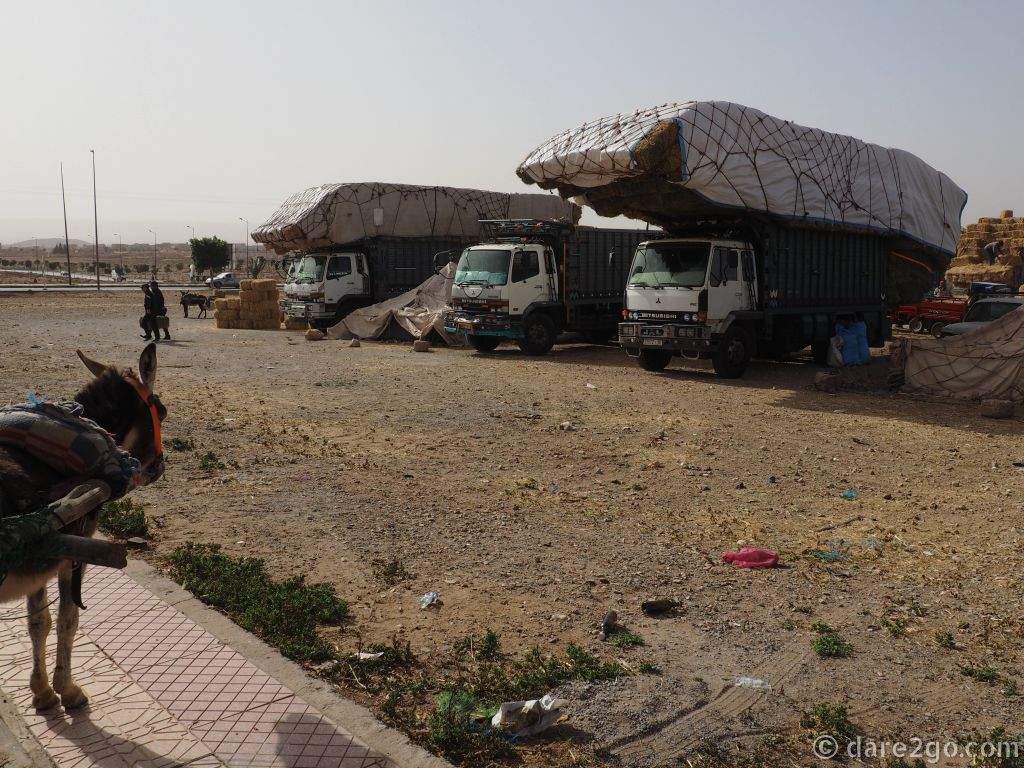
- You see these trucks everywhere in Morocco, stacked high, really high with hay bales. Often they transport these from the more fertile north all the way to the dry south.
The road network has been significantly improved
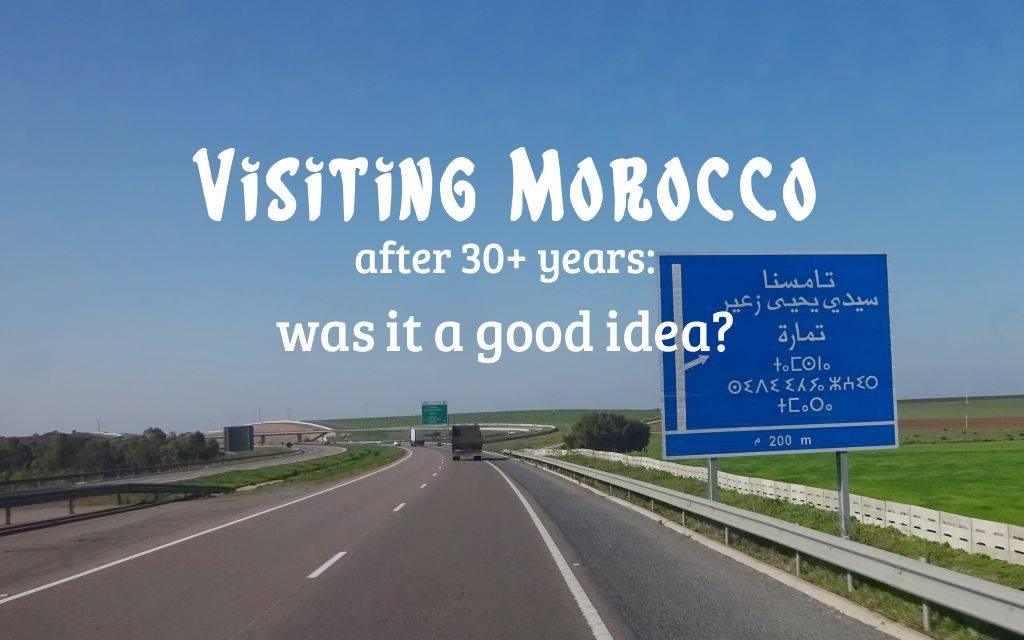
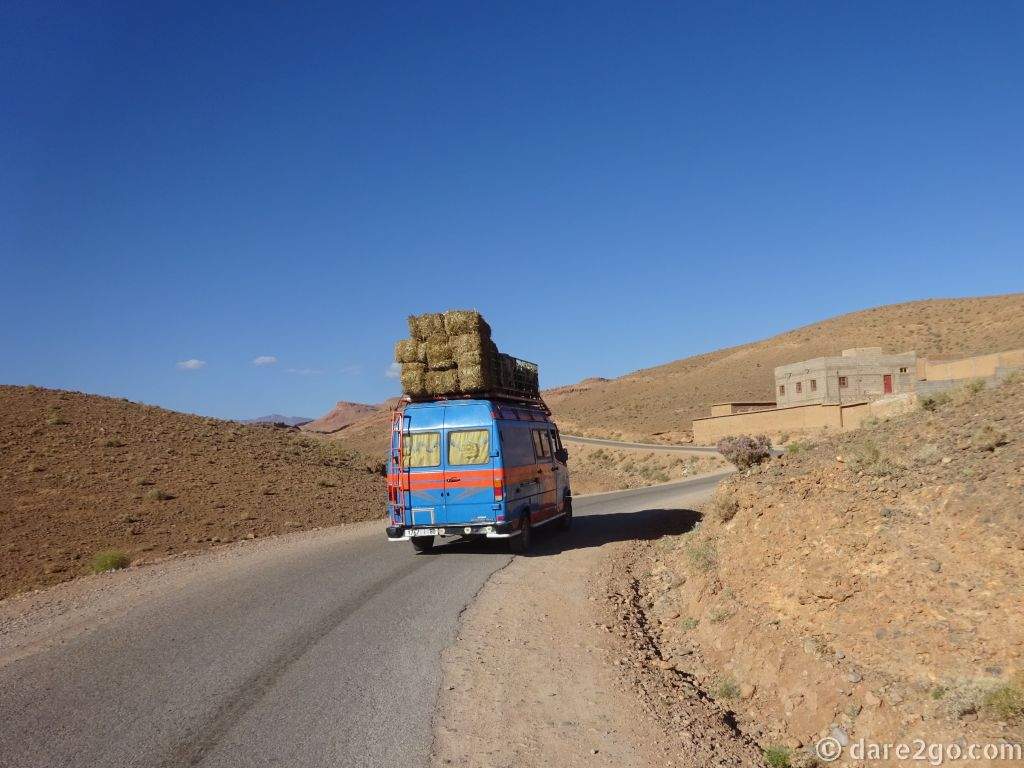
Yes, you still find some rough, dusty, dirt roads in Morocco, but not that many! Coming off the ferry we drove straight onto a four-lane highway. This toll road goes all the way to Marrakech, and in another direction to Meknes and Fez. [See our header photo!] In the mid-80s there used to be a fairly well maintained two-lane road, which is now the N1 in a much improved state. It runs parallel to the toll road.
Country roads are usually paved, but often only wide enough for a single truck, with a dirt edge to get off for oncoming traffic. But we didn’t need to use it often, due to the very few cars we met. Only around Tafraoute, did I have the feeling that the road network wasn’t really up to the volume of traffic. But, in the 1980s, I had to bump along a very rough stony dirt track, all the way from the coast road to Tafraoute! Needless to say, back then I didn’t drive any further…
Nearly everywhere seems to have power and clean water
…and mobile phone reception! This is a change I really noticed. In the 80s, north of Essaouira (which is the more developed part of the country), I refilled with Diesel at hand operated pumps several times, simply because they didn’t have electricity in that town!
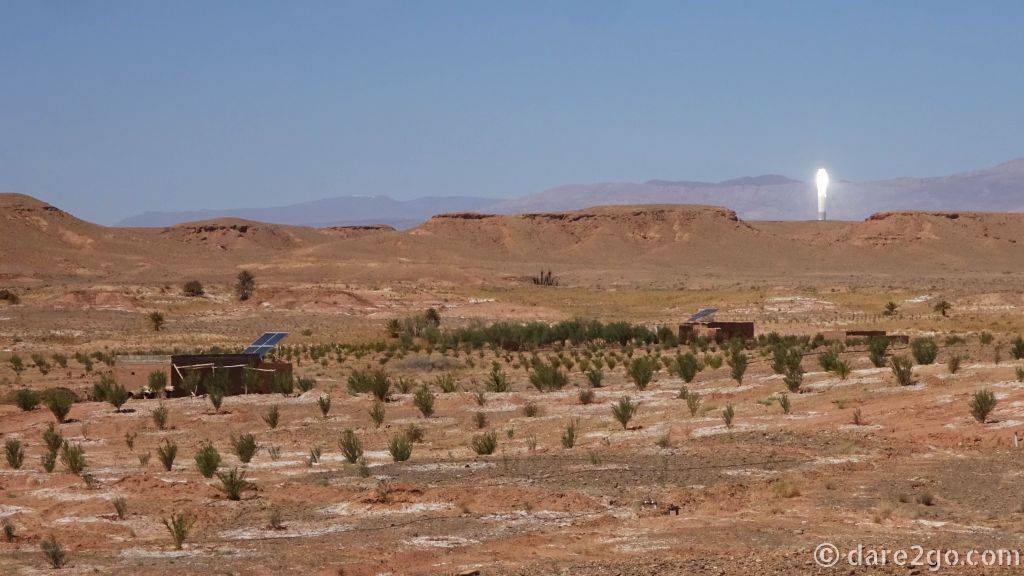
Alternative energy in the dry desert near Ouarzazate in Morocco: in the foreground 2 farms with large solar panels to power irrigation pumps, in the background the collection tower from the NOOR power plant.
When we needed water, we often had to drive to local wells, where we shared the water hole with the locals, who filled jugs and jerry cans with water to carry home. And the water in these wells was often dirty and of dubious quality. To this day I vividly remember one lot, where I found strange looking red things wiggling around the otherwise clear water – I promptly developed stomach problems.
Now I saw such dramatic changes that I realised I had obviously missed an entire step in between. In most villages you will still see central water outlets, but with the taps (faucets for Americans) missing or broken, because every household seems to be connected to clean mains water.
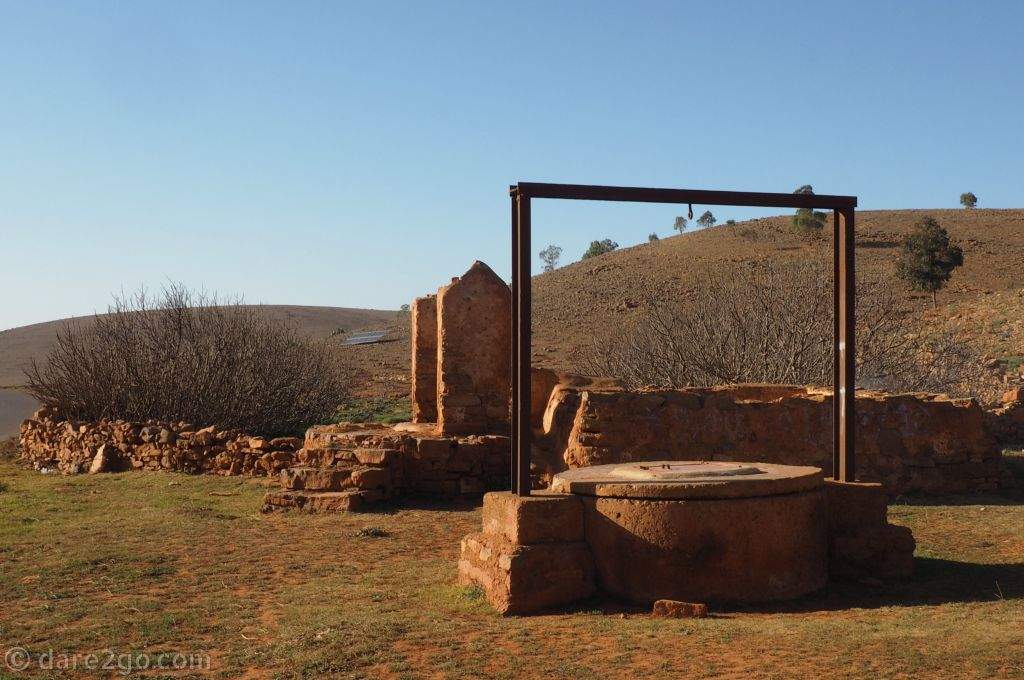
This depicts the progress in water supply: the old well in the foreground has been closed off. In the far back you see an array of solar panels. These now power a pump, which feeds the water straight to the nearby village.
The only parts of the country where you don’t see power lines is the far south and some desert camps. Today, these people get their electricity from solar panels – enough to warrant a large satellite TV dish on the roof! Morocco is fairly developed when it comes to alternative energy. This is evident by large, modern solar power plants you see in many places. The country is aiming to become a “green power exporter” to Europe.
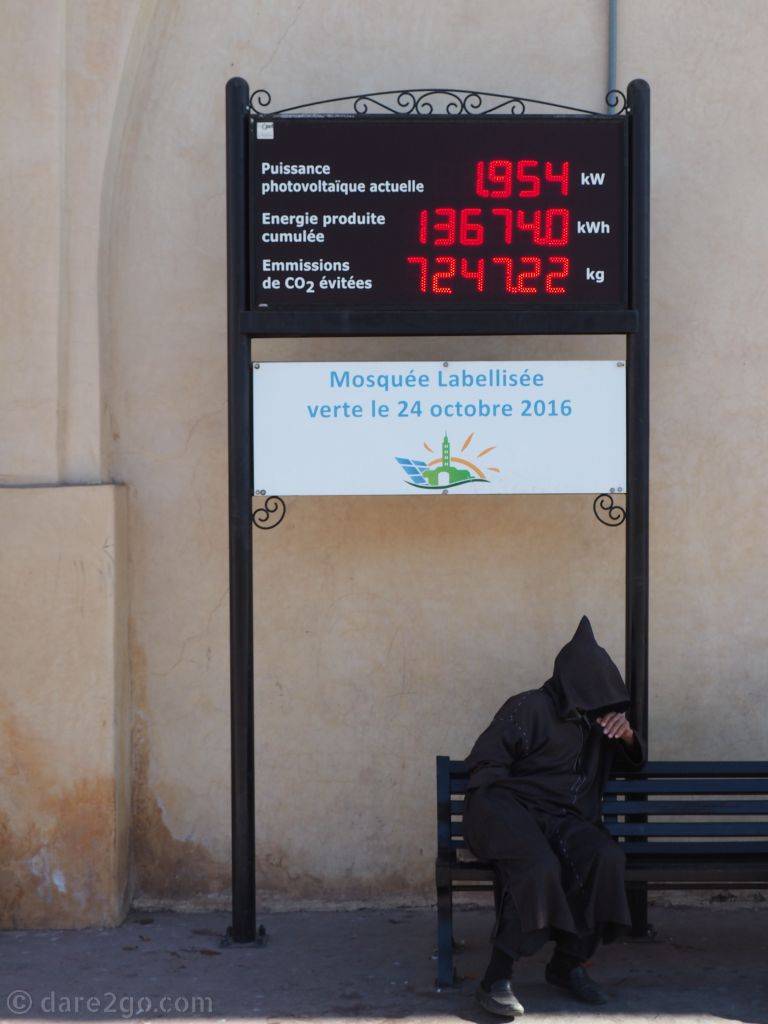
A sign outside the Kasbah mosque in Marrakesh, which shows how much solar energy was harvested from its roof.
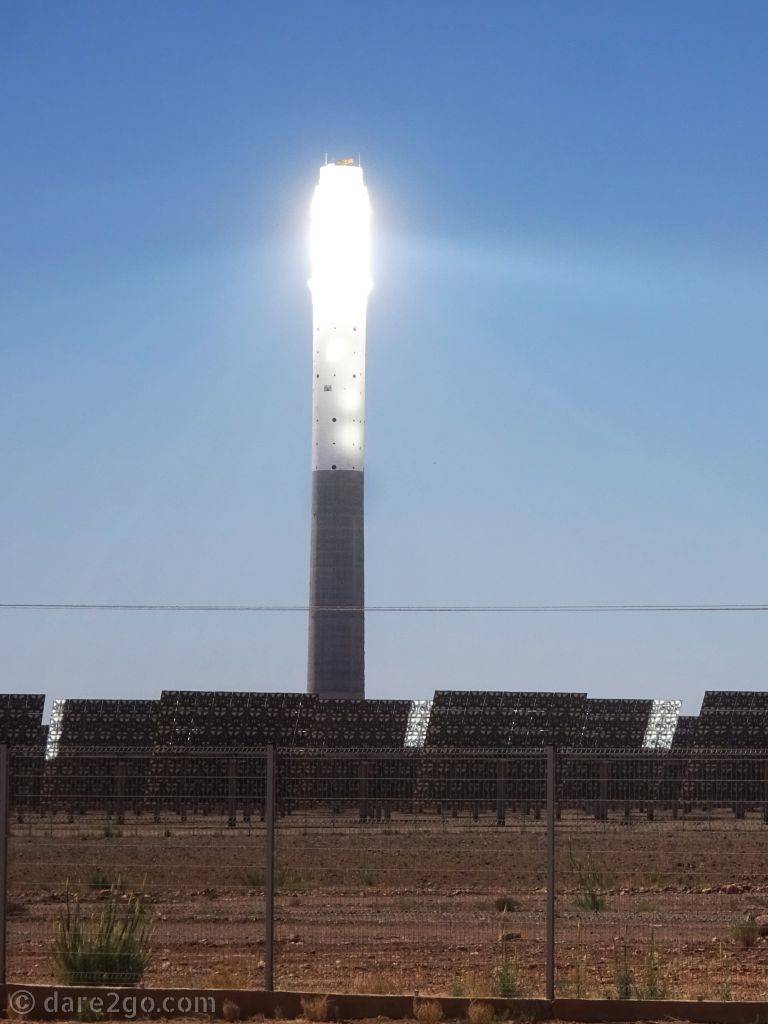
This is the NOOR 3 power plant near Ouarzazate in Morocco – the largest of its kind in the world! Rings of adjustable mirrors reflect the solar rays to a central collection tower.
We had a SIM card from Moroc Telecom and found good reception almost everywhere. We both assume that Morocco is another country, which went straight from no telephones to mobile telephones for everybody (as we had previously seen in Latin America).
Unfortunately, with all the aforementioned technical innovation comes a sad fact:
Traditional crafts are slowly dying
I vividly remember how I stood around the coppersmiths and wood carvers in Essaouira, watching with fascination how skilled these craftspeople were. I watched one man forming a flat sheet of copper with his hammer, until he made a large round bowl with a perfectly flat base centred exactly. It was noisy and dirty work, but also highly skilled!
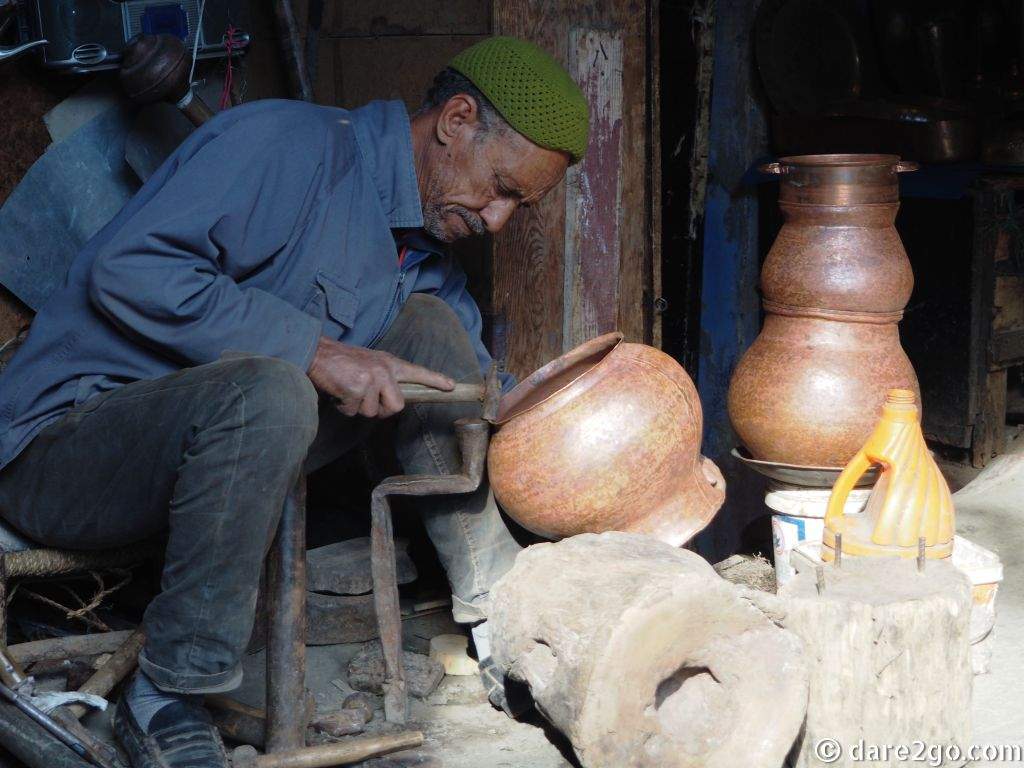
Hidden in a yard, off a hidden side lane in Marrakesh’s Souk, we finally found this old man. He’s still making the traditional copper and brass pots by hand.
Today, you really have to go deep into any Medina to find such expert craftspeople – and there doesn’t seem to be many left! In the 80s, you just had to follow the noise of hammers beating the thin metal, as these workshops often occupied prominent small squares in the maze of lanes that form a Moroccan Souk. The most talented craftspersons would usually occupy the cleanest and best decorated shop, in the best location. But despite this, they’d sit in front on a low wooden stool and produce their wares – one by one!
Please click thumbnails below for a larger photo with description.
-
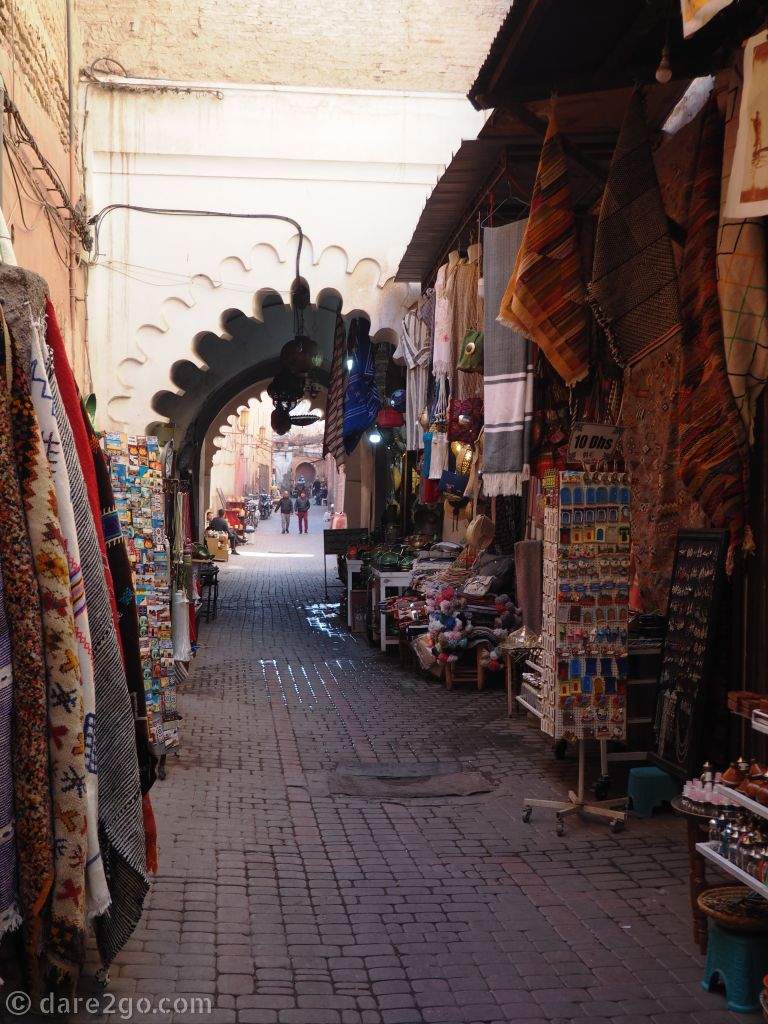
- The more typical tourist shops in a Souk of Morocco: some carpets, some nick-nacks, and a lot of cheap imported “souvenirs”
-
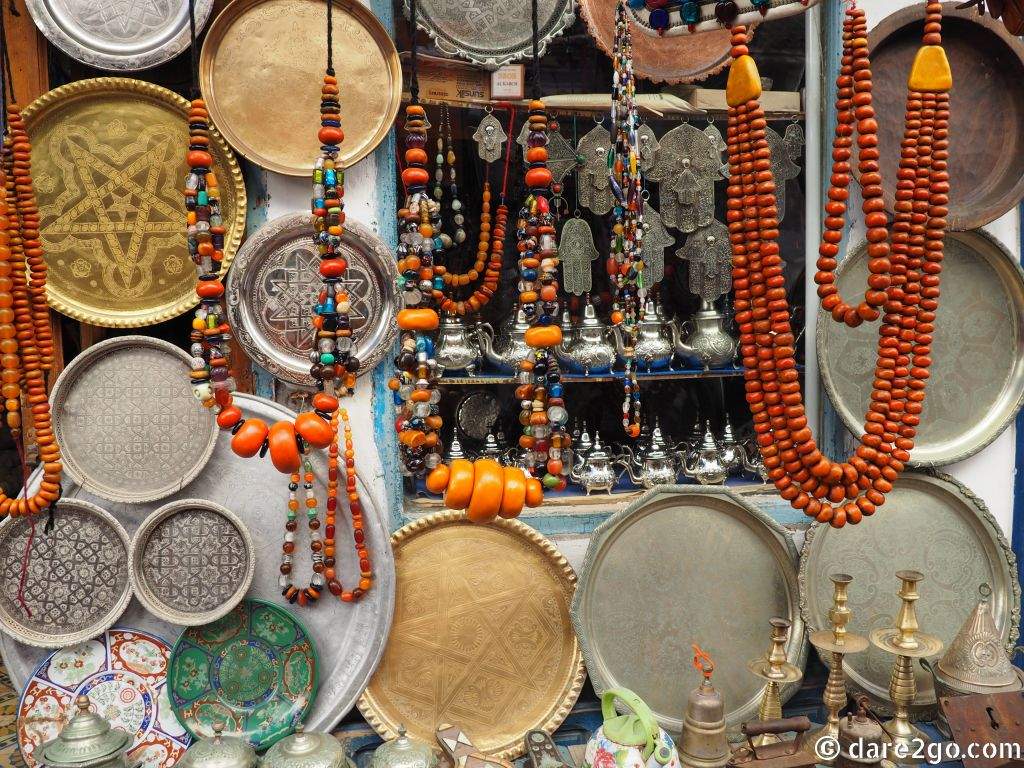
- A not quite typical tourist shop in Essaouira in Morocco: lots of new things displayed alongside a few old wares.
-
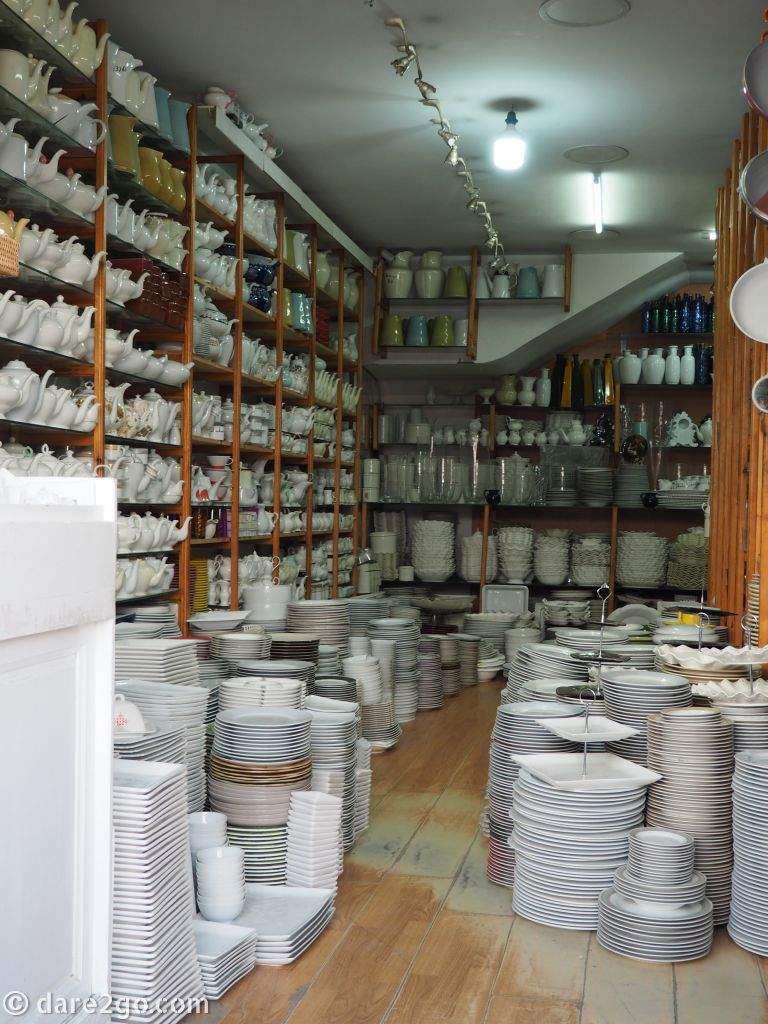
- No elephants allowed in here: a porcelain shop outside of the old town of Essaouira.
-
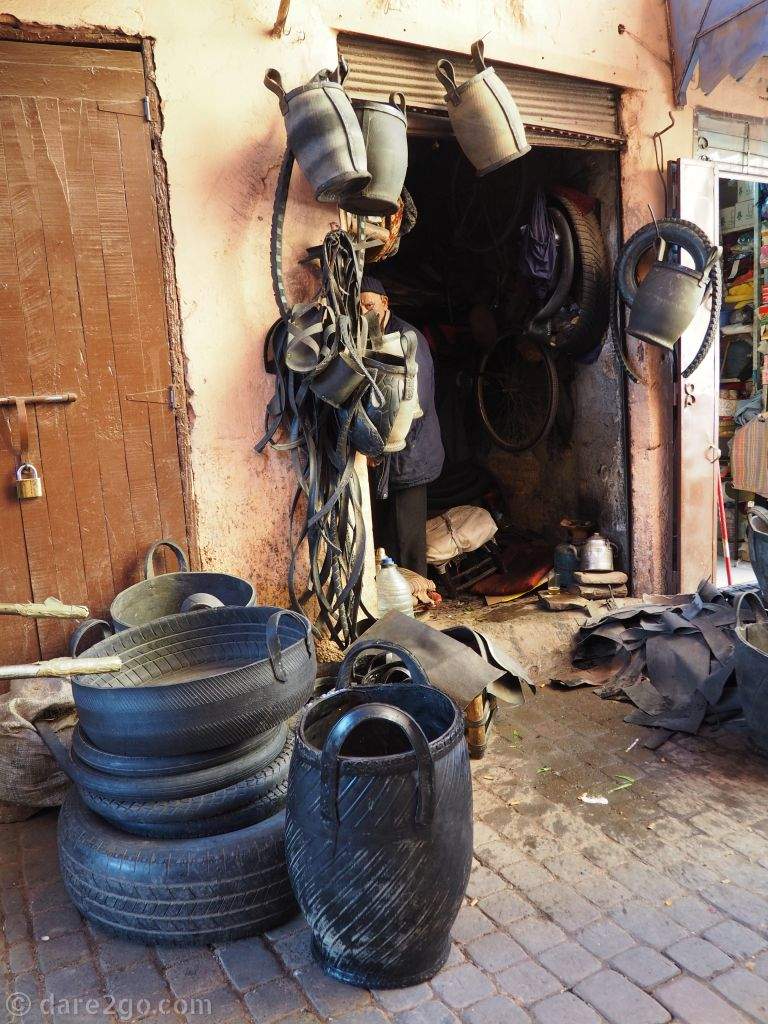
- A shop recycling old tires and making bowls, buckets, and other useful items from the rubber.
I believe that tourism and China are both partly responsible for the diminishing presence of old crafts. Of course, the fact that the younger generation has different aspirations also affects it. But, especially in Essaouira and Marrakech, we heard many stories that shop owners and people, who traditionally used to live in the Souks, can’t afford the prices anymore.
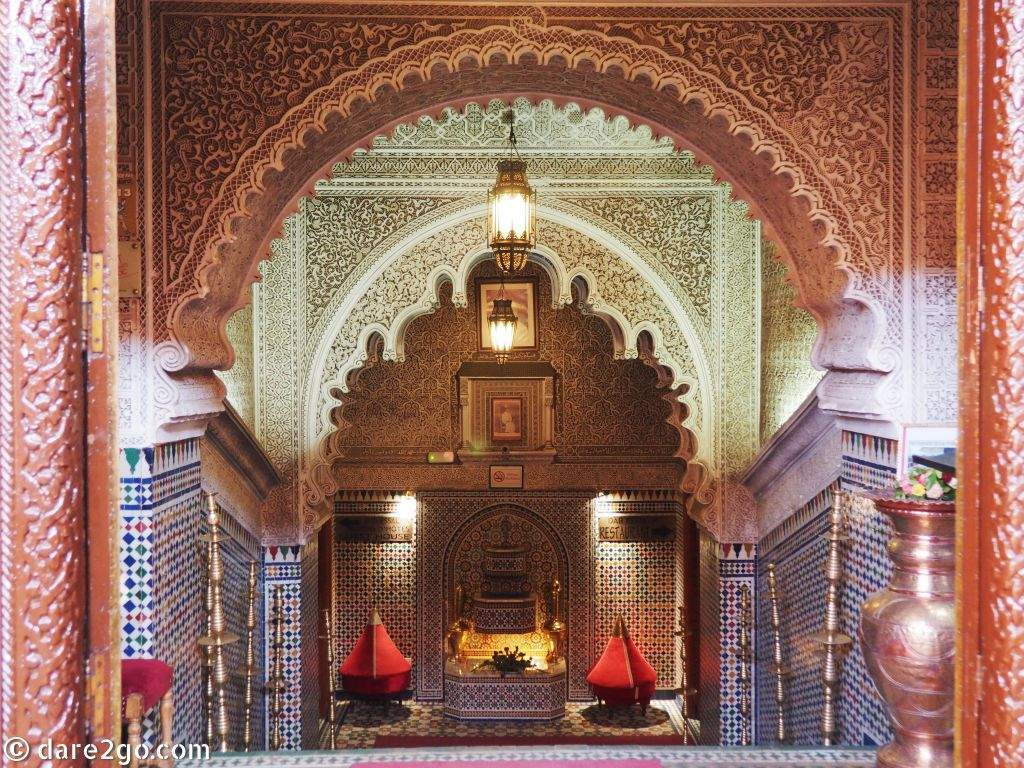
The impressive entrance of an upmarket Riad (guesthouse) in Marrakesh. These are slowly pricing the locals out of the old town.
A shop with imported “traditional souvenirs” can simply afford higher rents than a craftsman making one-off items. A ‘riad’ for international guests can pay more for a nice house than a large family, who often lives on a single meagre income. And once you have been removed to the outskirts of town, you can’t sell your wares in town anymore; you rely on a middleman, a merchant. Which brings me directly to the next topic:
Moroccans’ sense for a “quick buck” (or better Dirham, the local currency)
Most Moroccans have a good sense of business and see tourists as easy pickings. Not much has changed here, except that nowadays they come much more quickly to the point. Gone are the days of several cups of the typical over-sweetened mint tea to sweeten a possible deal. Not much time for idle small talk before vendors point your eyes to their merchandise.
Wandering through any Medina in a tourist hotspot, like Marrakesh and Essaouira, can quickly turn into a fairly tedious exercise. There’s no time for real browsing, searching for that one unique piece that you won’t see in dozens of shops in that same lane. You’ll be quickly targeted by a keen salesperson. We are used to this from Bali – but then we haven’t been to Bali since 2001, simply because we feel tourism there had gone overboard. In Morocco these days, you are never left alone – even sitting in a cafe drinking coffee! People try to sell you stuff, from jewellery to paintings; children will come begging; and even shop owners will come and introduce themselves politely and then hassle you to come to their shop to ‘just look’.
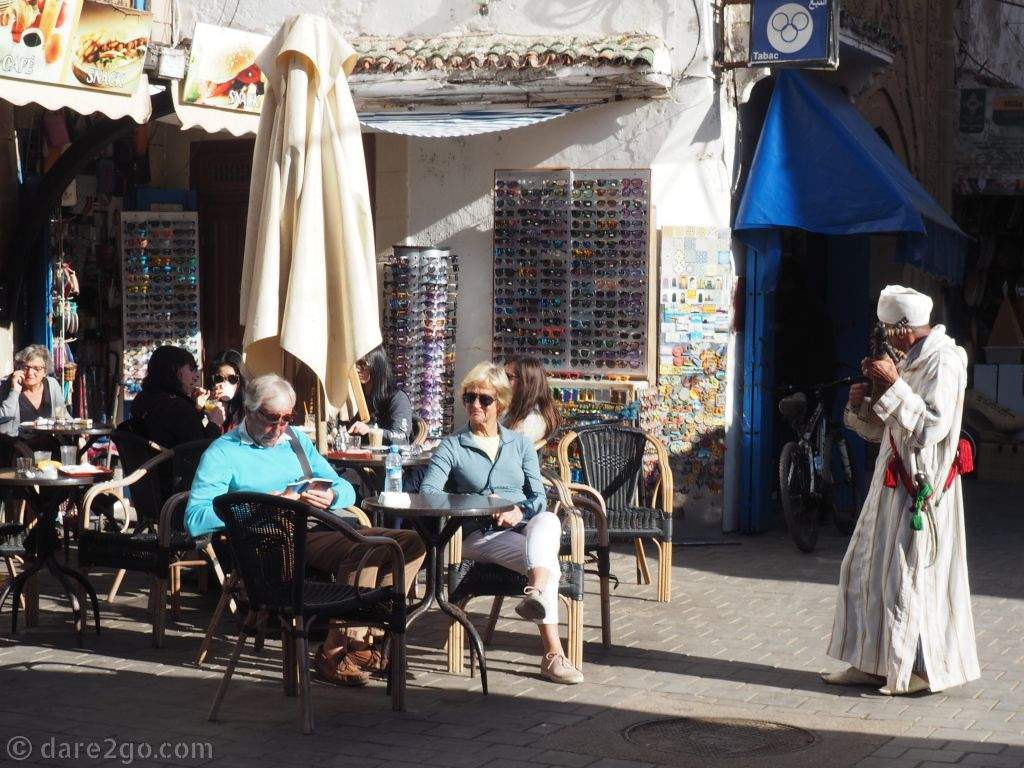
Don’t expect to relax completely at an outside coffee shop in Morocco’s tourist towns! There will be always somebody coming around who wants your money…
If you hail a taxi, be prepared to knock the asking price down to half, or often less. A fare, which might cost the locals 30DH, has a tourist price of 100-150DH. (If you want to get stress-free from the airport to your accomodation, we strongly recommend that you book your transportation ahead of time! ) So be prepared to haggle for almost everything, from market shopping to handicrafts. And in some places you simply pay thrice the price, specially in fancy tourist restaurants. A Tajine, the typical local dish in a clay pot, can cost anything from 25DH to 150DH – easily!
Then there is the begging! This has become particularly bad with children. They can be well dressed, have a shiny bicycle, and possibly their own mobile phone, but as soon has they spot any foreigner they hold out their hands. Where it was the ever present “stilo” (pen) question in the 80s, it’s a now a direct demand for money or chocolate – and not a humble request either…
The thing I find really sad with kids’ begging is that it is actively encouraged by their parents! More than once I watched a mother nudge her hesitant child to approach us, hand held out.
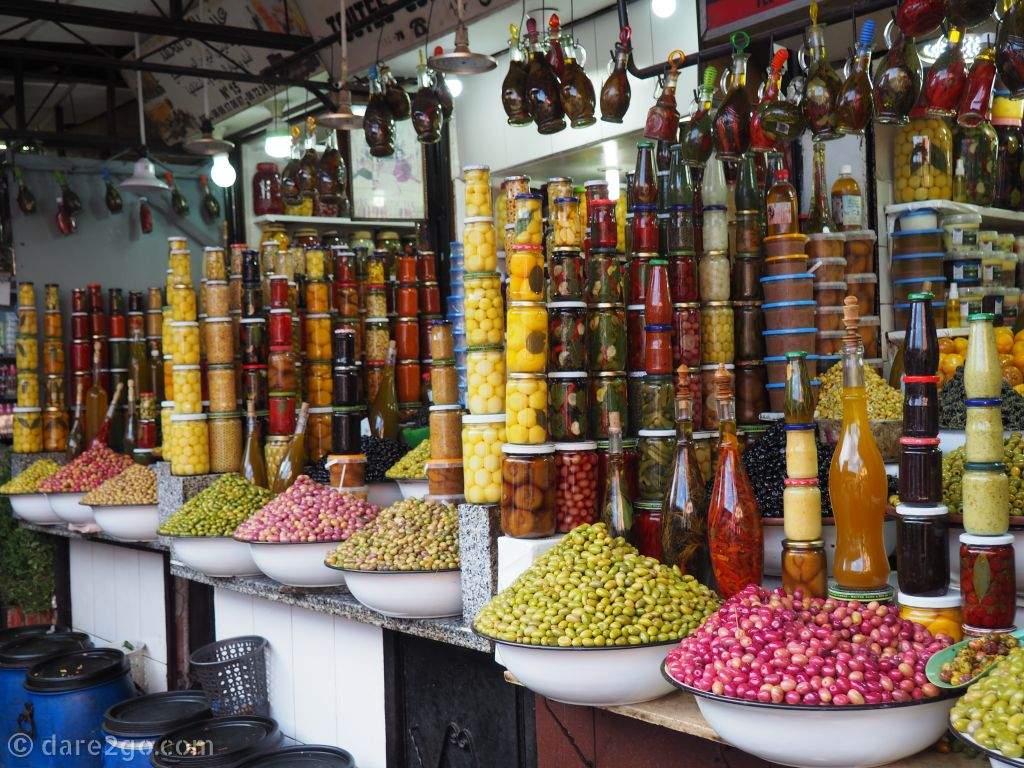
Healthy competition: three near identical shops selling pickles in a more residential area of Marrakesh’s Souk.
Of course, you can skip all the haggling and go to a supermarket! Over 30 years ago, you could only find supermarkets in the main cities. Now they seem to be in every major town. The downside is that often they are more expensive (as we experienced in South America too ). And their products, particularly their baked goods and vegetables, aren’t as good as you will find at local markets. So, for fresh food we still went to markets. Most times we were asked lower prices (without haggling!) than the next supermarket would charge.
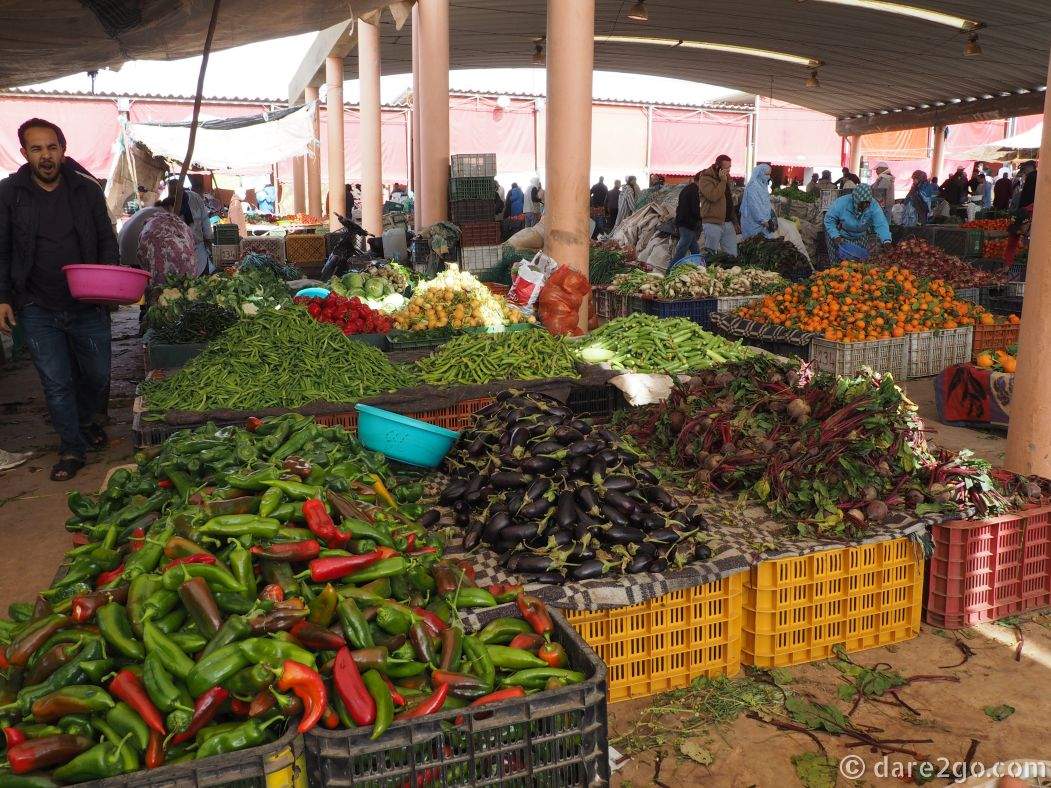
The colourful display of heaped vegetables at a market in Guelmin, Southern Morocco.
Things that haven’t changed much in Morocco
You can still find endless stretches of seemingly unpopulated landscape: on the coast south of Agadir; inland south of Taftraoute; and in the sandy Sahara desert of course. This makes Morocco a paradise for free camping. But don’t be fooled – if you stop for more than 5 minutes, a curious person will appear – seemingly out of nowhere! This experience is a lasting memory from the Morocco of the 80s too.
Poorer people tend walk for long distances, or ride a donkey – nothing much has changed there. In most regions, we hardly ever noticed women on donkeys, but in the north we saw more of them. A sign of slow “emancipation”?
The long traditional Djellaba coats with the pointy hood remain the favourite piece of clothing for men, or a thinner Kaftan with a turban wrapped around their head. A funny observation this time: often men would store their mobile phone or a plastic water bottle in the folded down hood when walking along country roads.
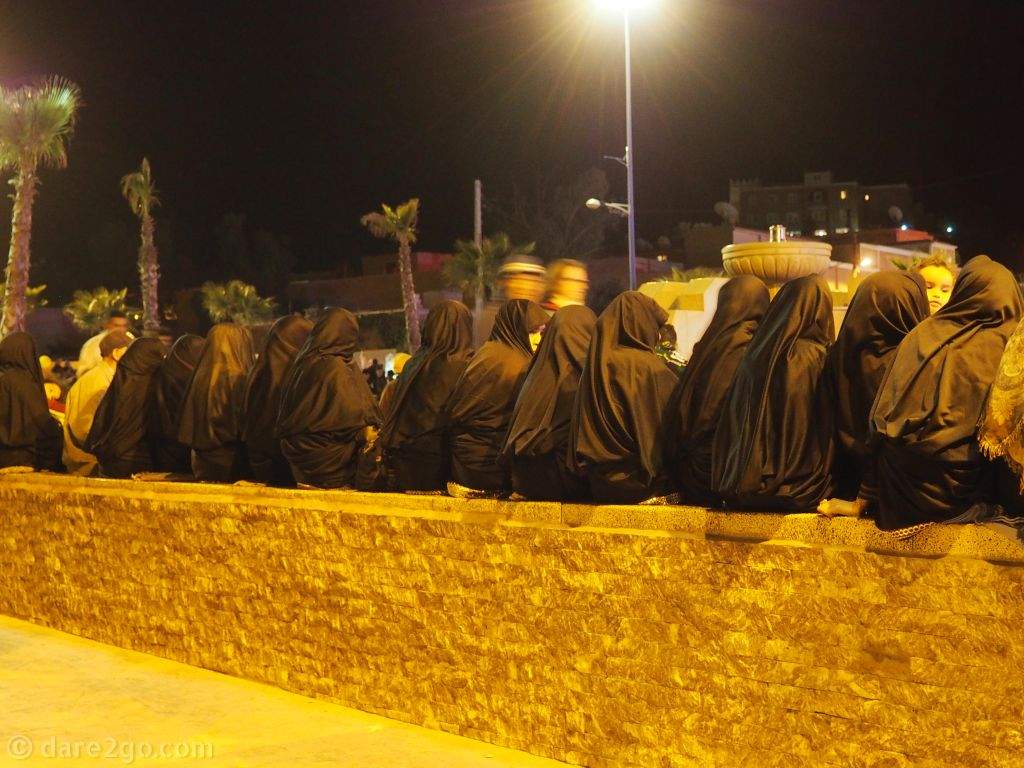
As expected, most women are covered up with a head scarf. But one thing I don’t recall from the 80s is women with their faces covered completely, except for an eye slit. This is the conservative Muslim-look you expect on the Arab peninsular – sadly this has reached Morocco too.
Please click thumbnails below for a larger photo with description.
-
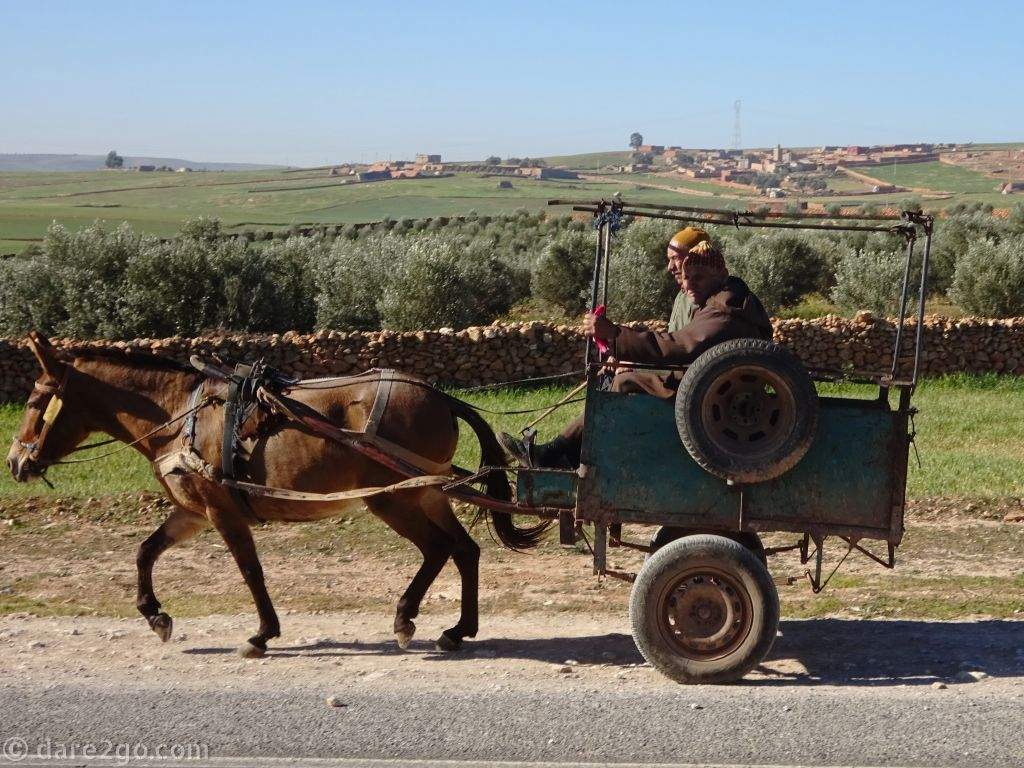
- Two men driving on a small donkey cart alongside a major road.
-
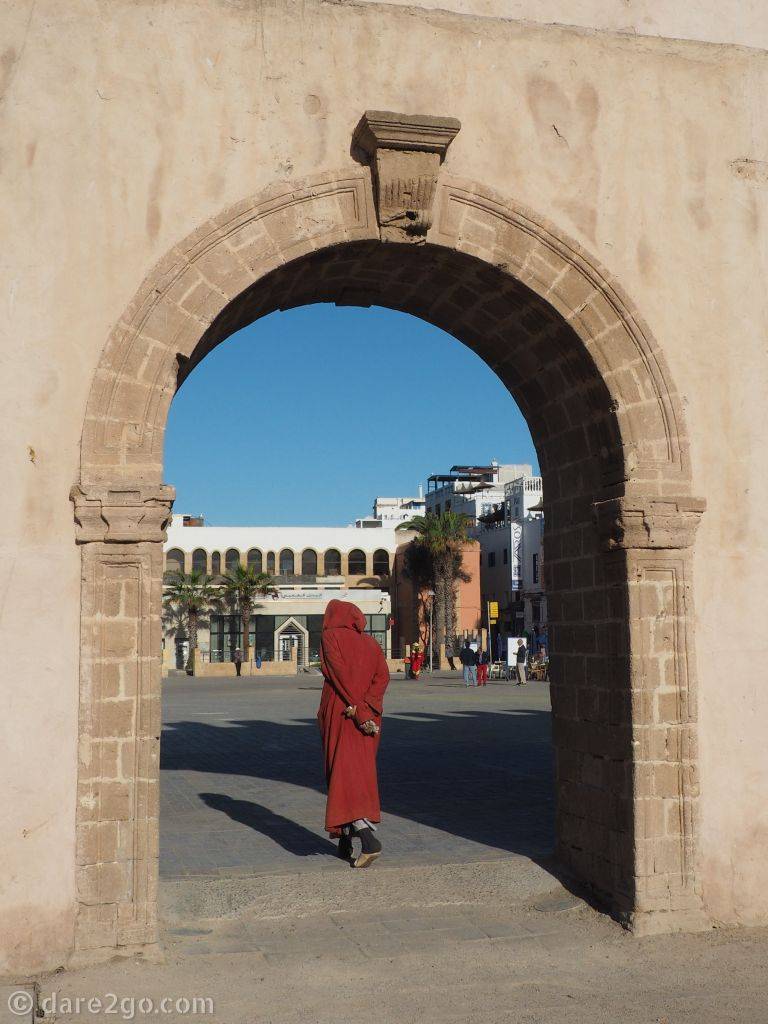
- An old man, dressed in a rust-coloured Djeballa coat, enters a gate in Essaouira.
-
- This is a typical sight of women around Taftraoute. They all wear a large black shawl around their head, mostly decorated with a fine colourful embroidery around the front edge.
-
- A shepherd driving his herd, some sheep and lots of goats, out of a village at dawn.
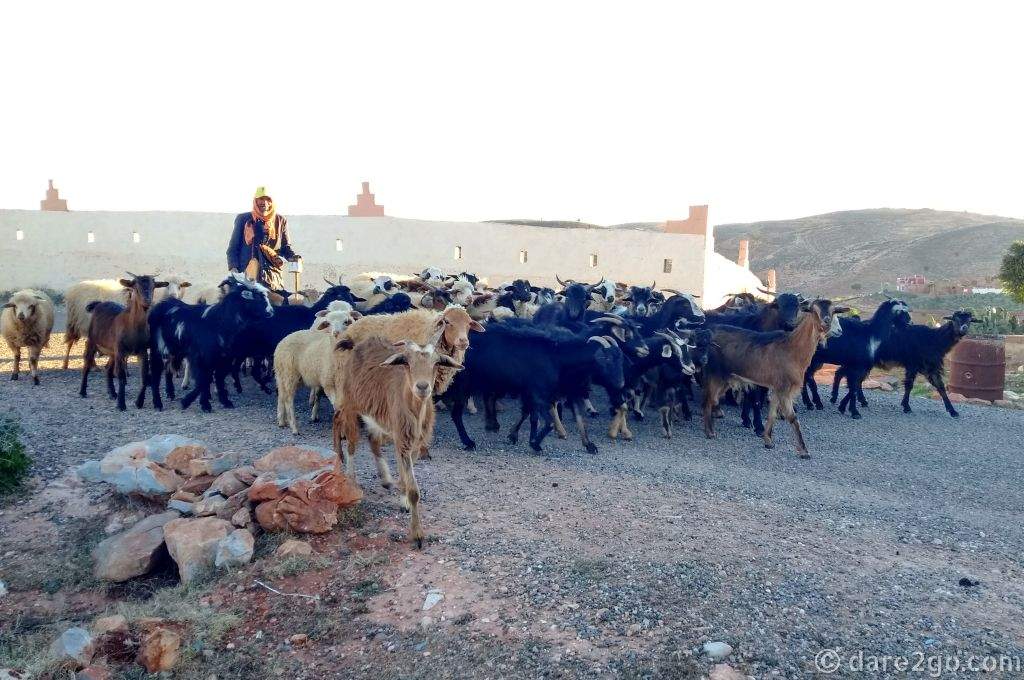
Finally, everywhere you go you still see shepherds guarding a small (or sometimes medium) flock of sheep and goats. Most herds seem to be mixed; sometimes more sheep, mostly more goats, hardly ever any significant number of cows. Technology has brought one change for the better: the young lads, bored with guarding the animals, used to use my moving van as target practice for rock throwing. Nowadays, they are more likely to have their eyes glued to a phone screen…
Our alternative recommendation: the MOON Guide Morocco (on Amazon).
Our big question: will we return to Morocco?
There were many aspects of Morocco that we both really enjoyed! Plus, our visit gave us the much needed opportunity to slow down. As Australians, we have to leave Schengen Europe every 90 days. This means we are constantly on the move, and we bypass many places we would like to visit, simply because we have to cover such long distances through a number of countries.
In Morocco, we had 90 days for one country – like we are used to from South America. We finally caught up with a few (but by far not all) blog related things. When we met other travellers we had time to stay around, spend a few days with them, and form a bond beyond that brief encounter “on the side of the road”.
What impressed us the most, were the open landscapes of Morocco and the countless bizarre looking mountains . And of course the historic sites, even though many aren’t well cared for in Morocco. As you might know, we became almost obsessed with the Berber Granaries of Southern Morocco .
On the other hand, our visits near, or in, any larger town always felt a little too stressful. Traffic was sometimes insane; the constant fending off of salesmen and beggars became tedious; and on occasion it was difficult to find corners of beauty or history among the jungle of new construction. Too often, we were eager to move on…
City visits almost always meant a stay on a formal campground, which we never really enjoy. These are often filled to capacity with “yoghurt cups”, the typical white camping vehicles of Europeans (mainly French, who generally like to stick to their own), who come to spend a mild and cheap winter in Morocco.
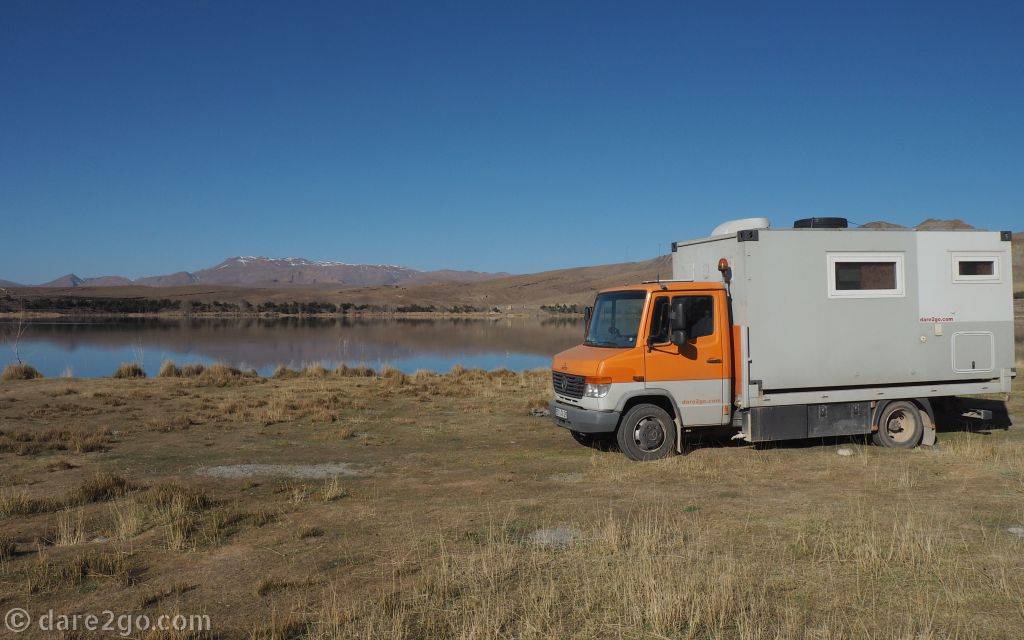
One of the many beautiful free camping spots in Morocco (although it was very cold over night).
Except these campgrounds are hardly ever cheap, compared to local income levels. You pay 40 or 50 Dirhams just to park on a dusty dirt lot, next to a noisy road (and mosque) – without any facilities. Or 80 to 120 Dirhams for something that might qualify as a camping place in Europe or elsewhere, although often with inferior facilities (like bathrooms). This is not to say that all of the campgrounds are of this standard; we did find a couple of excellent ones, but they come at a premium price! So most of the time we bypassed them.
Compare these prices to local wages and you quickly realise how well the tourists are being milked for their money.
The friendly Moroccan, who helped us with our flat tyre, told me that he was looking for work in Europe, because he couldn’t raise his kids on a Moroccan wage. He was working for an international security company, had a company vehicle and nice uniform, but his payslip was an eye-opener – just over 2,700 Dirhams per month, including a little overtime. That’s roughly €270!
Continuing our Roadtrip: Revisiting the South of France. For Yasha this was a return trip too.
Our roadtrip through “La Selva”, as the Peruvians call their enormous Amazon rain forest region.
For us, it was the solitude of the more remote south of Morocco that we really loved and found worth spending more time. But to reach that you have to drive 1,000 kilometres from the landing ports in the north. We also missed some attractive destinations in the mountains of the north, like Fez and Chefchouan. But the best time to visit these is late spring; not winter, which is the best time to escape to Morocco from Europe.
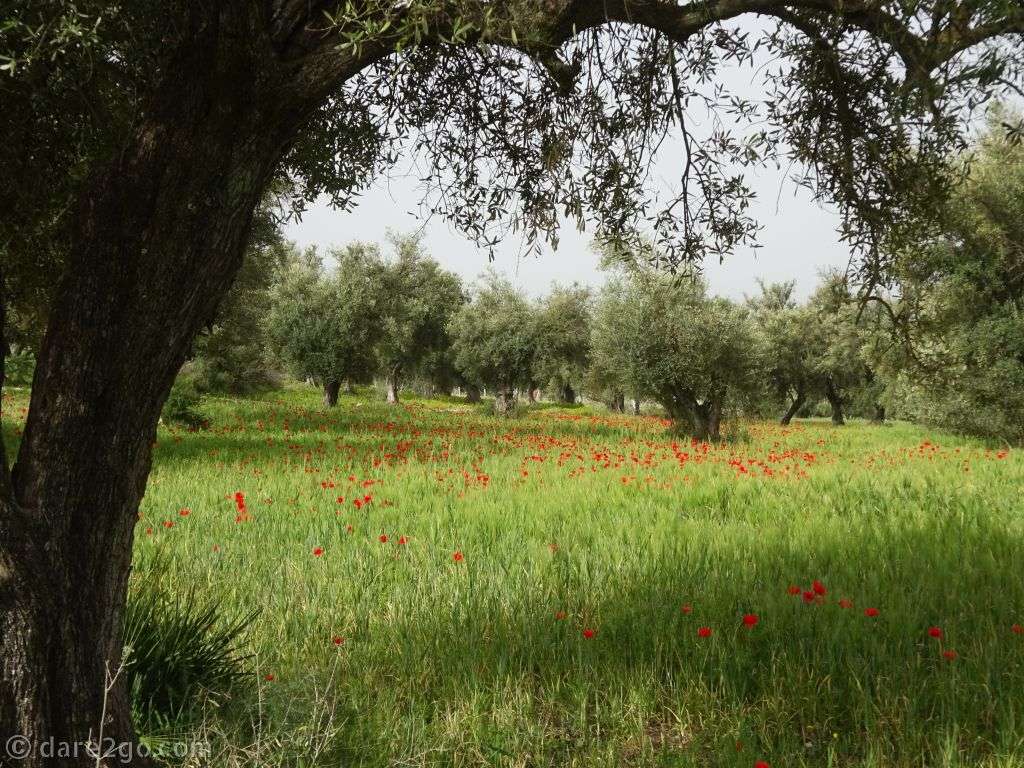
This is Morocco too: a lush green olive grove in the north of Morocco, with poppies flowering in the grain field.
So now, we’re still not sure if we will ever want to go back to Morocco! We are trying our best to keep an “open mind” about it. It’s the easiest option to escape Europe – the winter and the Schengen. The second most popular option, Turkey, can be much colder and wetter during winter. But we are both keen to return to Turkey – so time will tell…
And my own travel philosophy: something like “never return to the same place after a few years” – your pleasant memories are likely to be disappointed! There are so many new places waiting to be discovered, so don’t limit yourself.
Have you ever returned to a holiday destination years later?
What did you experience? Were you disappointed by what you found?
Tell us in the comments below!
Please share this post on Pinterest to show your friends or to remember for later:
Our alternative recommendation: the MOON Guide Morocco (on Amazon).






I’ve been to Morocco a few times, mostly in the 1980s/1990s. You have some options to avoid the hagglers…stay entirely in an exclusive resort or be chaparoned in groups organised by the hotels. Or for a more relaxing stay find a local place and stay there.. and perhaps learn a bit about the culture. I found Fez the most interesting city and would love to go back…but too many other places to visit and explore. Essaouira in those days was pretty relaxing and not well developed but it sounds as if that’s all changed….Marrakech was always a vibrant city but I’d be hesitant to go back there–not worth the stress. If I revisited the Iberian Peninsula I would also like to visit Tangier…always passed it by as I headed south but perhaps it’s worth exploring for a longer term stay.
We didn’t find the hagglers too bad. Places like Bali and Thailand are a lot worse… And the situation with the demanding kids has gone backwards a lot; I still remember having stones thrown at my truck in the 1980s. Unfortunately we missed Fez – due to our accident.
Just a little word about the “Yoghurt cups” ^^
In french, we call them the “Tupperwares”.. ’cause most of them are plastic boxes.. ;-)
Un “pot de yahourt” (yogurt cup in french) on the other hand could rather be a very small car like fiat 500 (the old ones) ;-)
Many thanks for your site, just discovered it since a short time, i’ll stay around for a while ;-)
STF in the french Alps
Welcome! The expression “Yoghurt Cups” is a straight translation from German, my cultural background. But its meaning is no different to “Tupperware”.
Yes, it also fit exactly, not surprised, Germany is also a country with a lot of converted vans/trucks.. and a lot of yogurt cups too..
Interesting read and I enjoyed your lovely photographs alongside the text. Jim had a business trip to Rabat and Cassablanca during the early 1970’s and brought back a handcrafted brass plate which he saw completed by the artisan. We now have it on our boat. Enjoy Scotland and hope to see you both soon on your return to England.
It always seem a bit of a pity that things change so much – but that’s the way of life…
What a treasure that brass plate is, complete with the memories it evokes. We treasure our memories from our travels above all.
Bit cold here in Scotland at the moment – hoping it gets better.
We look forward to seeing you soon.
I enjoyed this summation of your journey to Morocco. I must confess, given the world political climate, I was a bit worried about the two of you, but following your regular posts I quickly relaxed and enjoyed your travel posts. You are great travel journalists and it’s always rewarding to read about your adventures.
Hi, Kendra! Overall the world is still full of friendly, helpful, well-meaning people. It’s a shame that some political extremists manage to instill a sense of (irrational?) fear in the general population. We do wonder what the real agenda behind this could be. Certainly the mainstream media can take a fair bit of blame for this current situation. I’m happy to read that you enjoy our posts! There’ll be more – we have a lot of catching up to do…
Great to hear your tales of revisiting Morocco. Like you I am reluctant to go back to many of the places I visited as a child in the 1960s & 70s or even once I was independent. I did go back to Mostar to see the rebuilt bridge (pleasantly surprised) and to morocco (disappointed with Marrakesh but enjoyed some other bits in a brief visit). There are too many places to see so I like to go to new ones….preferably off the tourist trail. Keep writing
I completely agree. We didn’t stay long in Marrakesh either; initially we had thought to return but then decided against it. The one place we really wanted to visit in Marrakesh, the old Koran School, was closed for renovation. That was a real disappointment because we had read several endorsing reports written by overlanding friends. But then we visited the smaller and equally beautiful one in Meknes.
I guess to have any “authentic experience” nowadays you have to stay off the main tourist trail.