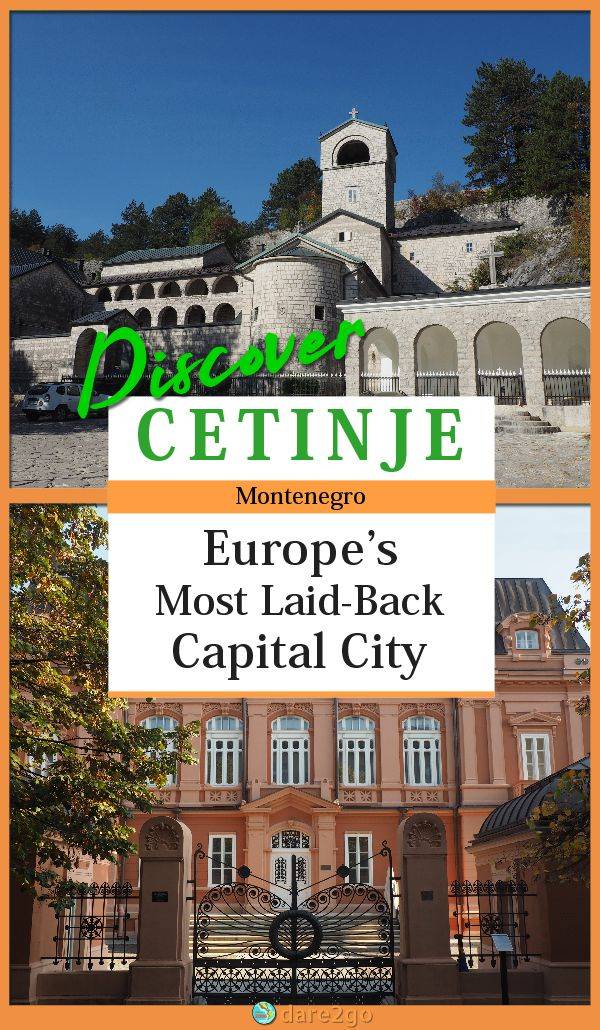
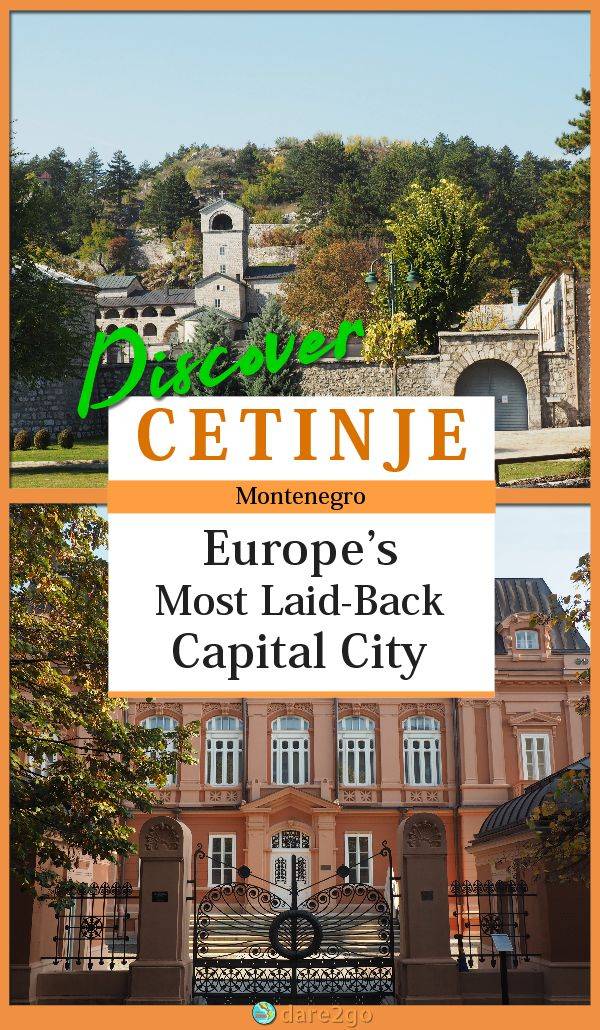
Discover Cetinje, Europe’s most Laid-Back Capital City
Our regular followers will probably know that we don’t visit capital cities very often, and write about them even less often. Cetinje is a different story: we actually want to encourage you to visit the beautiful Royal Capital of Montenegro!
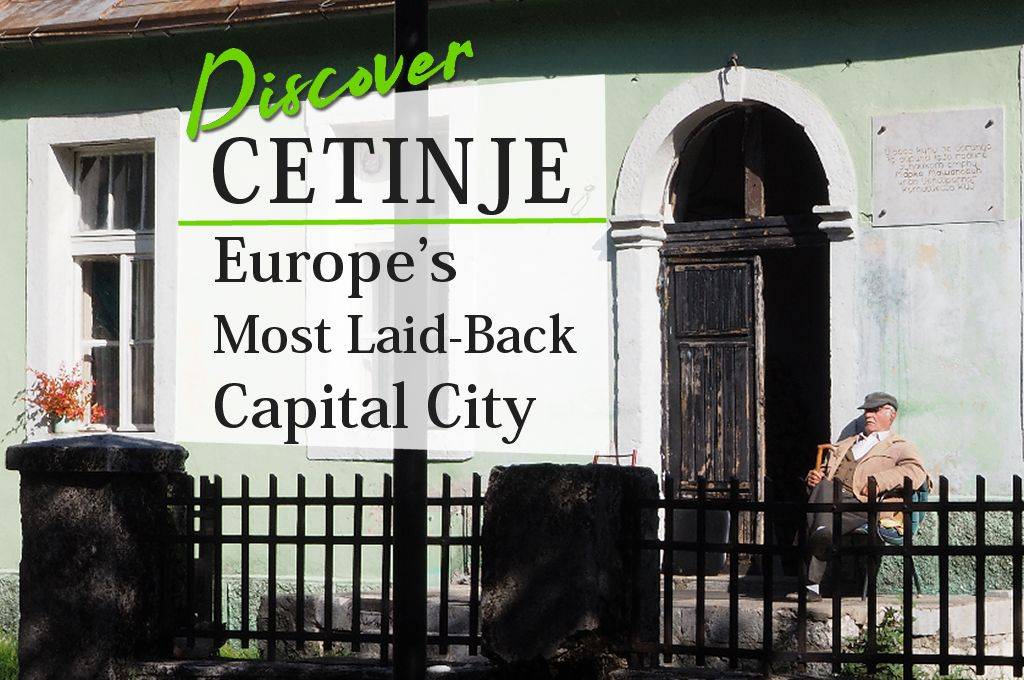
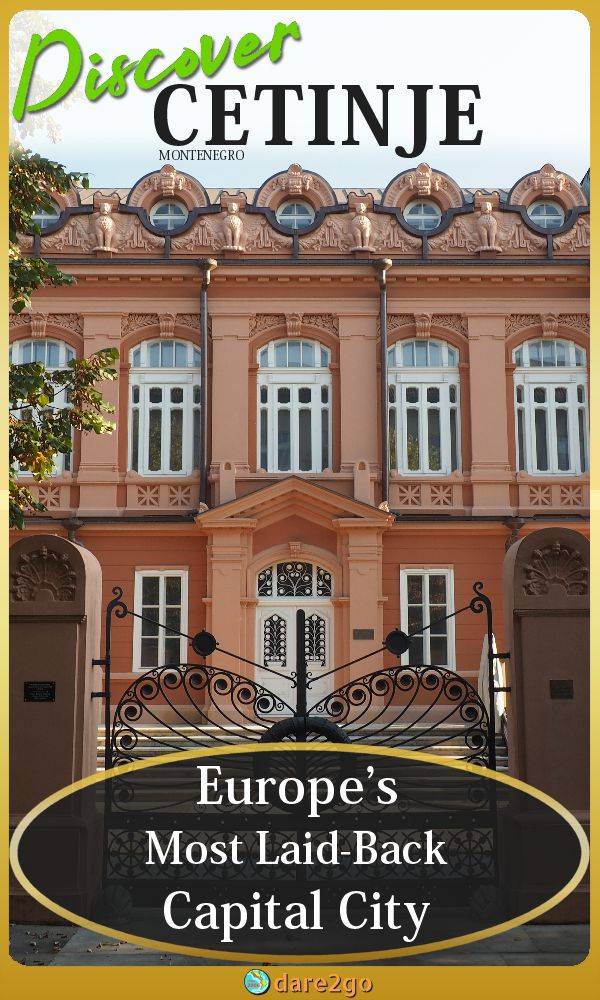
Discover Cetinje with its palaces and stately former embassies. The Royal Capital of Montenegro is also the gateway to Lovćen NP and the famous Lipa Cave.
First of all: Cetinje is not a city in the traditional understanding of the word ‘city’! It’s more like a small, sleepy town nestled in a valley, halfway between Podgorica and popular Budva on the coast (about 35 kilometres from each). It kinda fits Montenegro, which is also not a big country by population. All of Montenegro has fewer inhabitants than most medium-sized European cities: just over 628,000 at the latest count. Currently, the town of Cetinje has under 15,000 inhabitants and no high-rise buildings or shopping malls. That’s all part of the attraction!
Then what makes Cetinje a capital city?
What you will find in this article:
Introduction to the History of Cetinje
You have to go back a fair bit in history to understand this. Cetinje is still called the “Old Royal Capital” of Montenegro and is the official residence of the country’s president, to this day. But nowadays, it is only the Secondary Capital of Montenegro, since most of the administration is in Podgorica.
Cetinje was destined as a capital from day one. The town was founded in 1482, when Ivan Crnojević moved his capital from Obod, deeper into the mountains – purely for strategic reasons. Although this was a more easily defensible position in the valley of the Cetina River (from which the city’s name derives), it didn’t save the town from several downfalls.
Cetinje’s current shape and its main sights are the result of its last revival as a capital city of the Kingdom of Montenegro. When the country gained independence under King Nikola I, he engaged Josip Slade as chief architect to make a detailed design of a grand urban plan for Cetinje.
For more about the ups-and-downs throughout history, please read my section at the bottom of this post.
The Main Attractions of Cetinje
Today, Cetinje feels like it’s in a mothballed state of its former glory, showing signs of some careful and slow restoration. Among the things to see are a number of attractive historic buildings throughout this pedestrian-friendly town.
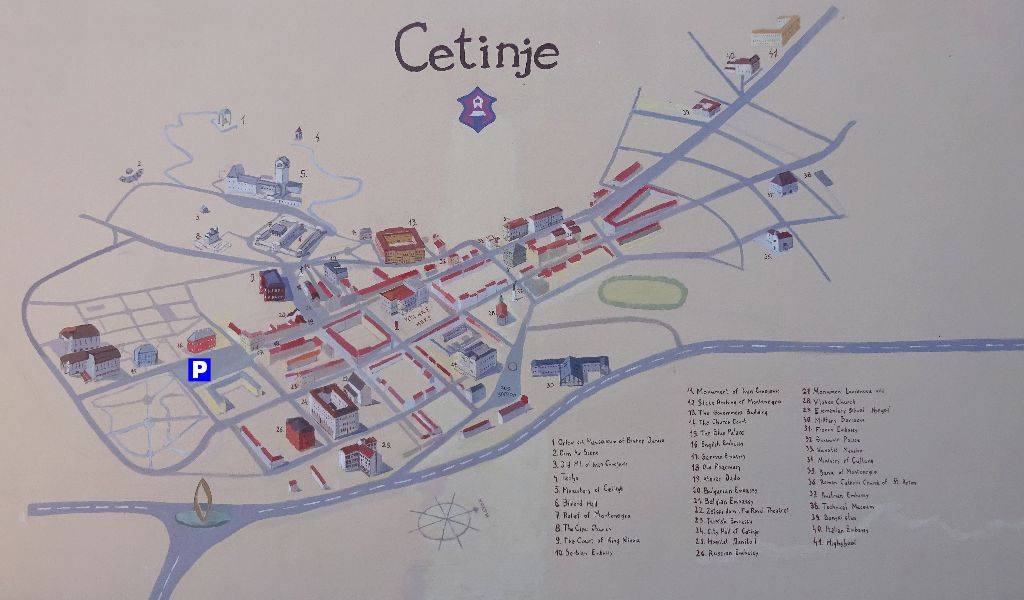
This map of Cetinje shows the small size of the city with all attractions marked.
Right now, Cetinje is still under the tourist radar – so it’s a good time to visit. Nevertheless, The Historic Core of Cetinje is on the Tentative List of the UNESCO Heritage council . Considering Montenegro’s small size and obvious lack of funds to progress with the preservation of the city’s heritage, an inclusion among World Heritage sites would probably be a blessing for the small town.
There is a lot worth preserving! As UNESCO describes in their formal language:
Due to the exceptional values of the urban agglomeration with the artistic and cultural-historical qualities of the individual monuments, Cetinje Historic Core belongs to the First category cultural monuments.
Cetinje Historic Core constitutes a heritage ensemble of exceptional importance, characteristic for its harmonious unity of heterogeneous elements, individually protected monuments, parks and a regular urban matrix.
We recommend visiting Cetinje with your own vehicle (or a rental car ). If you do, you’ll probably head for the main parking lot in town. So let’s start there.
The Blue Palace
The Blue Palace was built in 1894–95 for Crown Prince Danilo of Montenegro, the heir-apparent to the throne held by the Petrović Njegoš royal family. It now serves as the residence of the Montenegro president. For such a high official, there’s surprisingly little security; it mostly consists of CCTV cameras strategically positioned around the building.
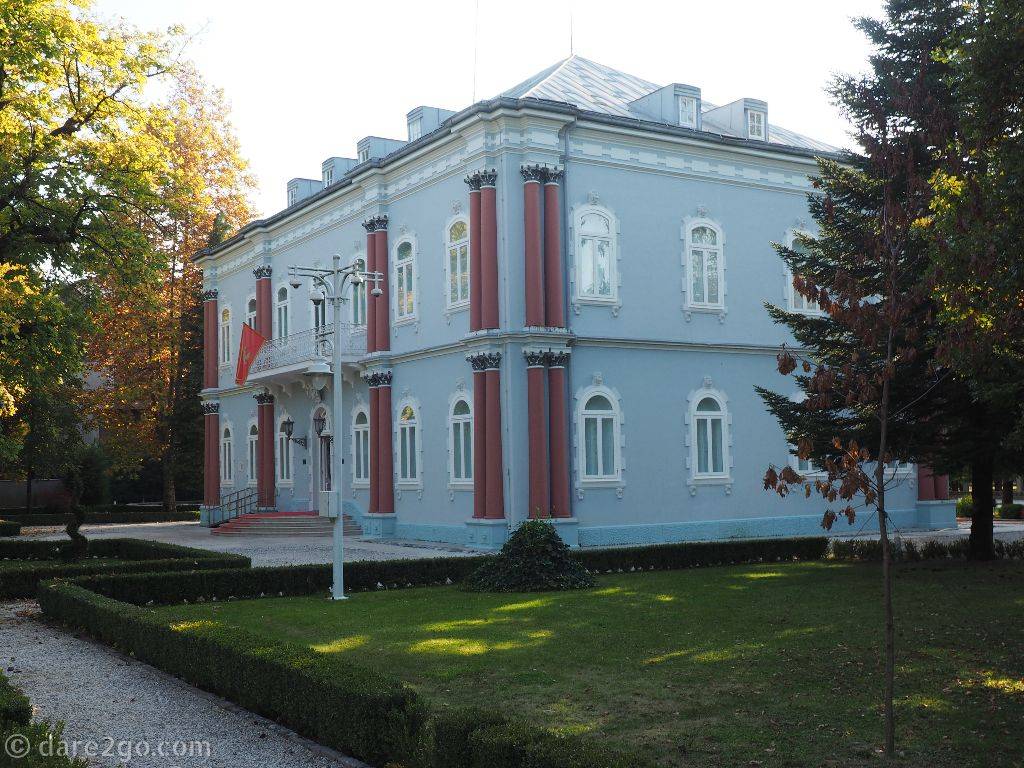
The Blue Palace, now residence of the President of Montenegro
The British Embassy Building
To the right of the Blue Palace stands the former British Embassy. It could be seen as a typical example of English understatement with its plain facade; a design by the British architect Harty. Its gardens, on the other hand, were planned around private tennis courts. Most hours of the day you will be attracted to this building by music coming from its open windows, as it now used by the Academy of Music.
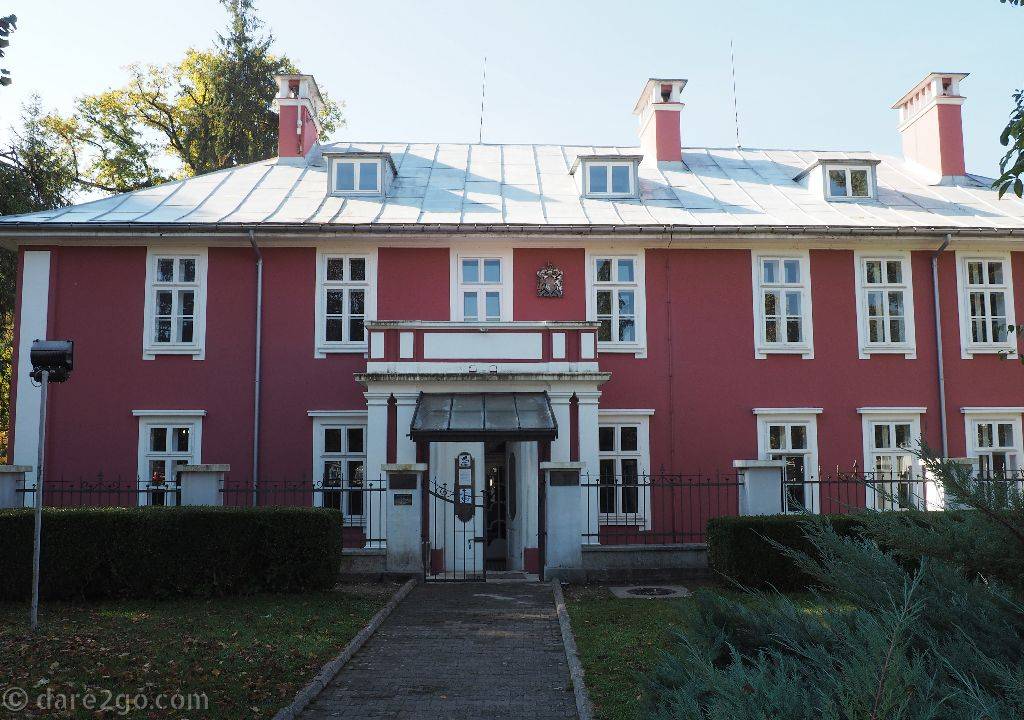
The former British Embassy in Cetinje
The German Embassy
As you walk down the pedestrian street, you soon come past the old German Embassy, an unpretentious row house. Only a plaque on the facade tells you of its former use.
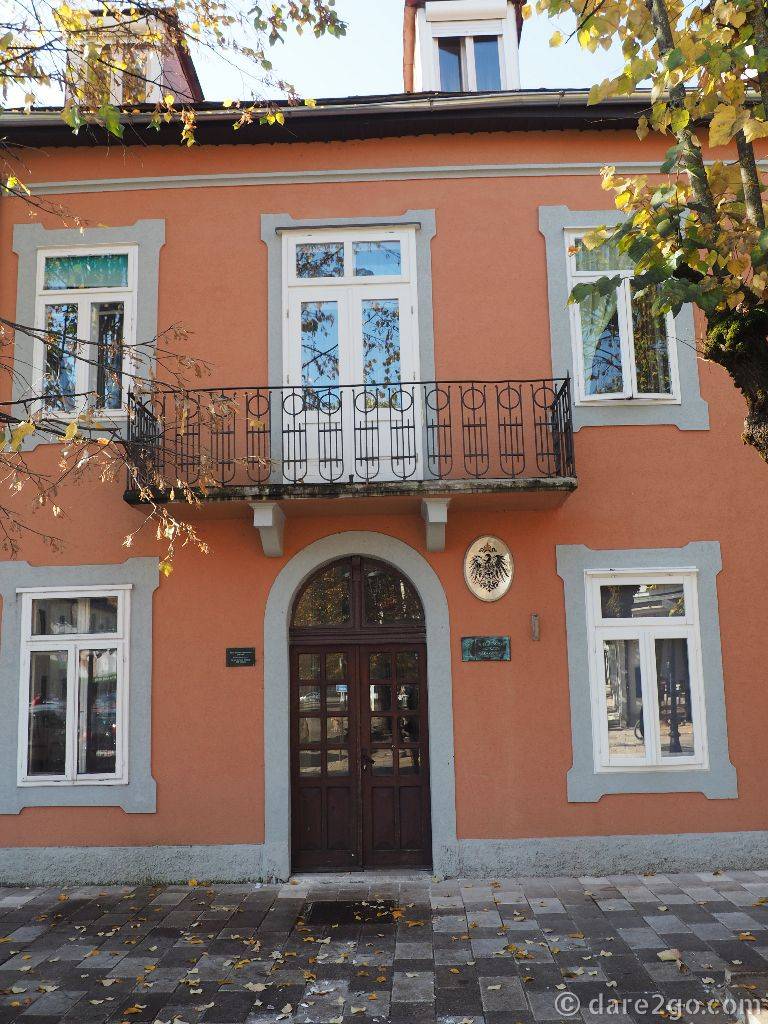
The former German Embassy in Cetinje
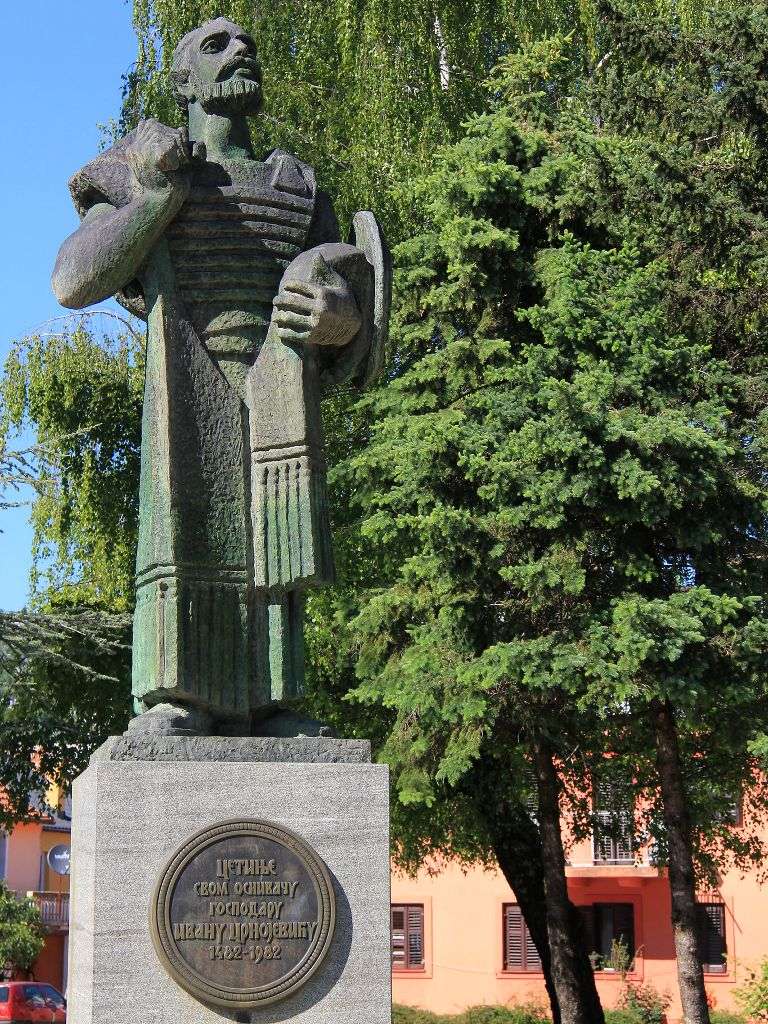
The statue of Ivan Crnojević [photo credit ]
Atelier Dado Art Gallery
If you haven’t stopped at any of the sidewalk cafes, you will soon reach a wide road to the left: Court Street. On the corner stands a plain green building with wooden shutters covering the windows. This is the Atelier Dado Gallery, an outpost of Montenegro’s National Gallery. Unfortunately, it was closed when we visited in October (out of season).
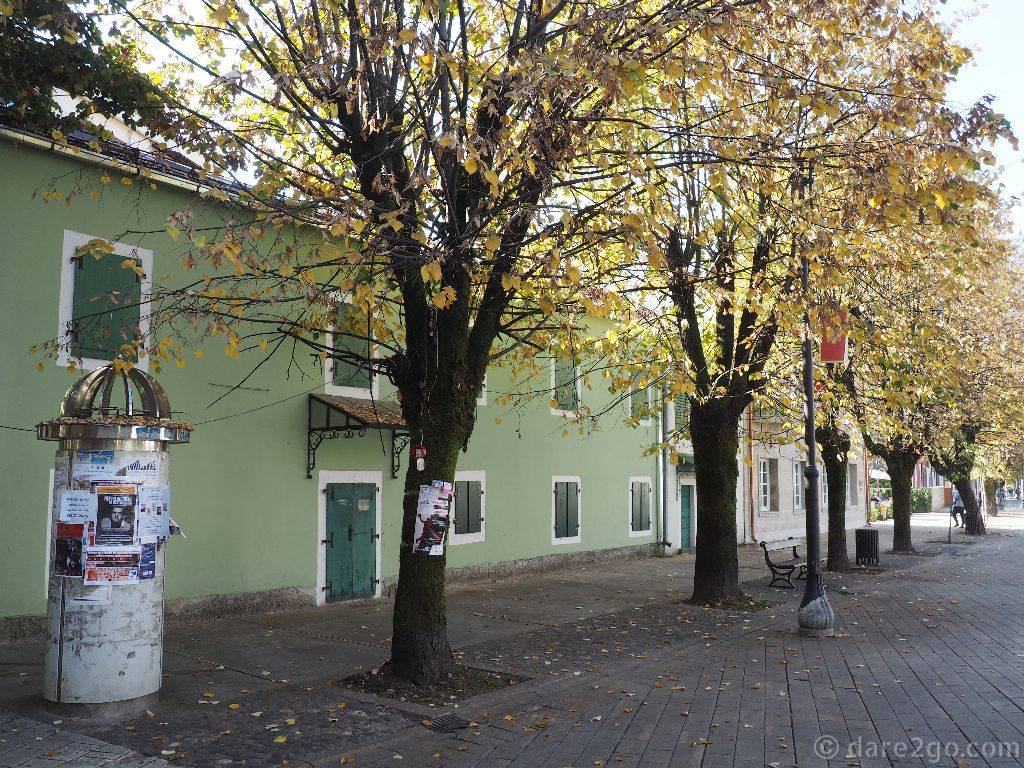
The Atelier Dado building, part of Montenegro’s National Gallery
The Bulgarian Embassy
On Court Street, two houses down from Atelier Dado, stands the former Bulgarian Embassy with its plain stone facade. This is a design by architect Fernando Balako, who was involved in the extension of the court of Prince Nikolas I down the same street. The yard to the right of it has been attractively transformed with a modern extension, all clad in shiny copper: the Hotel Gradska Cetinje.
Across the road is the unassuming Belgian Embassy, still awaiting renovation.
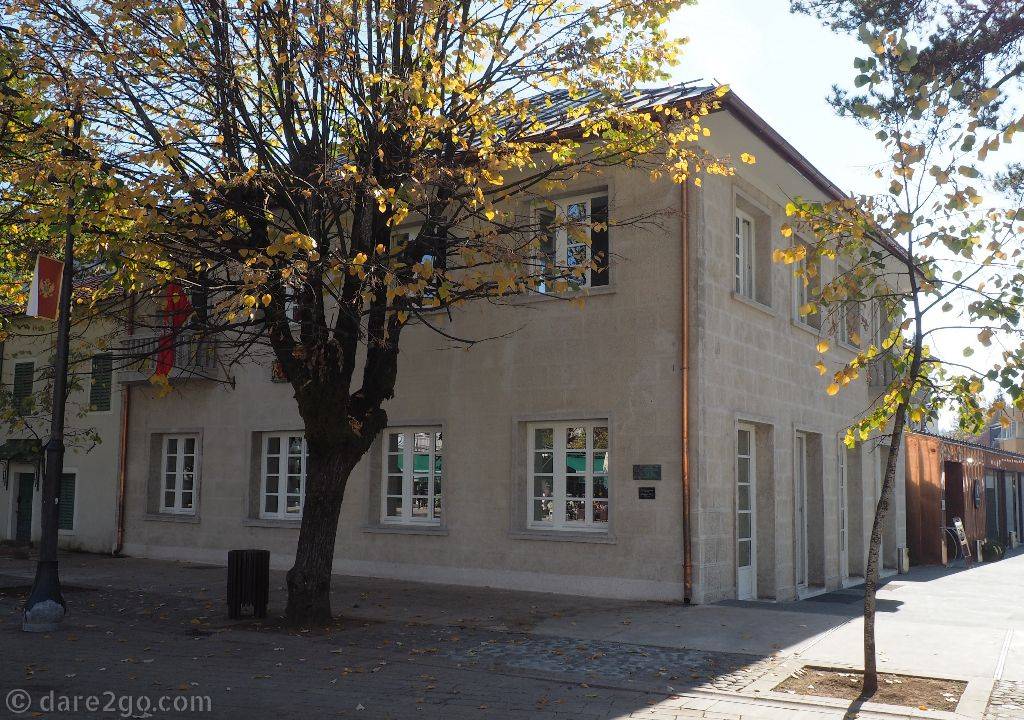
The former Bulgarian Embassy, now the Hotel Gradska Cetinje
The Serbian Embassy
Originally this house was built in 1883 as a wedding gift by King Nikolas to his daughter, Princess Zorka, wife of the Serbian King Petar Karadjordjević. The Serbian Embassy was established here in 1914. It is a very prominent location, diagonally across the street from the King’s Palace. Today it houses the Ethnographic Museum of Montenegro.
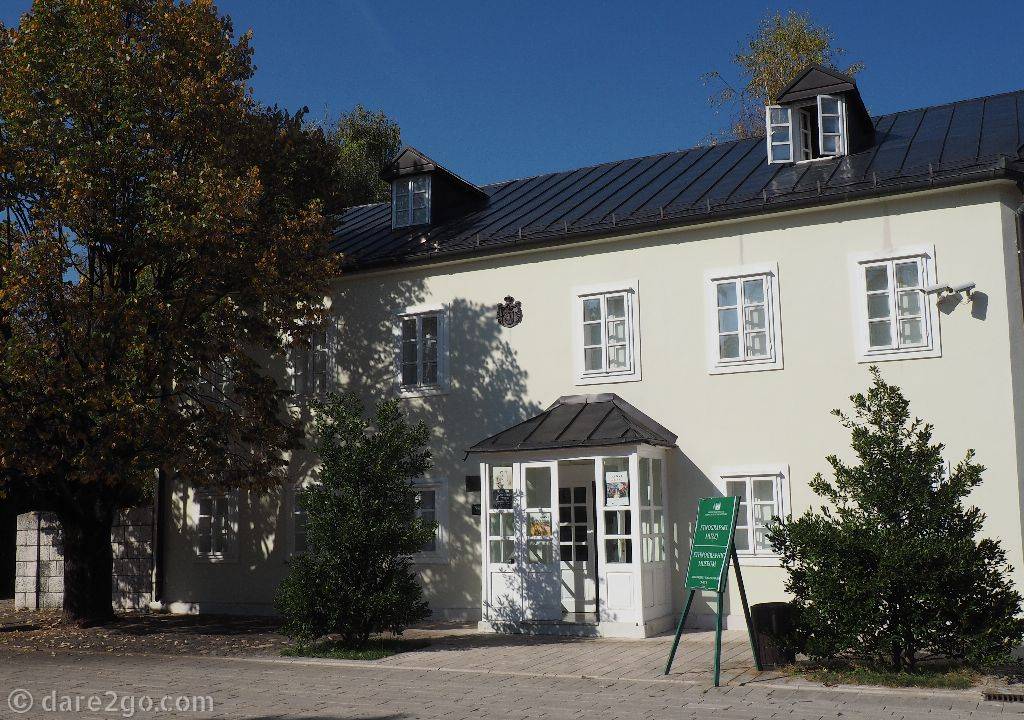
The former Serbian Embassy in Cetinje
The Court of Cetinje
This important structure goes back to a building, which King Nikolas had built for the widow of assassinated Prince Danilo, in 1863. But she never took up residence. Instead, the King himself decided to move his court here from the Billiard Palace. Two side wings were added to form an attractive courtyard overlooking the park behind.
Its fairly plain exterior belies the luxurious interior of the Court of Cetinje. It functioned as the official Montenegrin Palace until the country’s capitulation in WWI. In 1926 it was declared a museum, thus preserving most of its former splendour.
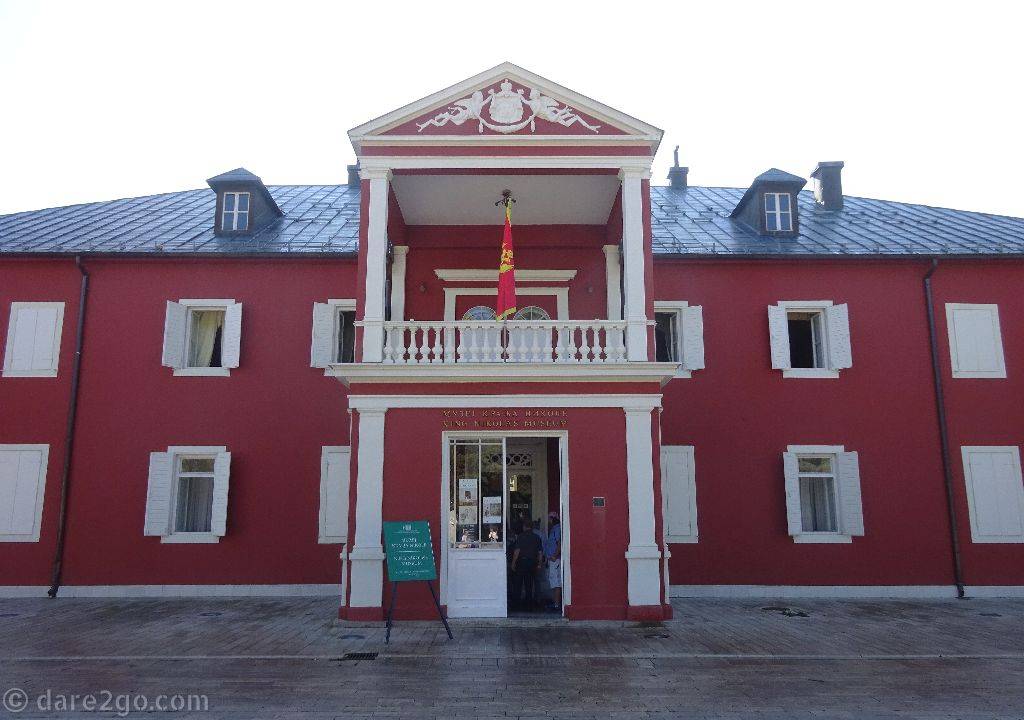
The former Royal Court in Cetinje
Past a small park with a statue of Ivan Crnojević, the founder of Cetinje, you come to the old palace of Montenegro. [see photo above]
The Biljarda (Billiard Palace)
The former royal residence of Montenegro, built by Petar II Petrović Njegoš in 1838, dominates the far end of Court Street with its extensive natural stone walls. This is the Billiard Palace, a name chosen for the regent’s love of this game. It has a dedicated room for a large billiard table. Now it forms part of the National Museum of Montenegro.

Part of the Billiard Palace in Cetinje, Montenegro
The Cipur Church
This small church, whose name translates to “Garden Church”, is the official court church of the Kings of Montenegro. The current church was restored under the supervision of the last king in 1890. Interestingly, it sits on top of the ruins of the original Cetinjski Monastery (see below). In 1961 the Ćipur Church was declared a National Monument, now under care of the Historical Museum of Montenegro. Since 1989 it has served as a mausoleum for the last Montenegrin King Nikola and his wife Milena.
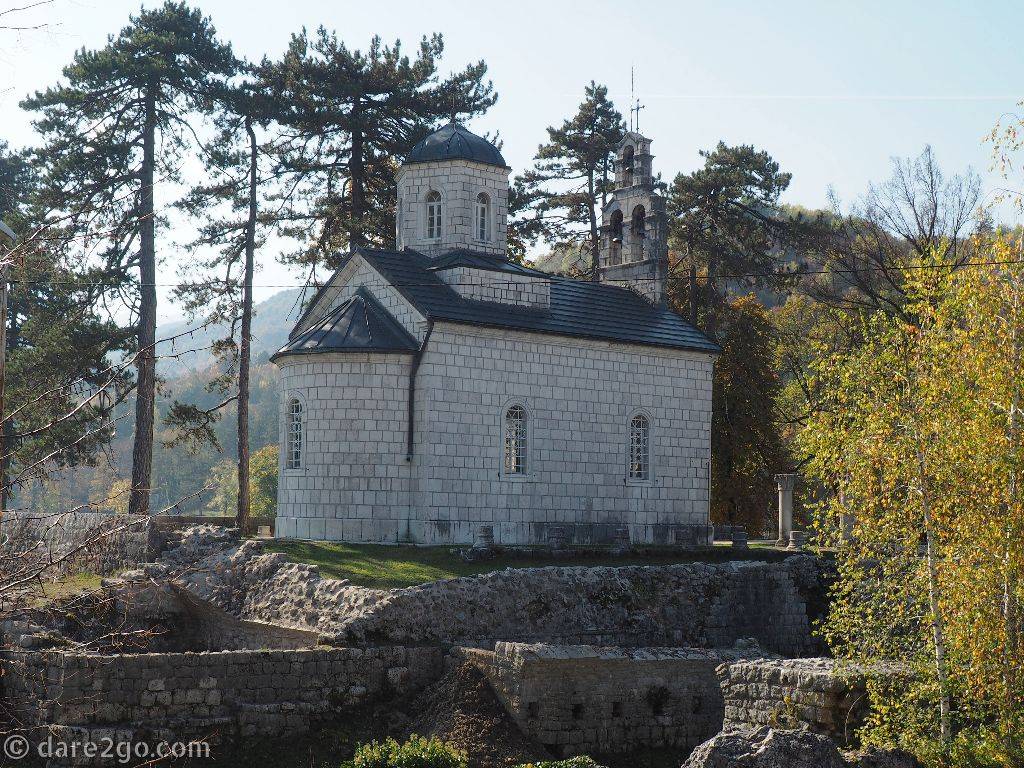
The Ćipur Church, now the mausoleum of the last King of Montenegro
The Cetinjski Monastery
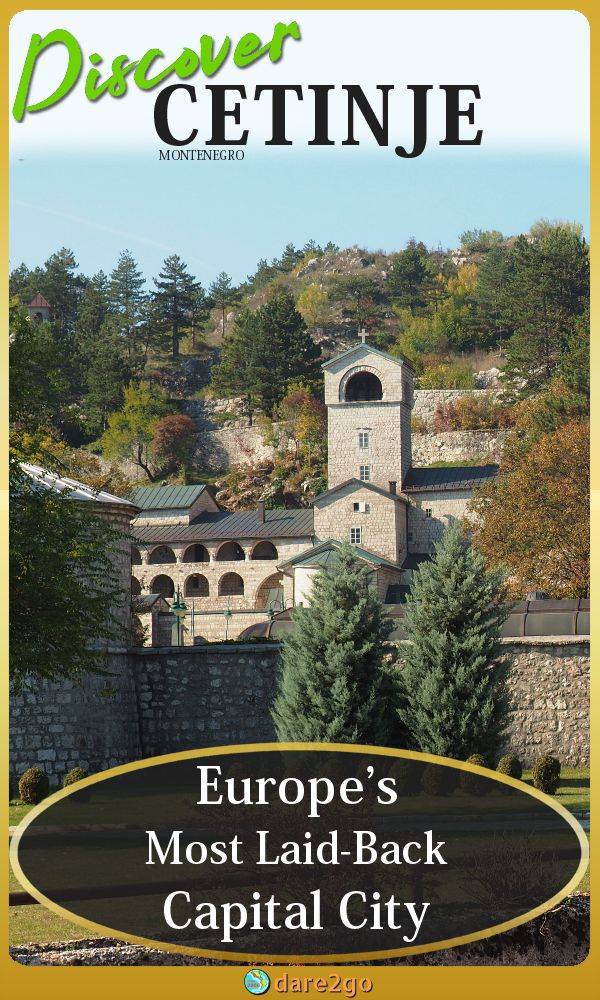
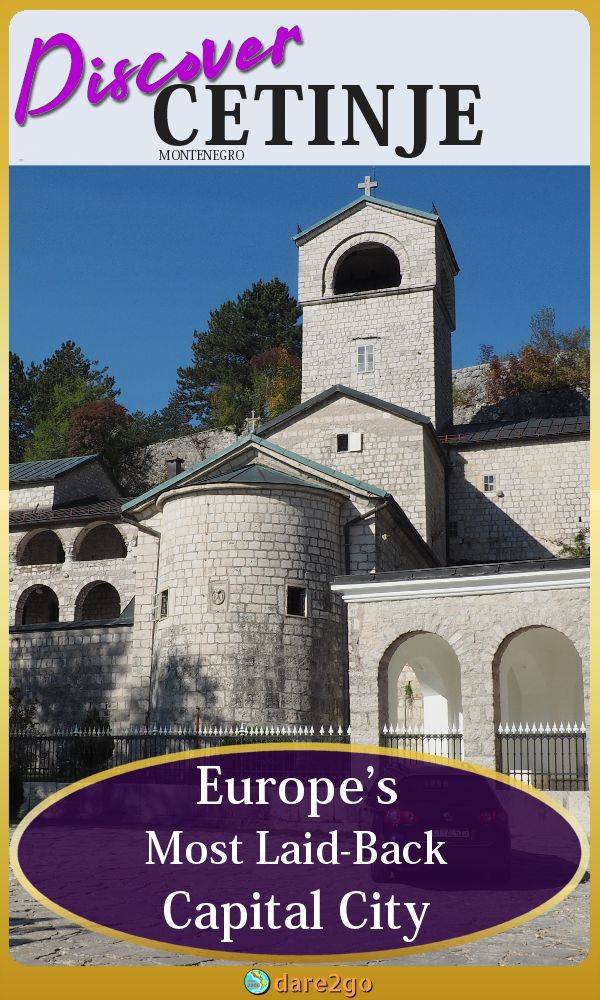
The monastery you see today dates back to 1927. The current structure is located on the hillside behind the Billiard Palace. Cetinje was always famous for its monastery. The first was built by the city’s founder, Prince Ivan Crnojević of Zeta, around 1484. The original Cetinjski Monastery was destroyed during the Sixth Ottoman-Venetian War; the retreating Venetians had booby-trapped the monastery. The explosion not only destroyed the monastery but also killed a large number of the victorious Ottomans.
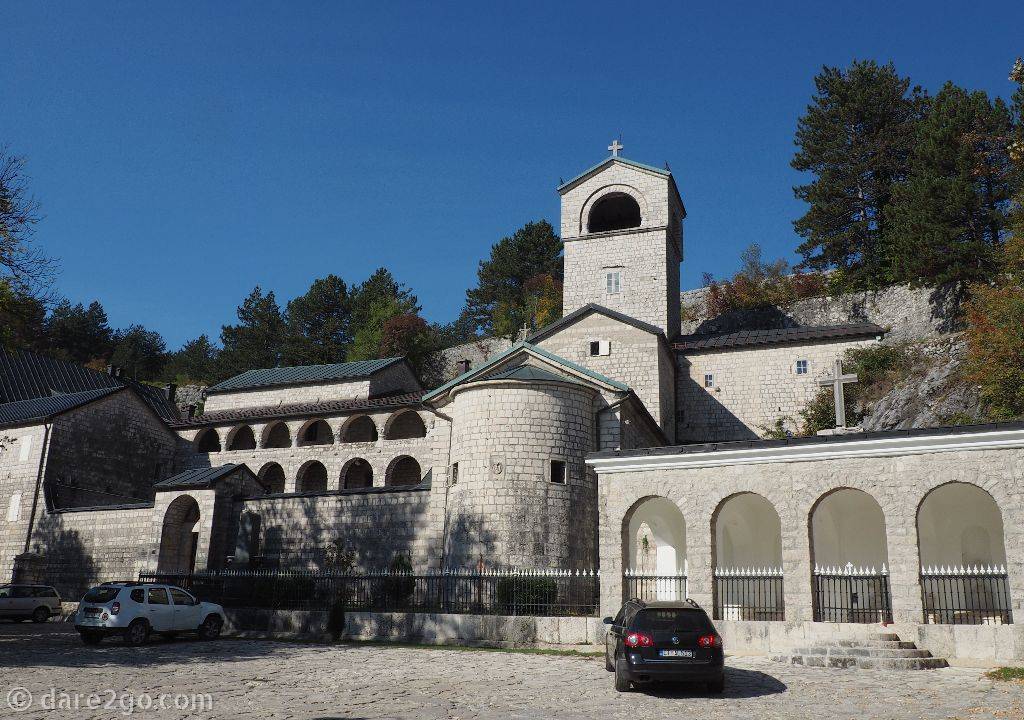
The Cetinjski Monastery
The Government House
The impressive Neo-Baroque 20th century Government House now houses the History and Art Museums of Montenegro. It is the design of Italian architect Corradini (you will encounter his name again further down), and was the first construction in Montenegro made from reinforced concrete. It was ceremoniously opened on the August 15, 1910 as the Parliament Building of the newly proclaimed Kingdom of Montenegro, and to house the related institutions.
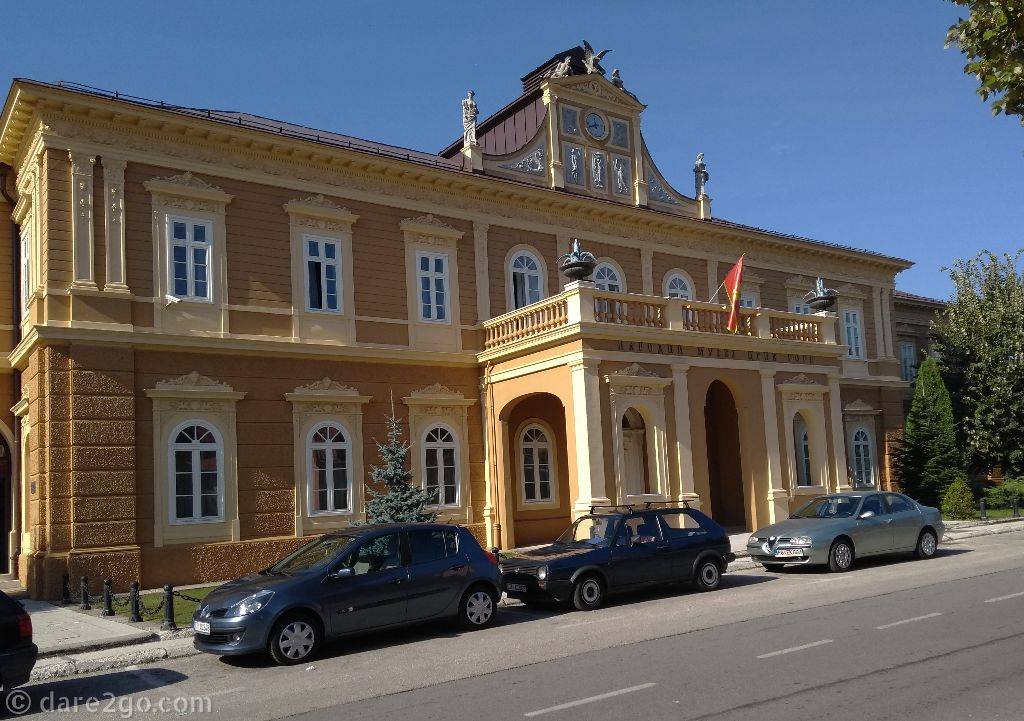
The former Government House of Montenegro
From here, we returned back to the main pedestrian zone of Cetinje to see more of the former embassies.
The Djukanovic House
The building has certainly seen better days, but the Djukanovic House is still fronted by a row of marvellous statues in good condition. In 1869, it was donated by the Russian Empress Maria Alexandrovna as the first Girls Institute of Montenegro. It not only contributed to the education of females but was also seen as a first important step towards gender equality in the young nation.
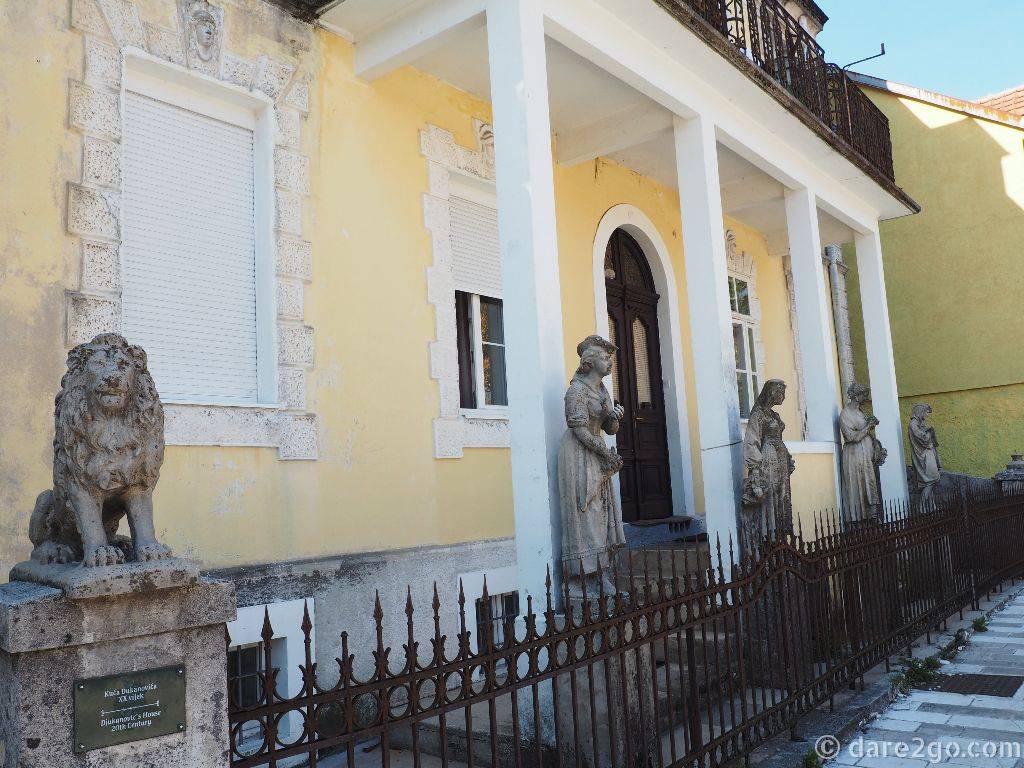
The row of statues in front of the Djukanovic House
The French Embassy
The Art-Nouveau-styled French Embassy is one of the most impressive buildings in this part of town. A local tale persists that this beautiful design was meant for Cairo, another embassy built at the same time, 1909-1910; but the French diplomatic mail mixed up the plans. Nothing of this is true of course; the design by architect Paul Gaudet was specifically for Cetinje.
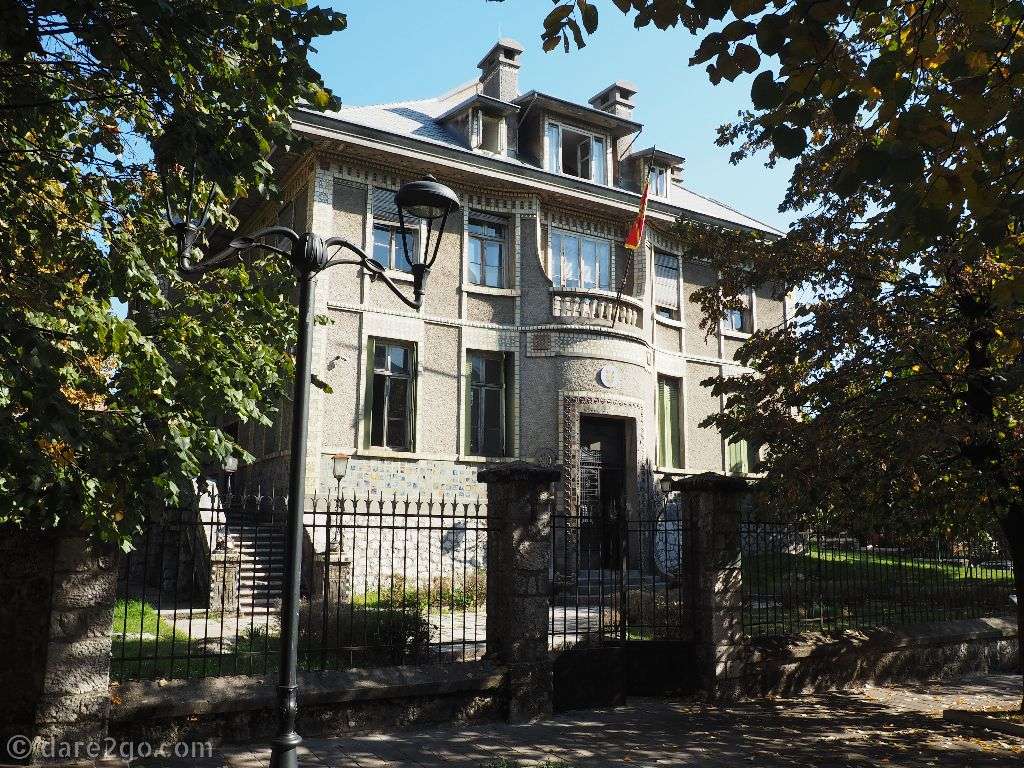
The former French Embassy in Cetinje
The former Presidential Palace
Across the road from the former French Embassy are two buildings of interest. The first is the 20th century Vukotić Mansion, which is currently in a terrible state of repair. Next is the impressive former Presidential Palace, now home to Montenegro’s Ministry of Culture.
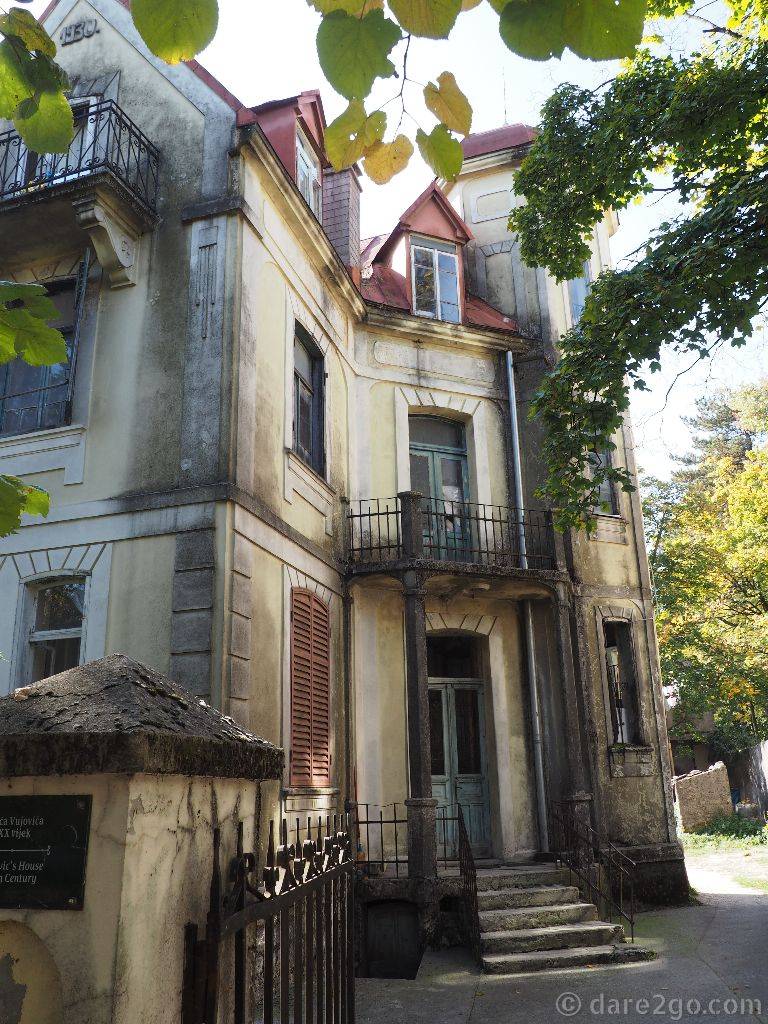
The Vukotić Mansion in Cetinje has certainly seen better days
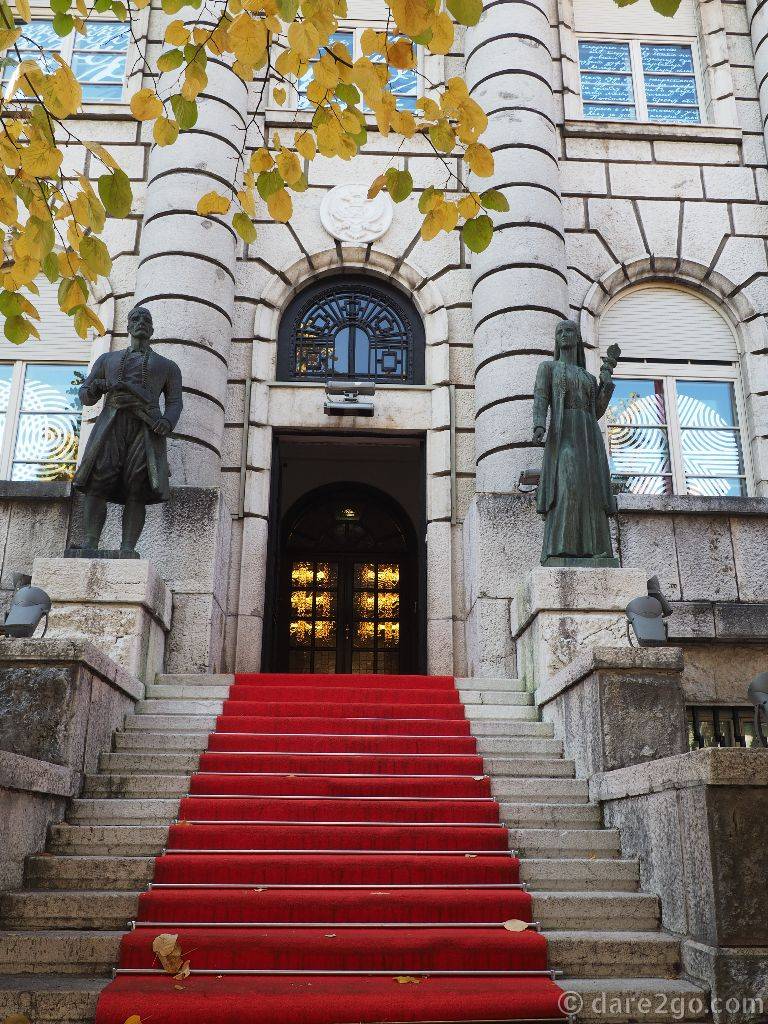
Entrance to the former Presidential Palace, now the Ministry of Culture
The Bank of Montenegro
The unassuming and plain stone facade of this building belies the fact that it once housed the very important Bank of Montenegro. Founded in 1906, it is now protected as a National Monument and houses the Montenegro Money Museum. Among the exhibits is a neat collection of old notes and coins and a historic minting machine.
We decided at this point to to turn around and walk back to our vehicle. If you continue to the edge of Cetinje, which is not all that far considering the town’s size, you will reach one of the oldest former embassies.
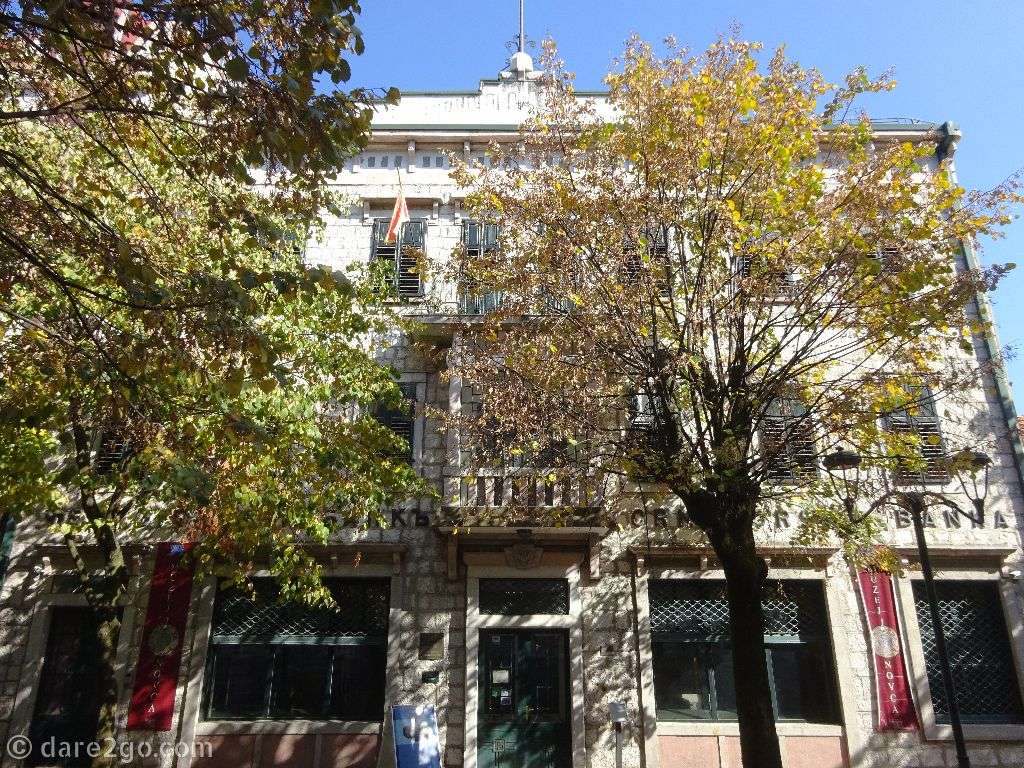
The Bank of Montenegro Building in Cetinje
The Austro-Hungarian Embassy
Located at the edge of the old town of Cetinje is the former Austro-Hungarian Embassy, one of the first built after the Nation of Montenegro was acknowledged by the Congress of Berlin (see history).
The design by architect Josip Slade was completed in 1899. Unique to this building is the small attached Roman-Catholic chapel. Today the building is used by the State Institute for the Protection of Cultural Monuments, something you would not guess by the poor state it is in. We drove past it on our way out of town.
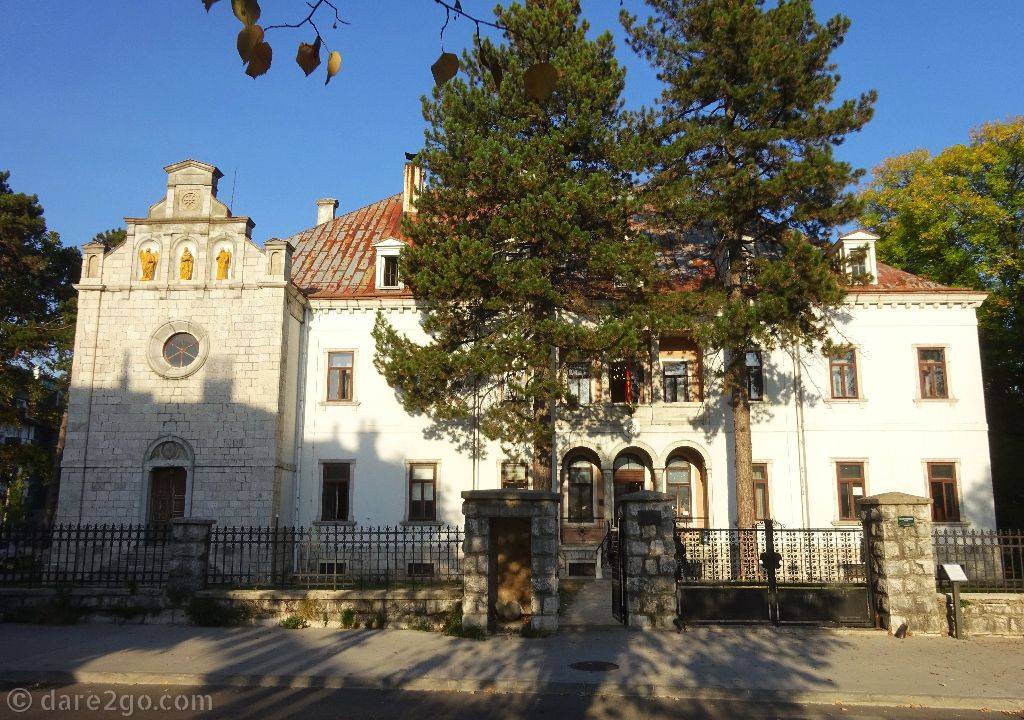
The former Austro-Hungarian Embassy
Let’s come back to our walk in the centre of Cetinje. If you walk back along the parallel road to the pedestrian zone, you will come past the following sights.
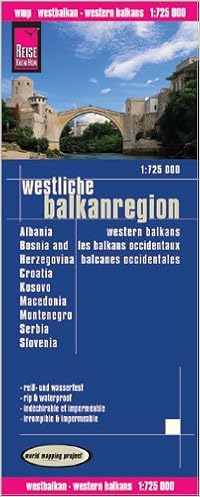
the Western Balkans Map from Reise-Know-How
This is our preferred brand of maps! They are usually very accurate, GPS compatible, and waterproof and tear-resistant thanks to their special paper. The Reise Know-How map is most likely the best paper map you will find for the Western Balkans. It covers all countries from Slovenia in the north to parts of Greece in the south.
The Lovcenska Vila Monument
The name of this statue from 1939 can be translated to “Fairy of Lovcen”. It was created by the local sculptor Risto Stijovic to commemorate the sacrifices of Montenegrins during WWI.
Set back behind this statue stands the oldest church of Cetinj; the Vlaška Crkva (the Church of Vlaska). The wedding of King Nikola I with his wife Milena Vukotic took place in this church in 1860. The fence around this small church is partly made from captured Turkish rifles.
The Royal Theatre
Even from the outside it looks like a neoclassical temple of culture with its impressive entrance. The Royal Theatre is another building designed by Josip Slade. Its Montenegrin name is Zetski Dom. It has recently been upgraded and is still in use for performances.
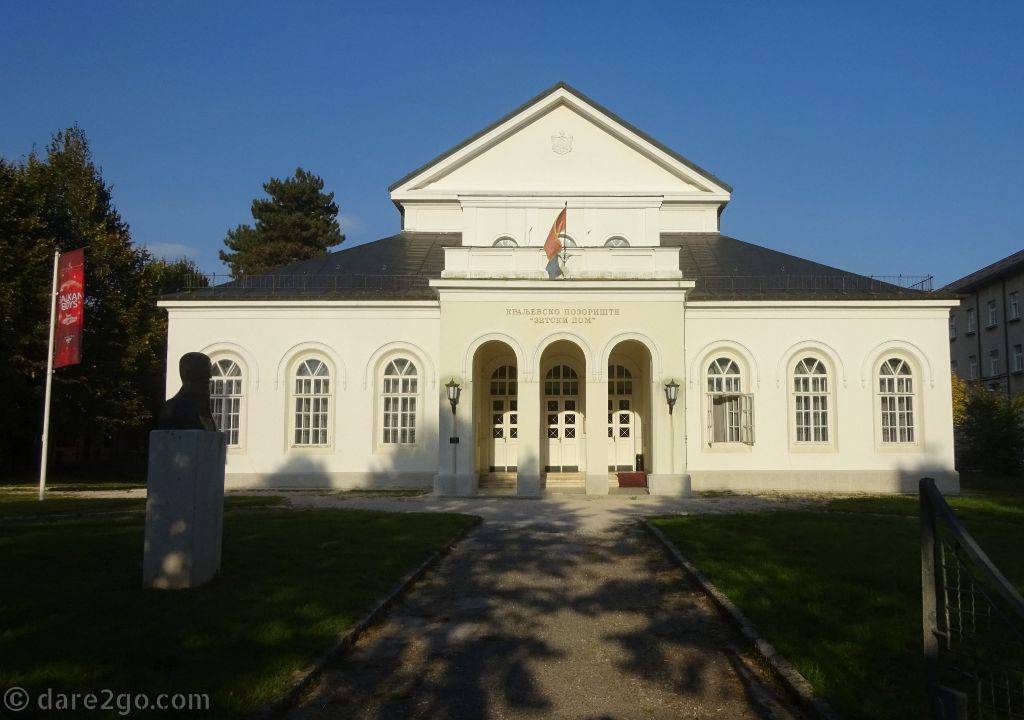
Zetski Dom, the Royal Theatre of Cetinje
The Town Hall of Cetinje
The Zetska Banovina Town Hall was designed by the Russian Nikola Kirsanov and completed in 1936. Later it came to importance when the Montenegrin Anti-Fascist Parliament of National Liberation used it for its sittings in 1945. It is still in administrative use to this day.
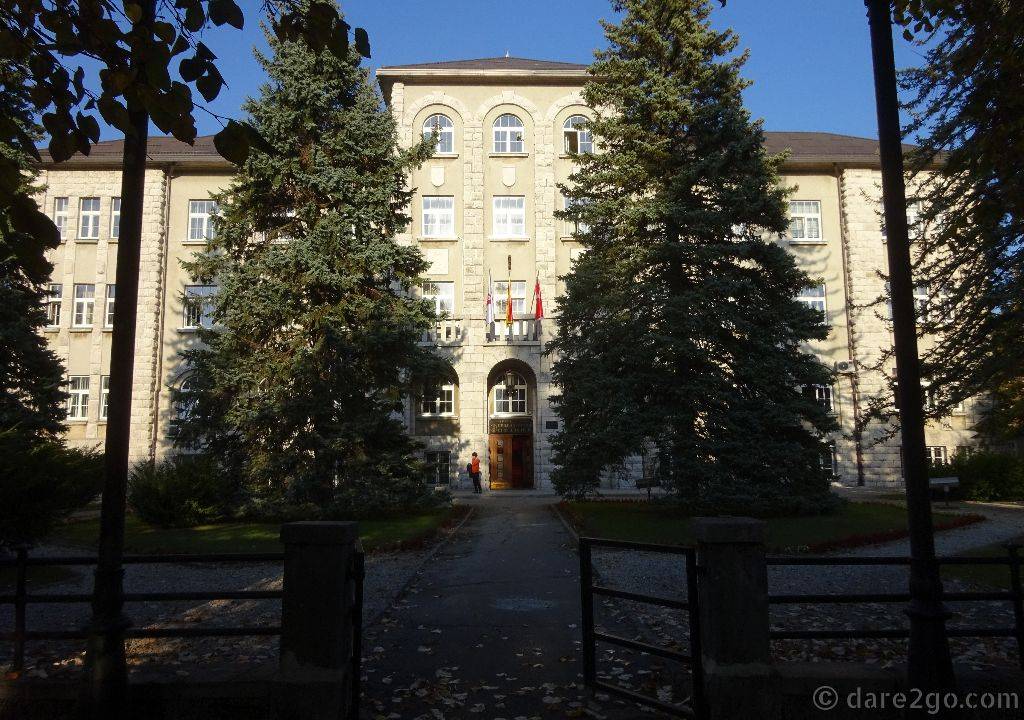
The town hall of Cetinje
The Turkish Embassy
Some countries took possession of former residential buildings in Cetinje and converted them. The former German Embassy (see above) and the former Turkish Embassy are excellent examples of this. Today, the small house is used by the Faculty of Drama.
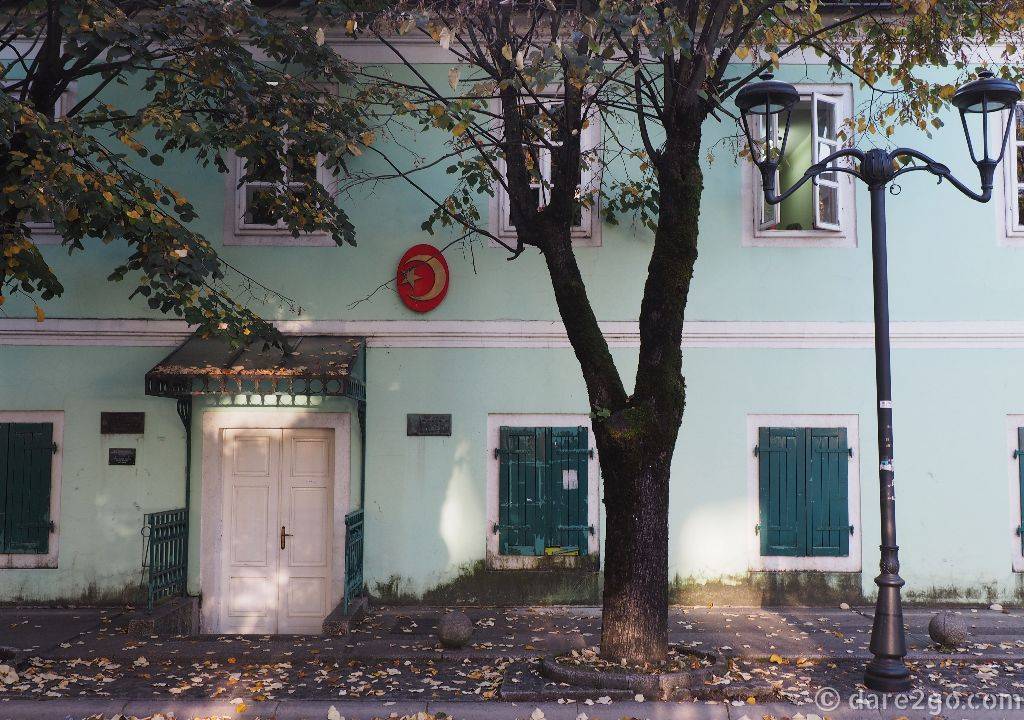
The former Turkish Embassy in Cetinje
The Russian Embassy
Just up the road, next to the town hall, stands the former Russian Embassy. It really dwarfs everything around it and is beautifully renovated. Built around 1903, it was designed by Italian architect Corradini. It is large and impressive, set in a generous garden with mature trees. The facade has Baroque style stucco decorations with palm fronds and several fantasy creatures. Today, it’s home to the Faculty of Fine Arts.
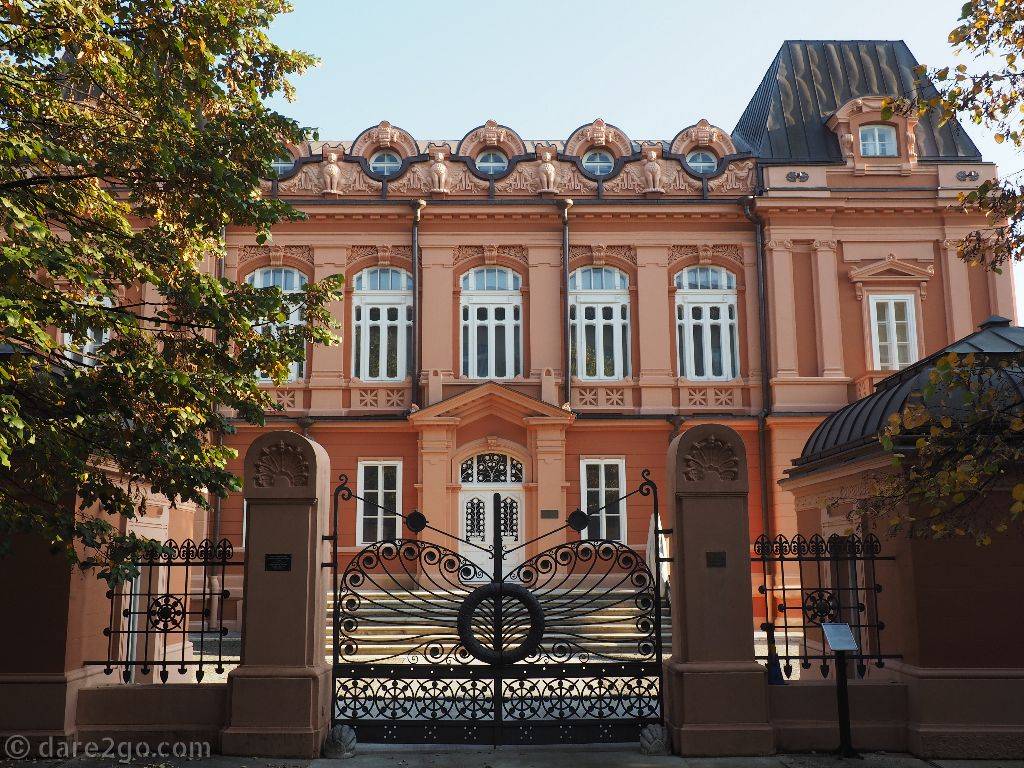
The former Russian Embassy in Cetinje
This concludes our visit to Cetinje. One other former embassy is of note: the Italian Embassy is located at the edge of town (we didn’t find it). It is reportedly another lavish design by the architect Corradini, the one who designed the Russian Embassy and Government House. Most of its splendour can be found inside but, as far as we know, there’s no public access.
Two Top Travel Tips in Alentejo: Vila Viçosa and Estremoz
15 Fascinating Things to Do and See in Merida, Spain
The Development and Decline of Cetinje
Soon after its founding, Cetinje attracted frequent attacks by the Ottomans and the Venetians. During these turbulent times, in the 16th and 17th centuries, the former court and the famous monastery of the Crnojevići Dynasty were destroyed (see above).
From 1697 onwards, Cetinje slowly started to flourish again under the rule of the Petrović Dynasty. In 1838, Petar II Petrović Njegoš built his new royal residence in Cetinje, called Biljarda (Billiard Palace). This is one of the many sights you can visit today.
But the battles with the Ottomans continued. During the Montenegrin–Ottoman War of 1861-62 the town finally fell into the hands of Omar Pasha’s forces. Their rule did not last long though. Only 14 years later, the Montenegrin forces were victorious in what is remembered as the “Great War”.
The leader responsible for this victory was Nikola I Petrović, who came to power at the young age of 19, after the assassination of Prince Danilo (see Blue Palace). For nearly six decades, he proved to be a skilled strategist and diplomat. He finally defeated the Turks and subsequently had the country’s independence recognised at the Congress of Berlin in 1878. Cetinje once again became the official capital of this European nation.
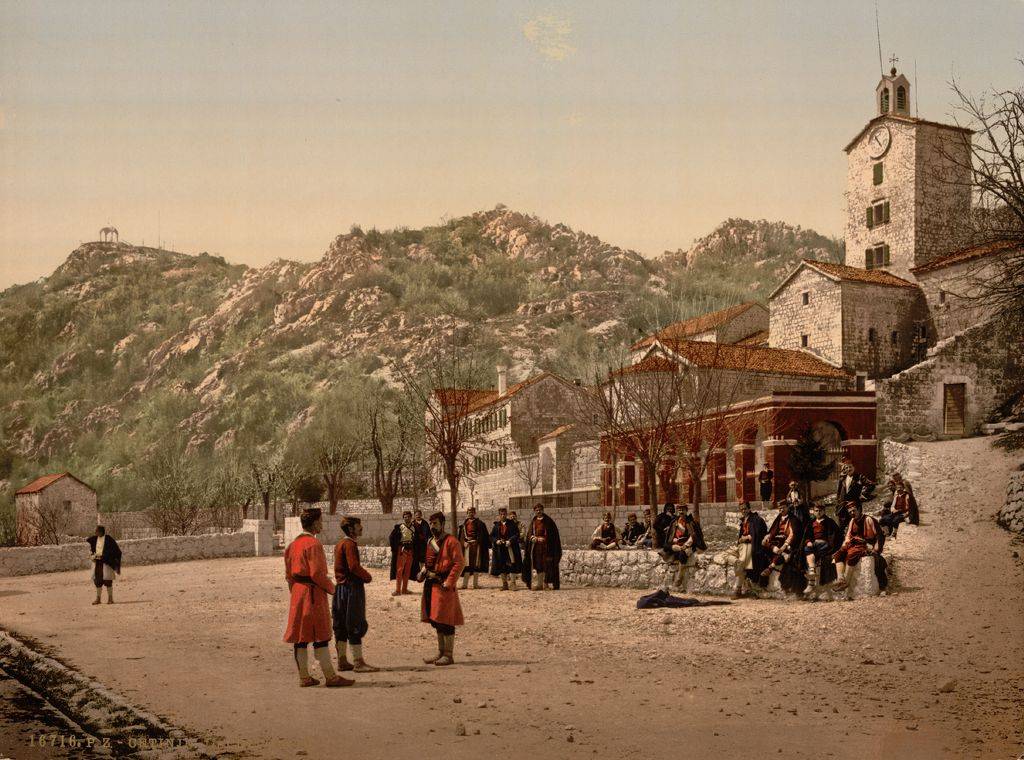
The following years, from 1878 to 1914, were the real glory days of Cetinje. Foreign countries established their embassies, and many intellectuals followed. After Montenegro was proclaimed a kingdom in 1910, the town prospered and expanded (still only small with just 5,895 permanent inhabitants).
Then fate hit again in the form of two World Wars. During WWI the Austro-Hungarians took possession of Montenegro and ended the rule of the Petrović family. The end of WWII led to the formation of Yugoslavia, of which Montenegro became one small republic. Everything came to an abrupt end for Cetinje, when the socialist government decided to move all regional administration to Podgorica, then called Titograd. The town declined rapidly.
After the end of the Balkan Wars, Montenegro held a referendum, in which a slim majority of its population voted for independence from Serbia. Thus the Assembly of the Republic of Montenegro made a formal Declaration of Independence on the 3rd of June 2006. Since then, the small country has been seeking full membership of the European Union.
The small Heritage Towns of Colombia you should see
Altena has one of Germany’s most beautiful castles and a very interesting industrial heritage
How much time should I plan for a visit to Cetinje?
It really depends on how much you want to discover, in and around Cetinje. If you want to see most of the important historic attractions in town and have snack in one of the many outdoor cafes in Court Street, a few hours would be enough time.
But if you would like to delve deeper, and understand its history as the former Royal Capital of Montenegro, by spending some time in a few of the many museums, then we would recommend at least an overnight stay in this laid-back town.
For all National Museum of Montenegro locations in Cetinje please visit this list (in English).
What Other Attractions are Near Cetinje?
We would suggest that you choose Cetinje as your base to explore more of the region. It will be much quieter (and cheaper) than popular Budva or Kotor. Otherwise, you could easily take a day trip to Cetinje from either Kotor or Budva.
The Lovcen National Park near Cetinje
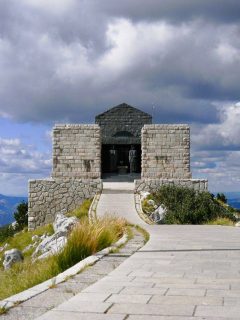
Mausoleum of Njegos [photo credit ]
Cetinje is known as the gateway to the famous Lovćen National Park, a rugged mountain area worth hiking. It is reportedly one of the last Balkan refuges for bears in the wild. Montenegro’s famous poet king Petar II Petrović Njegoš selected Mount Lovćen as his burial place; his mausoleum is located right on top.
Its significance in Montenegro’s history is not diminished by the fact that a new building replaced the historic chapel, which was originally designed by the king himself. (For more about this please read Wikipedia .)
We suggest that you explore more of this National Park on foot. Here are six hikes in Montenegro you absolutely should try , which includes a route through the Lovcen park.
The Lipa Cave, only 5 Kilometres from Cetinje
Another reason to base yourself in Cetinje: to explore the famous Lipa Cave, which is really close by. This is one of the largest karst stone caves in Montenegro – and the only one open to the public! The Lipa Cave is located in the village of the same name, 5 kilometres from Cetinje. Take warm clothes as the temperature inside the cave is a fairly constant 10°C! For more information see the Discover Montenegro website .
Should I Visit Cetinje?
Whatever you decide, one thing is certain: you don’t want to miss a visit to Cetinje!
On the one hand, it’s a nice, quiet place with a lot of open spaces, parks and squares, to relax. On the other hand, its student population from the numerous faculties of the University of Montenegro, which are spread around the former embassies, gives the city just enough life and events that it’s never really boring.
We certainly found it an interesting and relaxing place to experience. Cetinje could almost be called quirky – it is certainly a unique capital city in its very own right! (Even if nowadays it is only a secondary capital.)
the Western Balkans Map from Reise-Know-How
This is our preferred brand of maps! They are usually very accurate, GPS compatible, and waterproof and tear-resistant thanks to their special paper. The Reise Know-How map is most likely the best paper map you will find for the Western Balkans. It covers all countries from Slovenia in the north to parts of Greece in the south.
Practicalities for Montenegro
Although part of Europe, Montenegro is not a member of the European Union. This brings some advantages and many disadvantages.
Your time in Montenegro will not be counted towards your Schengen Visa allowance. You can enter and stay in Montenegro for up to 90 days within 180 days. 
Some nationalities will need to apply for a visa before visiting. (The rules and restrictions applied are similar to those in the Schengen region).
Montenegro uses the EURO as currency, which makes it quite convenient if you come from another country in the Eurozone.
We carry a VPay Debit Card from a large European bank – this did not work in Montenegro! As such we were restricted to our credit cards and cash transactions.
Since Montenegro is not a member of the EU, European mobile phone roaming is not supported. You either have to pay much higher roaming charges or buy a local SIM card , which is really cheap and easy to get.
Bonus: the data packages on the Tourist SIMs are absolutely, ridiculously, large and cheap: for 5 or 10 euros, depending the provider, you will get 1000 GIGAbytes of data for 20 or 30 days = endless Netflix binge watching and you’ll still not use it up! We bought a card from Telenor, which gave no problems and good coverage.
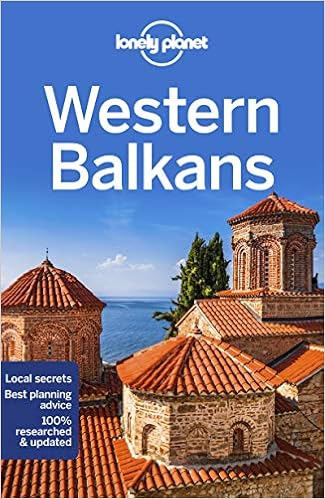
Our favourite travel guidebooks are from the “DK Eyewittness” series because they concentrate on the attractions, not on places to stay or eat. For the Balkans their last edition is from 2015, which we thought might be too outdated. The new Lonely Planet guidebook for the Western Balkans wasn’t released until after we had visited several countries. Other publishers seem to update their guidebooks for the Balkans as infrequently (which shows that the Balkans are still low in demand).
Currently the Lonely Planet Western Balkans is the most up-to-date guidebook you can buy for this region.
Please share this post on Pinterest to show your friends or to remember for later:

![The fortified old town of Cáceres in Spain is a true gem, still undiscovered by most tourists. The integrity of its historic buildings is UNESCO protected. [Our image shows a close-up of the wooden model of the fortified city, on display in the tourist information office]](https://dare2go.com/travel/wp-content/uploads/2019/10/Caceres-featured-image-520x245.jpg)







If and when we get back there, you’ve certainly put Cetinje on our list – looks like our kinda place! Great article.
We’re always happy if our posts really inspire a person to go and visit.
Very nice article. We’re always looking for new low touristed destinations. With all the historic sites looks like a great place for a night or two. Thanks for the education.
Cetinje might be worth more than a night or two if you want to explore the surrounding natural attractions.
What a great article on Cetinje. The title photo says it all with the gentleman relaxing so comfortably. The architecture is enough to pique our interest, but it looks like the city holds plenty more for travelers. Thanks for sharing.
Yes, Cetinje certainly can deliver more to any traveller, specially if you’re interested in exploring the surrounding natural attractions.