Diversity in Wales: Interesting Historic Towns & Villages
Wales is such a small country, we had thought to take just a couple of weeks – we stayed more than six, travelling in our motorhome! During our roadtrip, we discovered a diversity in Wales that surprised us. There are historic sites everywhere: from ancient ruins to the important national heritage of the industrial revolution. It also seems that every small town or village has a significant historic event to celebrate.

During our UK roadtrip, we were astonished by the diversity Wales offers travellers. This post introduces you to Wales’ interesting towns and villages. [Photo: the old stone bridge and houses in Beddgelert.]
This is the first of a series of posts about diverse travel in Wales. We will tell you about some of the interesting towns and villages we visited. There are so many more, and we encourage you to discover them.
The list is divided geographically, in the order we visited them – in a vaguely anti-clockwise direction around the country.
What you will find in this article:
Villages & Towns in Snowdonia, Wales

Snowdonia National Park: one of the views of lakes, mountains and forests that impressed us when driving through this part of North-West Wales.
Snowdonia National Park covers over 2000 square kilometres of North-West Wales. It is a mountainous region that includes Mount Snowdon, Wales’ highest peak. The mountains are full of forest, rivers, waterfalls and lakes. It is THE place for outdoor activities in Wales; from simple walks to serious hiking, and adventure sports like rock climbing, abseiling, canyoning, kayaking, mountain biking and more.
You can climb Mount Snowden, at 1085m, but there is also the narrow gauge Snowdon Mountain Railway to the top, which has been operating since 1896.
The Conwy Valley Railway originates in the beach town of Llandudno and follows the river, through the heart of Snowdonia, all the way to the Blaenau Ffestiniog, the former ‘slate capital of the world’. The Facebook page of the railway currently has a video of the journey in place of a cover photo.
Llandudno
Please click thumbnails below for a larger photo with description.
-
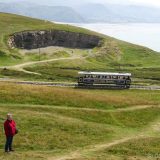
- LLandudno: Yasha on the Great Orme, with the historic tram that brought her there. The Bishop’s Quarry is in the background, where many interesting fossils have been found. Visitors love this bluff as much as the seaside below.

-
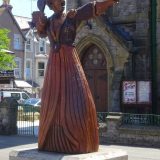
- LLandudno: proud of their association with Lewis Carol and his famous story of Alice in Wonderland, there are many sculptures of the characters around the town. Here the Queen is probably shouting “Off with her head”.

-
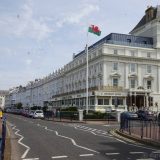
- Llandudno: an historic seaside resort town in Wales. Here are some of the well-preserved Victorian buildings you will find along the beachfront – a hotel with a view.

-
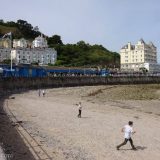
- Llandudno: visitors come for the beach, but the pier in the background is also a draw, with all types of amusements and sweet treats available there.

One of the famous Victorian seaside resorts, Llandudno lies just north of Conwy (and its World Heritage listed castle ), below the Great Orme. It remains one of Wales’ favourite summer holiday destinations. The beach is fronted by some impressive Victorian buildings, and has the longest amusement pier in Wales.
The Great Orme is a Local Nature Reserve, which is apparently as popular as the beach with locals and visitors alike. We rode the Great Orme Tramway up this bluff, just as others have done for more than a century. (Now there is also a cable car). At the top you’ll find historic sites, wildlife, great walks and plenty of places to sit in the sun and picnic. It also has a ski slope and toboggan run, said to be the longest in Britain – all year round!
An odd point of interest about Llandudno is its connection with the classic, Alice in Wonderland. Evidently Lewis Carroll met the real Alice in this holiday town in the mid-1800s. This connection is celebrated with many statues of the characters spread around the town. There are even a couple of apps you can use to follow the White Rabbit Trail.
Llanrwst

Llanwrst: If you follow the Conwy Valley south from LLandudno, you will drive through this historic village. If you google ‘Llanwrst images”, you’ll find this photo repeated many times. Hope you like our version.

Pen Y Bont: one of the historically important 17th century coaching inns in Llanrwst. It’s kept in very good repair and is still used as a pub.
Just 25Km from Llandudno, along the beautiful Conwy valley, we arrived at LLanrwst. The most recognised photo of this small village shows the 3-arched, stone Pont Fawr Bridge (1636), and the 17th century court house at the end of the bridge, across the River Conwy. It’s now a National Trust building, and houses a tea room and gift shop.
But this village has a history spanning more than 1000 years. Wander along the LLanrwst Town Trail and River Walk to visit some well-preserved sites like the old coach inns, St Grwst Church and Gwydir Chapel. It’s a peaceful and interesting place to spend some time.
Betws-y-Coed

Betws-y-Coed is the tourist centre of the Snowdonia National Park. Most people arrive here and then take tours starting in this town. The day we visited, we encountered a number of buses with visitors coming from cruise ships.
Just a few kilometres further down the Conwy Valley from LLanrwst, and we arrived in another pretty, small Welsh town. But the contrast couldn’t have been greater.
In Betws y Coed there was a constant stream of tourist coaches, loading or unloading hundreds of visitors that crowded the streets, which were mostly lined with souvenir shops and restaurants. The main reason for this is that Betws y Coed is the ‘Gateway to Snowdonia’.
We found the tourist information centre interesting. As well the normal souvenirs and information brochures, there are helpful, friendly staff and historic information displays. We also watched a video: ‘Flight over Snowdon’ – a bird’s eye view of Snowdonia .
Beddgelert

Beddgelert: flowers, stone cottages, rugged landscape – one of the interesting, historic towns we passed through in Snowdonia.
Often we plan ahead to stop at some town or village that sounds interesting; sometimes we just happen upon them. We had driven over Llanberis Pass in Snowdonia and arrived in Beddgelert – on our way to somewhere else – when the stone buildings and three arch bridge over a small stream, and the eye-catching display of flowers everywhere, stopped us in our tracks.
We looked for a place to park, and explored further on foot. Bedd Gelert translated into English is Gelert’s grave – Gelert is believed to be the favourite hunting dog of Prince Llywelyn the Great. You can read the legend , and judge the historical accuracy for yourself.
Other than the grave of a dog, Beddgelert has some well-preserved old houses, and did I mention the flowers everywhere? This place was also used as a set in the 1958 film, The Inn of the Sixth Happiness, starring Ingrid Bergman.
Such a pretty little village!
Villages and Towns along the West & South Coast of Wales

Wales Coastline: This farm goes right up to the top of the cliffs, which are the favourite place for long walks, following the coast.
The rugged coastline of Wales is an area with multiple attractions. The coastline is popular for its cliff top walking trails, and the seaside towns attract many summer visitors. We drove along most of it, and stopped in some villages and towns along the way.
Machynlleth

Machynlleth: this interesting town in Wales was a surprise find for us. We had no idea that it was so historically important until we arrived and walked around.
We only stopped in Machynlleth because there is a large parking lot where we could park for the night. But we found an attractive town, with some well-preserved buildings, that also holds an important place in Welsh history.
It was in this town that Glyndwr, the rebel who led the Welsh in the fight for independence from England, held a Welsh Parliament in 1404, and was proclaimed Prince of Wales. The Owain Glyndwr Centre stands on the original site of this event, and houses a display of the history of Glyndwr and the rebellion. It is unclear if part of the original building is incorporated in the one that stands here today.
Other attractions include Y Plas (The Mansion); house and gardens formerly owned by the family of the Marquess of Londonderry, which were given to the people of Machynlleth in 1948. The gardens are now a public park and the house has been used for a number of different public purposes over the years. There is also a clock tower, considered the centrepiece of the town, built in the 1870s.
Machynlleth is worth a stop and a wander around.
Aberaeron

Aberaeron: another seaside resort town on the coastline of Wales. It has everything you need for a beach holiday, including views like this one.
If you’re looking for the quintessential pretty, little, coastal, harbour town, then Aberaeron is a great example. It has a marina full of sail boats, lined by colourful Georgian townhouses. You can get fish & chips and eat them looking out to sea, and then top it off with their signature honey ice cream.
It was one of Wales first planned towns, created in the early 1800s as a resort town to rival Brighton and Bournemouth. It still draws many summer visitors, who come for the dolphins, the food and the picture perfect surrounds.
Cardigan

Cardigan: one of Wales most important ports during the industrial revolution. Although the port became unusable by the beginning of the 20th century, these warehouses serve as a reminder of former glory – and the smaller vessels still make use of the waterway.
The history of Cardigan began with the construction of a Norman castle. Then the town grew up around it, on the estuary of the river Teifi. Its location meant that, over the centuries, Cardigan became an important trade centre and port. By the 18th century it had become the most important port in South Wales. The estuary began silting up in the mid-1800s and by the turn of the century the harbour was basically unusable for large cargo ships.
The castle has also had a chequered history, being razed then rebuilt; left to decline and another castle built within the walls; once again neglected, bought by the local county council, then completely restored in the early 2000s. Today it’s a venue hired out for events and concerts, luxury accommodation, a restaurant, and a heritage centre with education facilities.
Cardigan is once again a thriving town, with the castle revival providing the motivation for innovation and growth. Visitors come for the castle and then spend time in the town, and the surrounding area. The whole coastline is famous for its walks, and Cardigan is no exception.
Cardiff
Please click thumbnails below for a larger photo with description.
-
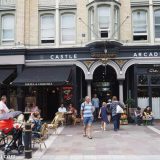
- Cardiff: the entrance to the Castle Arcade, one of the many beautiful arcades you can wander through in the centre of the capital city of Wales.

-
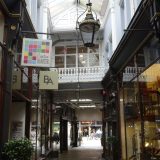
- Cardiff: the shops inside the historic arcades are all still in their original form. The decorated galleries and ceilings, and the light fittings, complete the picture.

-
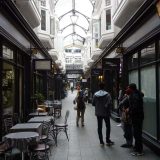
- Cardiff: most of the arcades have restaurants and cafes, which are almost always full if it’s around lunchtime.

-
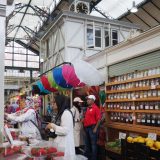
- Cardiff: the inside of the Victorian Market building. This is still a thriving market place today.

Our final coastal town is no small town or village – Cardiff is a city and the capital of Wales. We include it because it was a place we enjoyed very much. There was a parking lot right next to the Cardiff Castle and close to the town centre where we were welcome to stay as long as we wanted. It was £16 for 24 hours, but if you paid for 7 days it was £31.20 – what an encouragement for travellers like us to spend some time in a big city, with a minimum of fuss!
We came primarily for the Cardiff Castle, and we did enjoy our time spent there. But we also found the centre of the city interesting and worthy of time spent wandering around. Our walk into the centre took us past a long wall of graffiti leading to the Millennium Stadium. It was built for the 1999 Rugby World Cup. And just in case you’re interested, Australia took the cup home that year.
The city centre is pedestrian friendly. You will find outdoor cafes, if the weather is fine, and all kinds of shopping. The highlight of this precinct has to be the Victorian and Edwardian arcades. We found ourselves walking an arcade at every opportunity, just to appreciate the architecture. It’s also worth visiting the Cardiff Central Market. This Victorian indoor market has operated since 1891 and some of the stalls seem to have been there that long, like Ashton’s The Fishmongers and The Market Deli. The building is an excellent example of its kind.
Cardiff is a place where history stands side by side with modern development and, in this case, it certainly works. We stayed 4 days.
Border Towns of Wales with England

The Three Cocks Coaching Inn: all across Great Britain, the pubs have interesting names. This one, in the border region is no exception. The historic building is in great condition and is still operating as a pub.
Given that the Wales-English border is so close to these historic towns of Wales, there is a slightly different feel to them. They seem to be more of a mixture than the pure Welsh towns and villages we visited further west. But they are all part of what makes up the diversity in Wales.
Hay-on-Wye

Hay on Wye: the perfect town in the border region for book lovers. Many of the 30-something shops deal in 2nd hand books.

Hay on Wye: it’s not just books. There are plenty of historic stone buildings, on narrow streets, to be discovered. And the clock tower is certainly impressive.
A market town right on the Wales/English border, Hay-on-Wye has a history going back almost a millennium. But for the last 4 or 5 decades, it has been known simply as ‘The Town of Books’. It holds the internationally recognised Hay Literary Festival annually, and is considered a mecca for bibliophiles. The streets are lined with bookshops, most of them selling second-hand books, and interesting, sometimes amusing signs.
The long history of Hay-on-Wye has given the town its eclectic look. There’s a castle in the centre of town, and also the old cheese market hall, restored to its original look after many incarnations. There are stone houses, and also half-timbered houses, some of which have been plastered over.
It’s a pretty town, but also very interesting – especially to a bibliophile.
Welshpool

Welshpool: Montgomery Canal and the Powysland Museum make a visit to this historic town in mid-Wales even more interesting.
We could have seen it as just another small historic town, with some nice old buildings, if it weren’t for the Montgomery Canal and the Powysland Museum. The canal helped make the market town of Welshpool a transport hub. Unfortunately, the canal fell into disuse after a breach in the 1930s, and was eventually abandoned, until a large group of local volunteers decided in 1969 to renovate it…
The Powysland Museum is a small, but comprehensive museum of the old county of Montgomeryshire, housed in a restored canal-side warehouse. It includes archaeological finds from the stone, iron, and bronze ages, Roman remnants, medieval to Victorian eras, and curiously includes quite an extensive range of Laura Ashleigh clothes and textiles from the 70s. We didn’t expect that such a small town could have such a diverse historic collection.
The other great attraction of Welshpool is the Powis castle and gardens. We didn’t visit, mostly because we like our castles less-manicured and more original. But for those who love to visit stately homes, museums full of memorabilia from another era, and huge formal gardens, I’m sure you’ll enjoy the Powis castle when you visit Welshpool.
Llangollen

Llangollen: in North-West Wales, this interesting town is most known for its proximity to the Pontcysyllte Aqueduct. But it is a lovely historic town in its own right.
In the far north-west of Wales is the small town of Llangollen. It’s a neat little settlement with enough facilities to keep visitors happy. You will find coffee shops and restaurants, small bric-a-brac stores, accommodation, and plenty of parking. Two of its major attractions are within easy reach.
Plas Newydd is a property at the edge of town, located on a hill overlooking the valley. Our guidebook – DK Eyewitness Travel Great Britain – led us to this historic house:
The town became notorious in the 1700s when two Irishwomen, Sarah Ponsonby and Lady Eleanor Butler, The “Ladies of Llangollen”, set up house together in the half-timbered Plas Newydd. Their unconventional dress and literary enthusiasms attracted such celebrities as the Duke of Wellington and William Wordsworth.
Their idyllically located half-timbered house in now a National Trust property.

Llangollen: just on the edge of town, Plas Newydd is a very important historic house, now in the care of the National Trust. Its style and wood carvings are unique. On the hill in the background you can see the ruins of Castle Dinas Brân.
The most famous sight is the Pontcysyllte Aqueduct, on which the Llangollen Canal crosses a deep valley. This World Heritage listed “River in the Sky” was constructed from 1795 to 1805. Please see our dedicated blog post about the British canal sights .
St Fagan’s National Museum of History, a Collection of Preserved Historic Welsh Buildings
We were so very impressed and interested by this museum that we are including it as a supplement to this post. St Fagan’s is not strictly a village or a town, but it gathers together so much that typifies the diversity we discovered in Wales. It is described in its map and guide brochure as:
A walk around Wales – from Celtic times to the present day.
Please click thumbnails below for a larger photo with description.
-
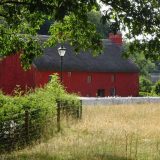
- St Fagan’s National Museum of History: Kennixton Farm Buildings – built in Llangennith around 1850 – re-erected at the museum in 2012.

-
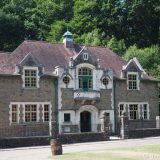
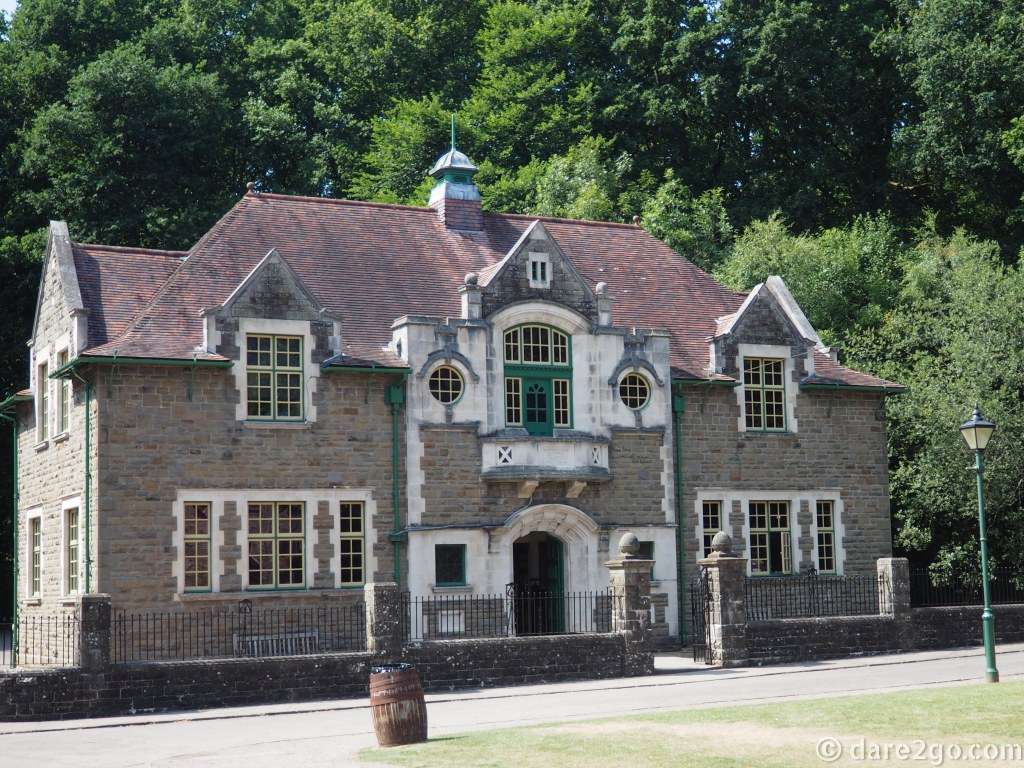
- Workmen’s Institute from Oakdale, opened in 1917, closed in 1987. It was re-opened at St Fagan’s National Museum of History in 1995.
-
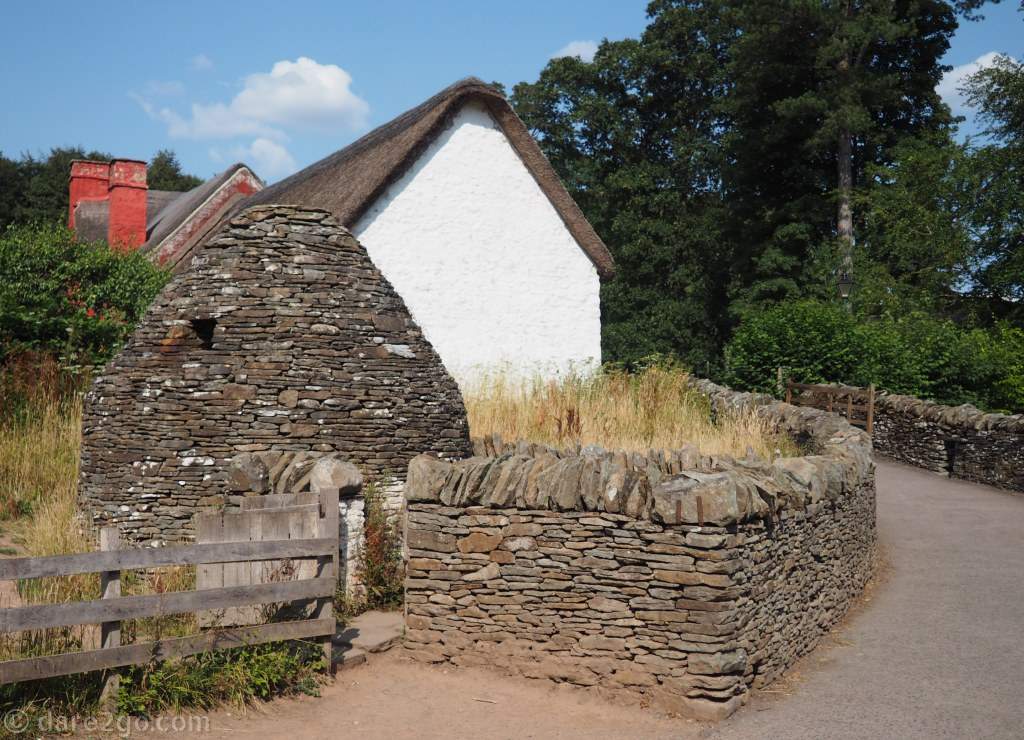
- St Fagan’s National Museum of History: a pigsty from a farm near Prontypridd, built in 1800. Re-erected in 1976. Why is it round? Because pigs like to dig in corners. This style of pigsty was very common in South Wales.
-
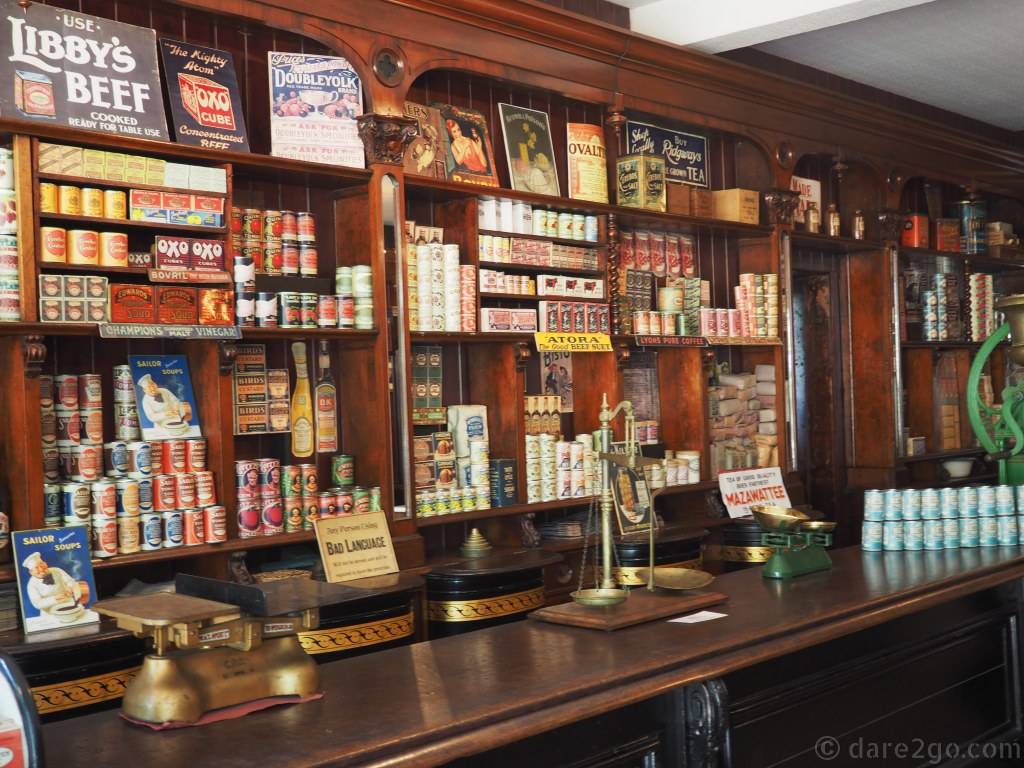
- St Fagan’s National Museum of History: one of the most interesting museums we visited in Wales. This is the interior of the Gwalia Stores, moved to the museum from Ogmore Vale in 1991, where it had operated for almost 100 years until 1973.
The museum opened in 1948, and since then they have moved more than 40 historic buildings from all over Wales to this site. It often means that they have taken the buildings completely apart, piece by piece, and reassembled them in this new location. And the number of buildings is increasing all the time. They are set out in a parkland forest, which makes it a very pleasant place to wander around.
If you are interested in history in general, and the historic sights of Wales in particular, we really recommend a visit to the St Fagan’s National Museum of History outside Cardiff.
We hope you’ve enjoyed these sites through our eyes. They are just a small portion of the diverse industrial heritage of this small country. If you have discovered other sites on a journey through Wales, please share them with us in a comment below.
Discover the Diverse Industrial Heritage of Wales
A Diverse History of Wales – in Ruins (from Roman relics to beautifully preserved castles)
Conclusion
Wales is certainly an interesting country with diverse possibilities for the traveller. We hope we have inspired you to take a look at the historic towns and villages in a small, proud country. This is by no means a definitive list: we would recommend driving yourself, if possible, giving you the opportunity to stumble upon your own surprise, which will make another special memory for you to take home.

Please share this post on Pinterest to show your friends or to remember for later:


![The Industrial Revolution is an important part of the heritage of Wales. As diverse as they are, each site has a unique and often fascinating story to tell. [Photo shows the water balance tower of the Blaenavon Ironworks.]](https://dare2go.com/travel/wp-content/uploads/2018/12/Industrial-Heritage-Wales-featured-520x245.jpg)







When you take the country’s size into account Yasha, pound for pound, the place has to be the most beautiful place on earth. What range. Fabulous post.
Maybe not the most beautiful, but it’s definitely up there.
We also enjoyed some beautiful towns and villages in Colombia’s Coffee Region and the Small Heritage Towns of Colombia.