Karajia Cliff Tombs: Remains of the Mysterious Chachapoya
The Karajia archaeological site was a mystery to me; much like the people responsible for creating it. They are known as Chachapoya (Cloud Warriors), but this name was probably derived from what the Incas called them. How they named themselves is, and probably will remain, a mystery. They were evidently fierce warriors and the Incas had some difficulty overpowering and subjugating them.
Chachapoyas is the capital of the Amazonas state of Perú. It is named for the people who inhabited the area from around 800AD until the Inca overwhelmed them in the 1470s. Karajia lies to the north-west of the city.

Not much is known about the Chachapoya culture, but the discovery of cliff tombs like these at Karajia, is going some way towards uncovering the mystery.
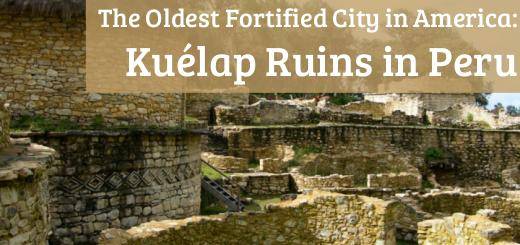
The Chachapoya themselves are also something of a mystery – after some considerable study by archaeologists and anthropologists, still very little is known of this great culture. That it was great, is clearly exhibited by the archaeological site of Kuélap , which is one of the largest discovered so far. It is also the most accessible to visitors (especially since the recent opening of the teleférico).
We were on our way to Kuélap when we were contacted by friends we had met in Argentina 2 years ago. They had just visited Kuélap and were on their way to Karajia. I looked it up on our Reise Know-How map [Amazon affiliate link] to see if I could find it. It was marked as an archaeological site and was on our way. So we went looking for our friends.
It’s around 35Km off the main road. First you drive a zigzag up the mountains on a fairly good gravel road to reach Luya. After that the height doesn’t change much more, but the road is sometimes rough. Part way there the rain came down in buckets. The road was completely overrun by water in places, but we made it to Karajia unscathed. Our friends were there and we spent a lovely evening together.

When the rain came down,on the way to Karajia, the road was over-run like this in many places.

The path down to see the Karajia cliff tombs was rocky, rough and very muddy. This was actually worse than it looks in the photo.

Berta with Nessie once again. It was great to catch up with these overlanders again near the Karajia cliff tombs.

A typical house along the road we took to the Karajia archaeological site.
The next morning we set off to find this local attraction. The 2Km path down is rough and muddy; probably muddier than usual considering the downpour of the day before. It’s also made worse by the cows and horses that also use the path, stirring up the mud even more. After about an hour, we made it to the bottom and reached the viewpoint. We were so concentrated on the path that we missed the first sighting – but it showed up in a photo!

Our first sight of the Karajia sarcophagi – but we didn’t realise it until we looked at the photo.
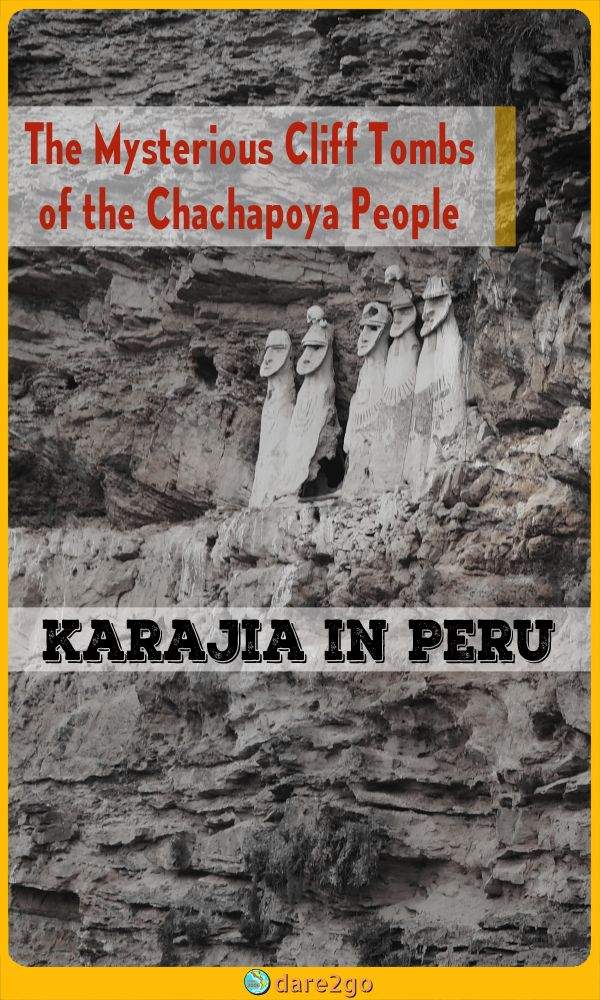
What we found were two burial sites in the cliff face above us – you have to walk down, and then look up. Cliff tombs are a distinctive feature of the Chachapoya. The most obvious one has a collection of sarcophagi or purunmachus, as they are locally known. Originally there were 8 – now you can clearly see 6. They stand on a stone ledge. Apparently they were constructed in situ, the sarcophagi built around the funeral bundles. They are made of mud or clay mixed with grass over a frame of sticks or bamboo, and have false faces with prominent chins. While these are not the only Chachapoya sarcophagi to be discovered, they are apparently unusual because of their size. They stand around 2.5m.

Looking back for a last view of the Chachapoya sarcophagi in the Karajia cliff tombs.
The other tomb looked like a cave that was enclosed. Even through the camera, completely zoomed in, it was difficult to work out the details. But there didn’t appear to be individual sarcophagi, although there were a number of faces fashioned into the structure that sealed the entrance.

Karajia cliff tombs: the less important people of the Chachapoya were entombed in a depression in the cliff face, which was then enclosed. Notice the false faces.
The discovery of sites like Karajia supports the research into the Chachapoya. Its remote and inaccessible location has inadvertently protected it from looters and vandals, who are often several steps ahead of the archaeologists in this part of Perú. Also, perched high in a cliff face crevice, there is little threat of water damage in an area with very high rainfall and resultant flooding.
As Peter Lercher states in his National Geographic article, Lost Tombs of Peru [article no longer online]:
“Fortunately for us, this reverence for the dead has preserved a part of the Chachapoya past that otherwise would have been long lost to decay.”
During the following days, we went from Karajia to Kuélap, one of the most impressive sites of the Chachapoya culture . And from Kuélap to the Mallqui Museum at Leymabamba, with its very impressive collection of mummies, rescued from the Laguna de los Cóndores after the site was first discovered and vandalised by looters. As a result, our knowledge of the Chachapoya culture was certainly expanded and my interest was piqued. Once again, we were reminded that there is more to pre-Hispanic history in Peru than the Incas and Machu Picchu.
Please click thumbnails below for a larger photo with description.
-
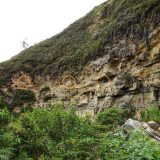
- The Karajia cliff tombs: from the viewpoint we could eventually pick out what we had come to see.

-
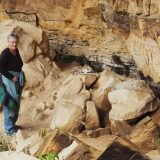
- When we reached the bottom and were walking around to the viewpoint, we came upon this pile of human bones on a rock. I guess they were once inside the broken sarcophagus.

-
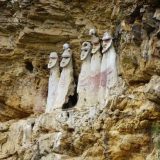
- Thankful for the zoom on our cameras, a clear view of the six remaining sarcophagi from the viewpoint at Karajia archaeological site.

-
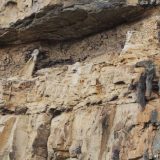
- The remains of a broken sarcophagus on a ledge down and to the right of the other 6 at the Karajia cliff tombs.

-
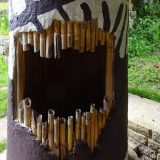
- After we visited Kuelap, we also stopped at the Leymabamba Museum, which had this reconstruction of the Karajia sarcophagi on show. The opening in the back shows a framework of bamboo covered with a clay and grass mix.

-
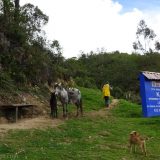
- On the way back up the hill from the cliff tombs, we are offered the chance of riding horses instead. No thank you – not our chosen form of transport.

-
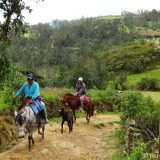
- The horses seem to be sure-footed on the slippery path, but we preferred to walk up after visiting the Karajia site.

-
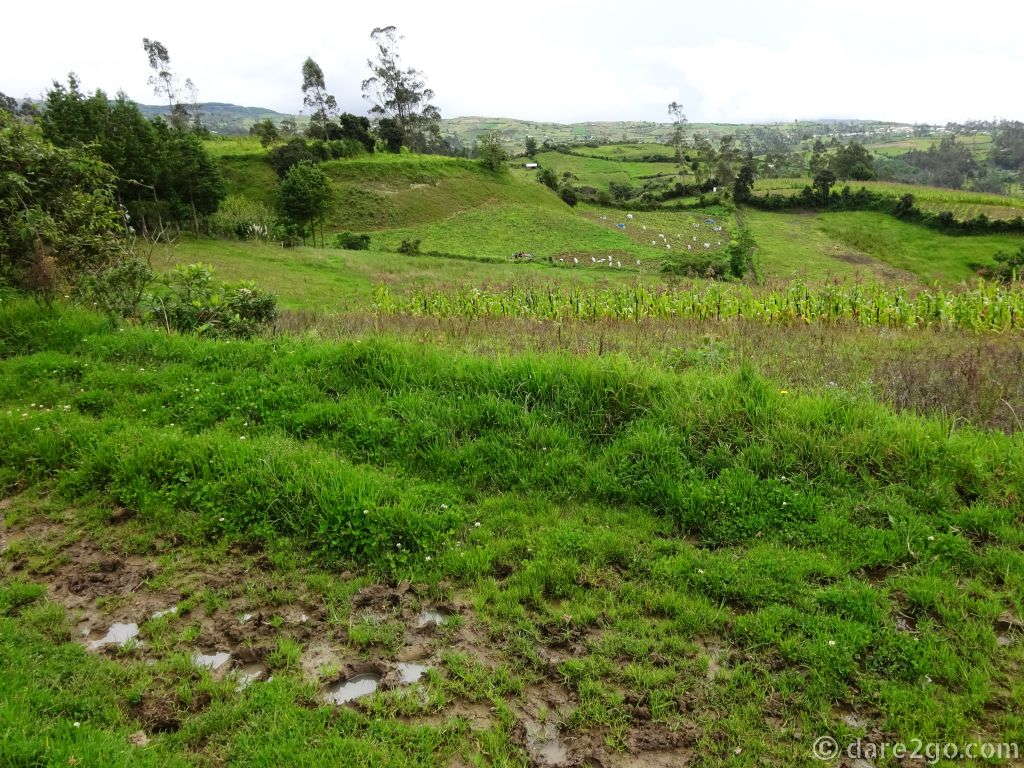
- At the beginning of the path down to the Karajia tombs, we saw these people harvesting a field of potatoes by hand. By the time we returned, around 3 hours later, they were almost finished.
An Overview of Chachapoya Archaeology and History by Adriana von Hagen [PDF-file], leading archaeologist of the Leymabamba museum.
The BBC documentary, Lost Kingdoms of South America: People of the Clouds (from 2013) [youtube]
In this documentary, Adriana von Hagen stated in an interview that probably only 5% of the archaeology of the Chachapoya culture has been discovered yet.
Realm of the Cloud People, by Victor Englebert , published in Archeaology.
Liked this? PIN THIS!

The Gocta Waterfall viewed from the main road. You can visit this on the way to the Karajia archaeological site.
And if you like waterfalls, on the way from Pedro Ruiz to the turnoff to Karajia, you can visit the Gocta Waterfall. At around 770m, it is one of the world’s tallest waterfalls – but whether it’s in 3rd place, or perhaps 5th, is still open to discussion. We didn’t visit it because there had been a lot of rain in the area and we didn’t trust the road. And we were not so keen to tackle the 3-4 hour hiking trail is such wet conditions. We photographed it from the main road and had to be satisfied with that.

A view of terraced mountainsides – some in sunshine and some shrouded in cloud. That typifies the weather in this part of Peru, where the Chachapoya lived.







Chachapoyas a charming place to spend a holiday surrounded by nature, hotels with stunning views towards the Gogta waterfall.
Wish we were there. 😊
Then I hope you have a plan to make your wish come true. You won’t be sorry. Peru is an amazing place – its archaeological sites especially.