Korça is a Gem Off the Popular Tourist Path in Albania
Korça, Albania is a lovely town that hasn’t been discovered by most foreign tourists, who visit this small Balkan country. But this doesn’t mean that it’s an unattractive city or that it doesn’t get its fair share of visitors. The opposite is true!
To locals, it’s known as the “Paris of Albania”. Its proximity to Tirana, and its temperate mountain climate, makes it a popular weekend destination. Therefore, during the week, you will find a much quieter city with plenty of accommodation choices.
We didn’t expect much and were pleasantly surprised by what we found in Korça (or Korçë, pronounced kor-cha). The city has a particular flair; it is fairly quiet and green, easy to explore on foot, and surprises visitors with its contemporary art installations in many places. The old bazaar part has been lovingly restored.
![Korça is an undiscovered gem of Albania. Stroll through this city and you will find public art, green spaces, several museums, and plenty of cafes for a rest. [Photo shows the full length of the public sculpture gallery in Rinia Park.]](https://dare2go.com/travel/wp-content/uploads/2020/11/Korca-featured.jpg)
Korça is an undiscovered gem of Albania. Stroll through this city and you will find public art, green spaces, several museums, and plenty of cafes for a rest. [Photo shows the full length of the public sculpture gallery in Rinia Park.]
What you will find in this article:
(Please note: we visited Korça in early September 2020, when Covid-19 had led to the temporary closure of several attractions. So we haven’t visited all sights inside!)
The history of Korça [< Wikipedia entry] dates back to late 15th century, when it was founded as a Muslim settlement. The city went through many ups-and-downs, typical for places in Europe with a history of ever-changing political and religious domination.
Korça became wealthy as a trading post and a centre for many craftspeople. In the recent past, its most influential inhabitants were wealthy Christian merchants of orthodox roots.
Korça has many of the features, which make a city more pleasant and livable:
- signs of homogeneous growth, where old and new don’t clash
- a broad population mix, with many young people thanks to its universities
- green spaces that reduce pollution and allow its citizens to enjoy the outdoors
- a pedestrian and bicycle friendly city centre, which encourages small business
- public art and other cultural attractions, which add to city’s ambience
No small wonder that Korça is Albania’s unofficial Capital of Culture.

One of the many parks we found in Korça, this one along Boulevard Republica.
You will find Signs of Creativity on Every Corner in Korça
This is something that really surprised us: the evidence of creativity and public art pieces in Korça. We also saw some rather inspiring modern architecture, often juxtaposed to crumbling remnants of the socialist era (see photo further down).
The Public Sculpture Section in the Rinia Park
The section of Bulevardi Rilindasit that leads through Rinia Park in the north of the centre, has an extensive selection of contemporary granite and marble statues lined up on its widened median strip. Since we stayed nearby, this was our first sight in the city of Korça; a pleasant surprise, since we’re always interested in sculpture parks .
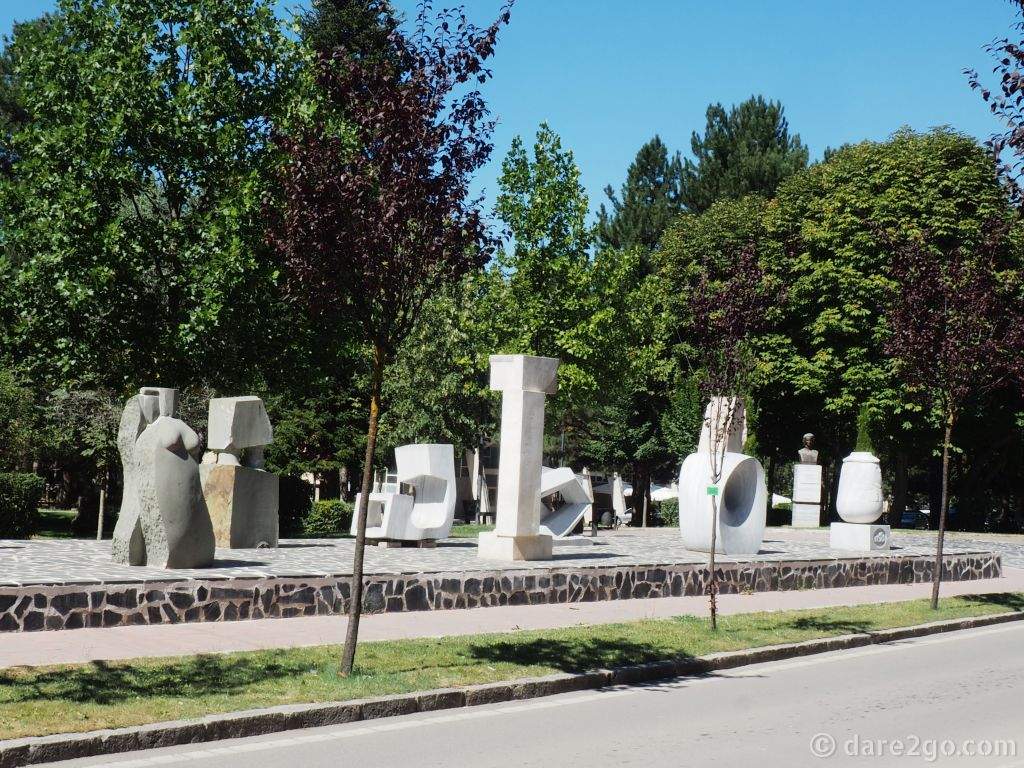
Part of the sculpture exhibition in Rinia Park in Korca. There are so many different granite and marble sculptures that you might just find one that really connects with you – take your time! (for more see our “title image” on top)
Other contemporary sculptures are placed in the shade of mature trees on the north side of the boulevard. In the mornings and evenings, this park is abuzz with people exercising, families walking with baby strollers, and friends gathering for a drink at the many al-fresco coffee shops.
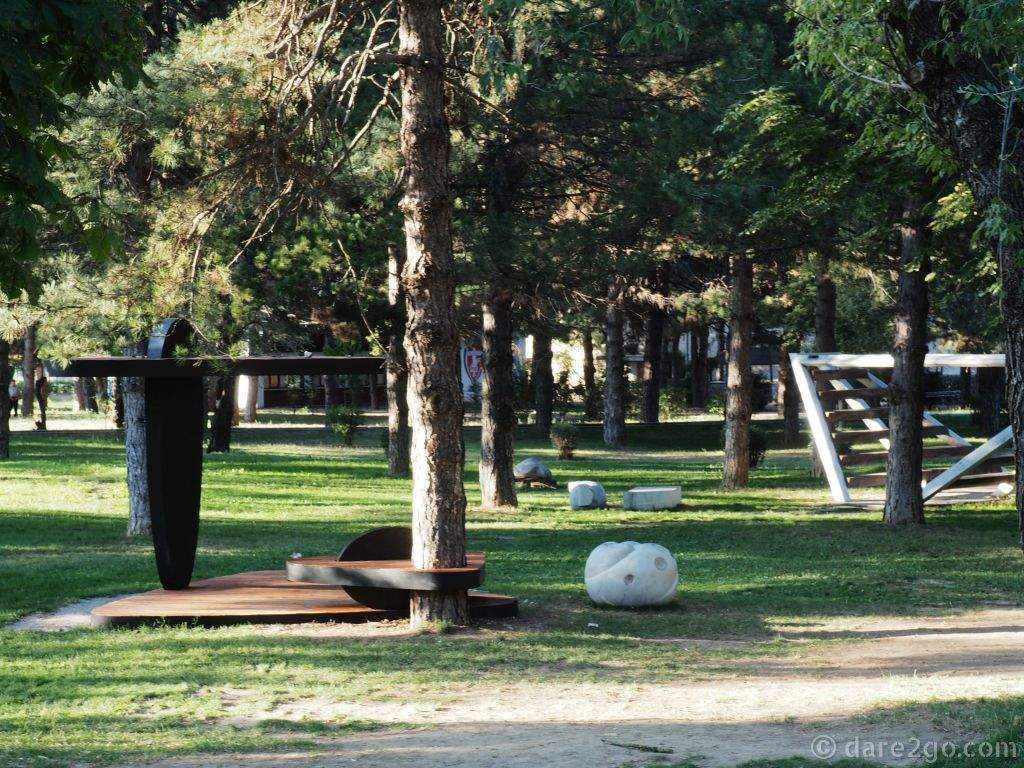
Next to the row of sculptures are more art objects placed onto the grass under the shady trees.
The Facade of the Andon Zako Çajupi Theatre
This is reportedly one of the best theatres in Albania. The Andon Zako Çajupi Theatre was built in 1950 and recently renovated, when a modern front was added. This facade is fairly minimalist and at the same time absolutely fitting for a theatre.
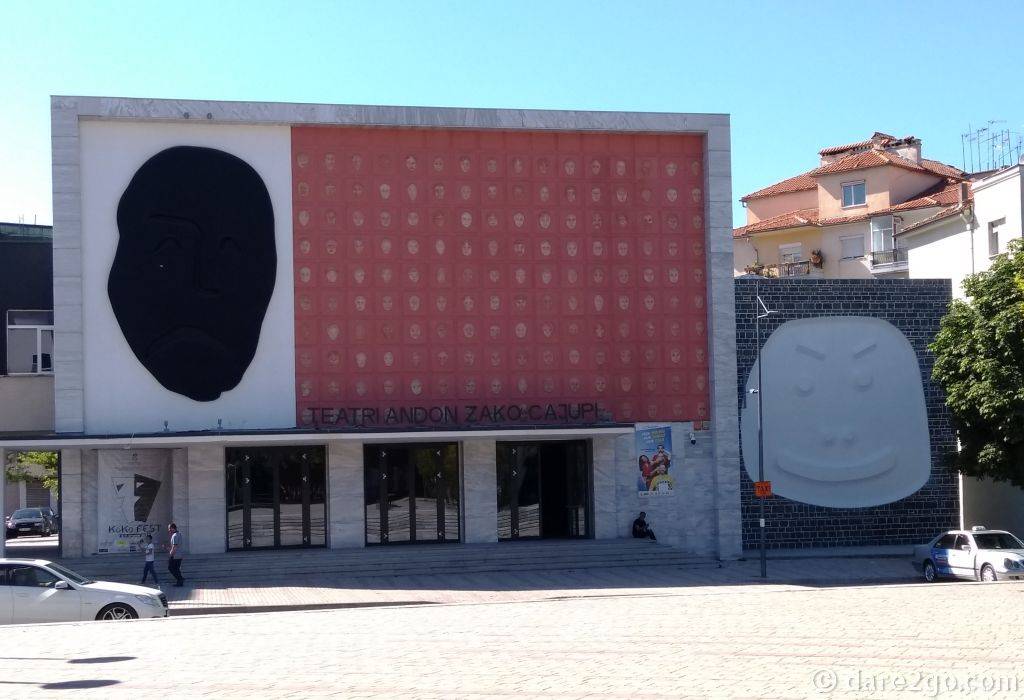
The Facade of the Andon Zako Çajupi Theatre: on the left the sad face in black, in the centre the collection of clay masks, on the right the happy face in white.
To the left and right you will see modernist interpretations of the sad face and the laughing face – symbolic for stage performances. The middle has rows and rows of large clay masks in various expressions of characters in plays.
ORIENTATION: opposite the theatre you will find the city’s small tourist information office and the tall Panoramic Red Tower, which you can climb to get an excellent view across the roofs of the city.
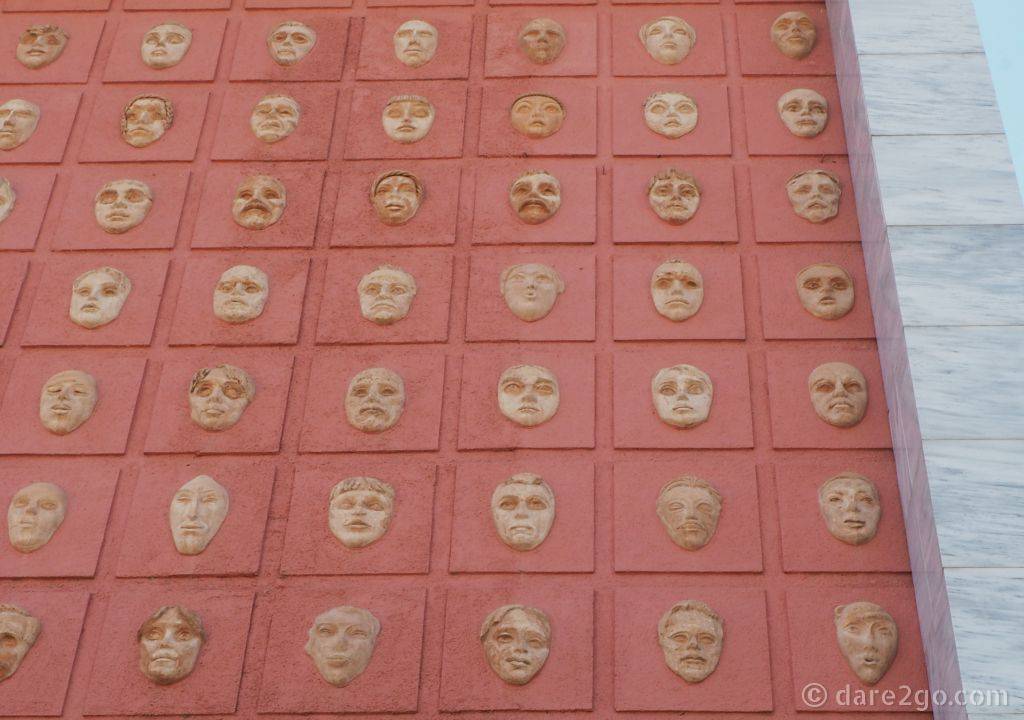
These clay masks, covering the larger middle section of the theatre’s facade, are amazing – study the individual expressions and you’ll understand why they belong on this facade.
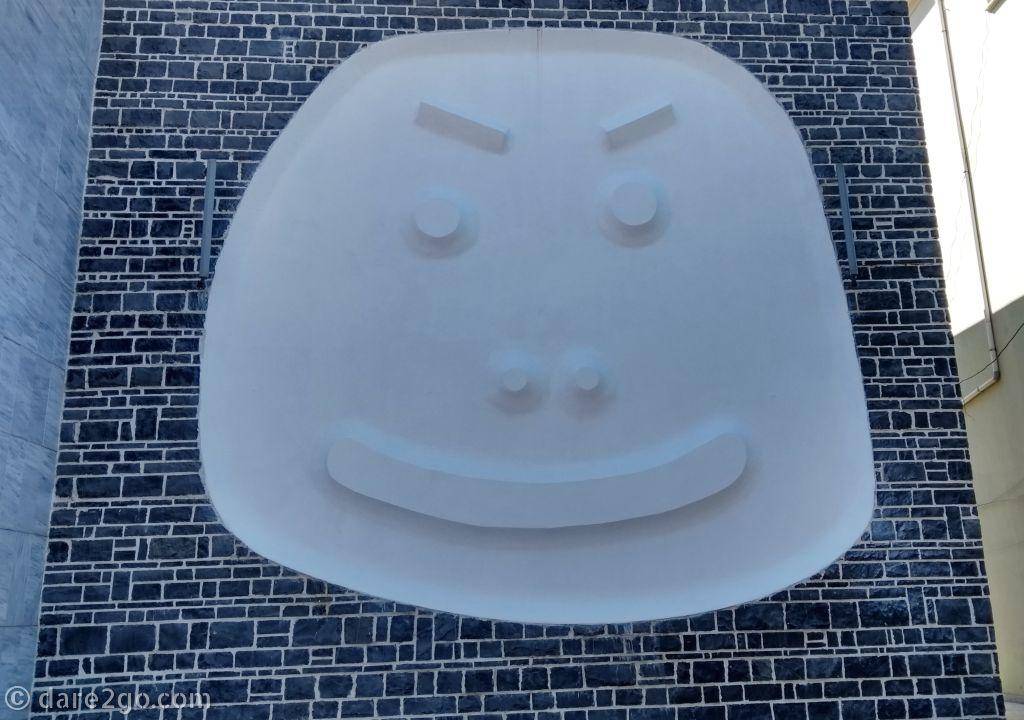
The happy face on the facade of the theatre.
Sculptures, both Modern and Classic Socialist Style
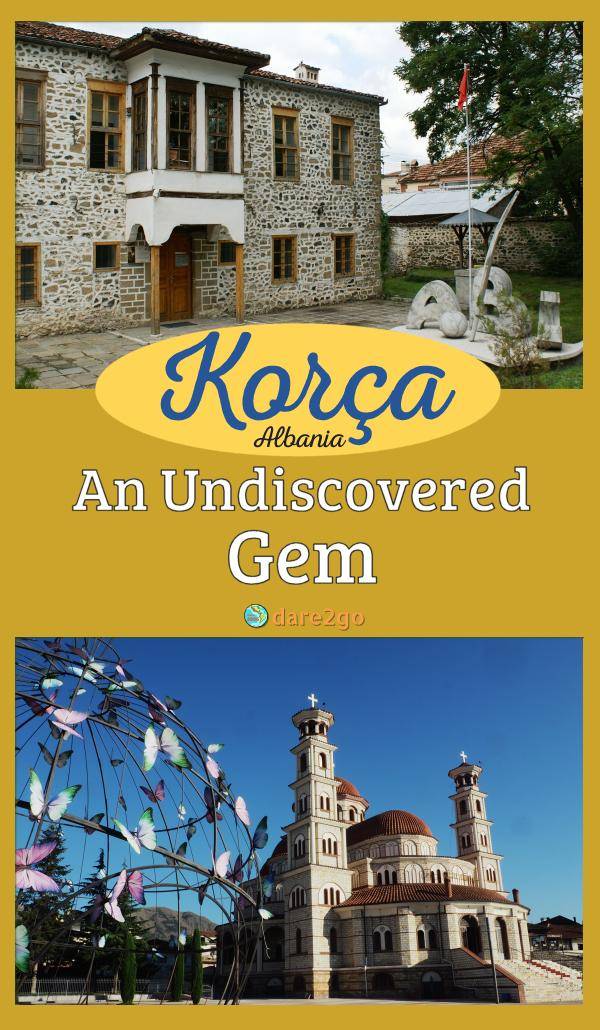
You will encounter public art in other parts of the city. Besides the typically stark monuments of the socialist past, like the Skanderbeg statue at the stadium, you will find some modern pieces of surprising lightness, like the butterfly covered globe in front of the orthodox Resurrection Cathedral.
The Old Sits Comfortably Next to the New
Some sights, like the aforementioned Panoramic Red Tower, are entirely bold and modern. Not far away, on one side is the Historic Ottoman Bazaar and the Mirahori Mosque; on the other side, the feudal mansions along Boulevard Republica. In between, you pass some unaesthetic, functional residential blocks from the socialist past.
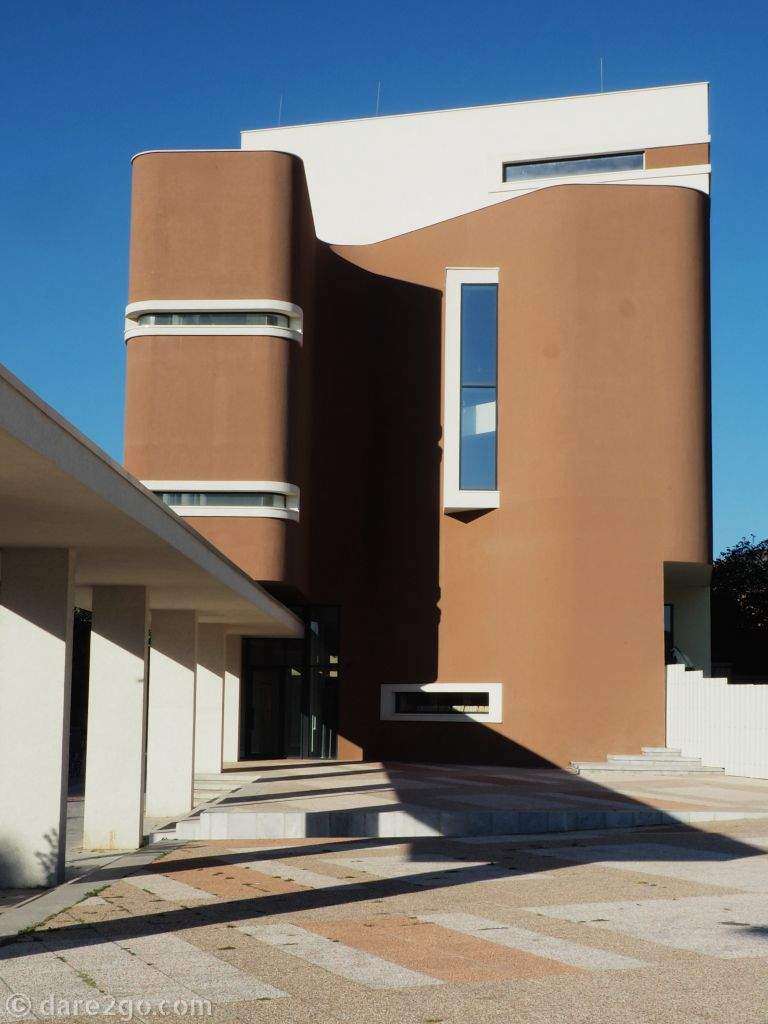
This modern facade (is it a cinema? we are not sure) next to the cathedral caught our eye.
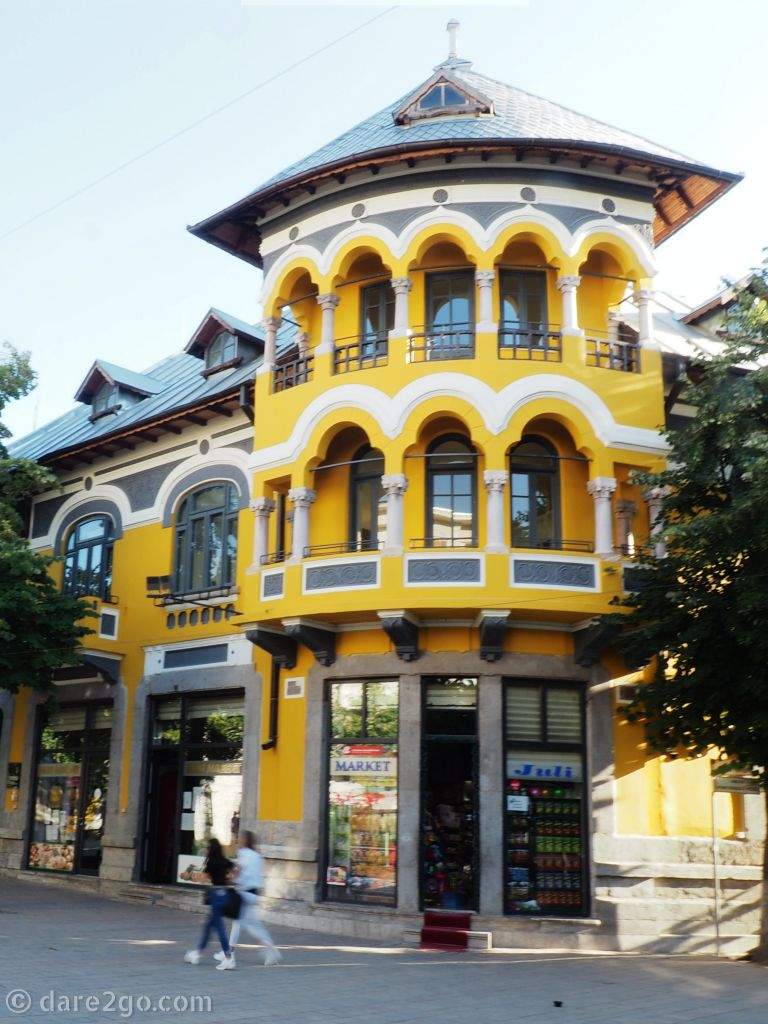
The distinct facade of the Gjon Mili Museum in the pedestrian zone.
Somehow in Korça, it all melds together into a pleasant urban web, connected by tree-lined streets and many open, green spaces.
The Restored Ottoman Bazaar
We have been to many towns and cities in the Balkans that try to preserve their historic bazaar area. These typically consist of tiny houses with basement shops, lining one narrow lane after the other, all laid out in patterns you can get lost in.
Whilst in years gone by, these bazaars had been buzzing with activity, hosting small specialised craftspeople and traders, they somehow don’t seem to fit into today’s life with industrialised, mass-produced goods and large shopping centres. So the old bazaars decline and the ramshackle old buildings deteriorate.
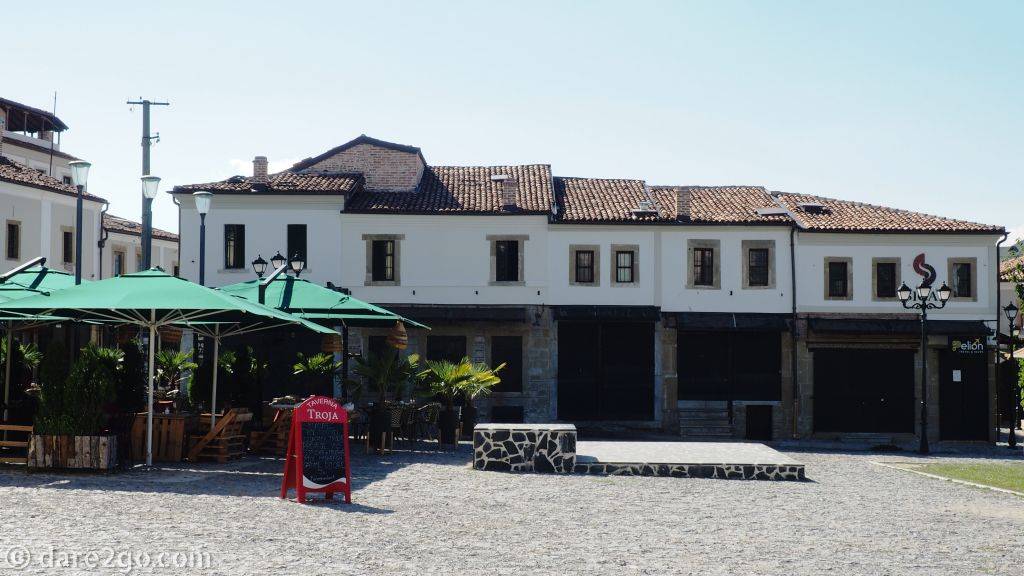
The completely restored old bazaar of Korça is now a new home to several restaurants with outdoor seating.
The city of Korça recently tried to halt this trend and has spent over 4 million Euros to restore the buildings and modernise the surrounds – in an effort to revive this section of town that’s so conveniently close to the city centre.
Now the bazaar is a lovely spot to have a drink or a meal in one of the many bars and restaurants. One thing we noticed though: there need to be more small shops in the bazaar area to make it more lively. But they might come once tourism picks up.
The Mirahori Mosque and the Old Clock Tower
The two oldest structures of Korça stand side-by-side, not far from the Historic Bazaar.
The small Mirahori Mosque was built in 1494-96 by the city’s founder Iljaz Bey Mirahori (also known as Iljaz Hoxha). Its minaret, demolished during the communist era, was rebuilt in 2014.
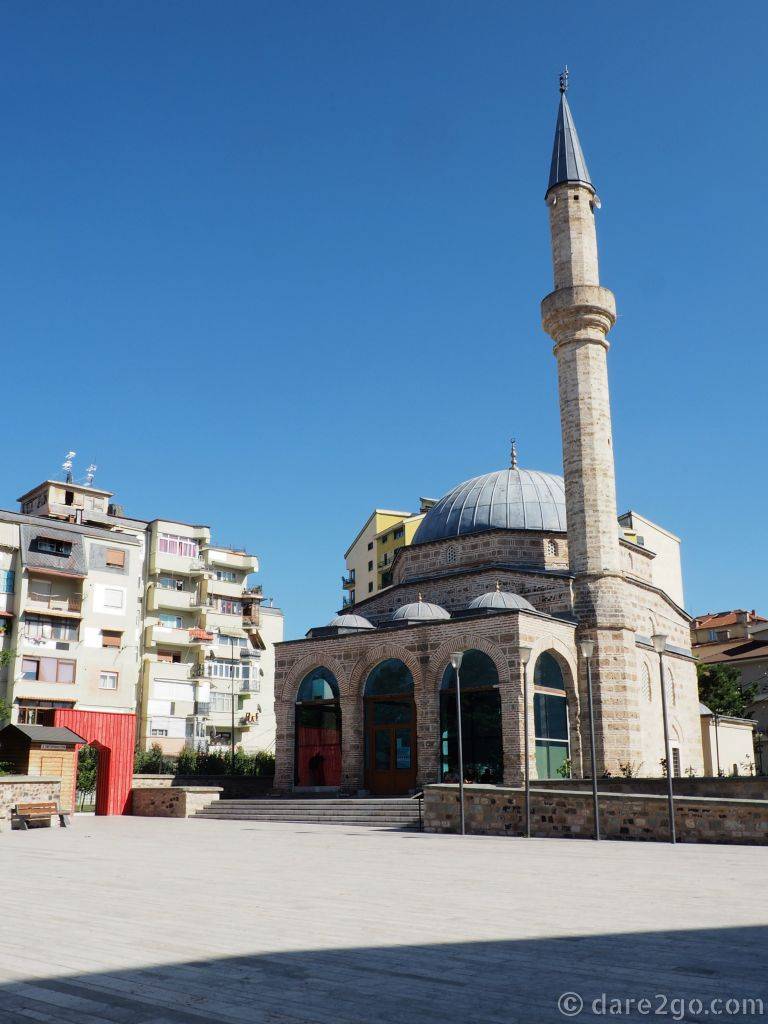
The small historic Mirahori Mosque was built in 1494-96.
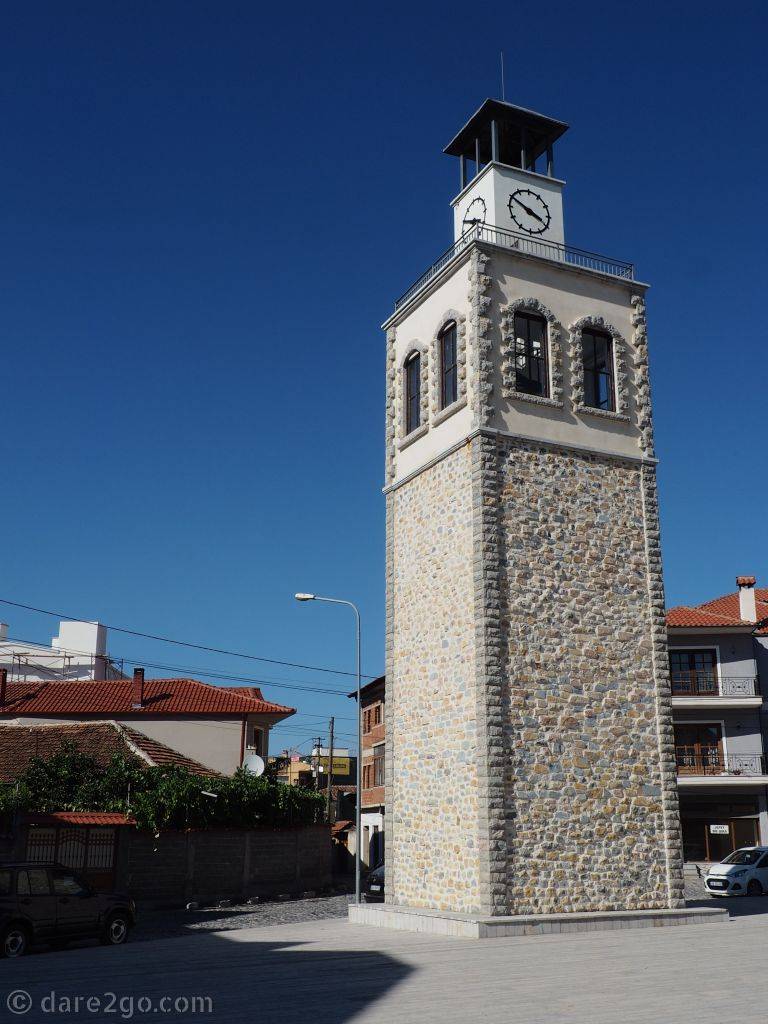
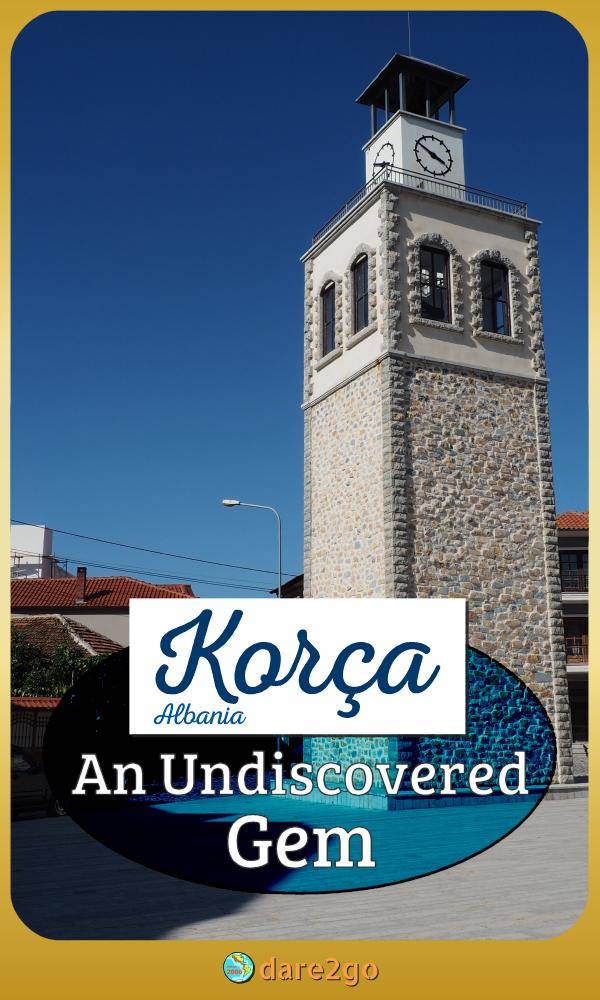
The Ottoman clock tower opposite the Mirahori Mosque.
It seems that every Ottoman town or city needs a clock tower. In Korça this stands right opposite the mosque, at the other end of the small square.
Stroll through the Shops along Boulevard Republica
From the style of many buildings Boulevard Republica must have once been the best address in Korça, probably home to the city’s wealthiest merchants. Now many of the former mansions have been converted into up-market (for Albania) speciality shops and restaurants.
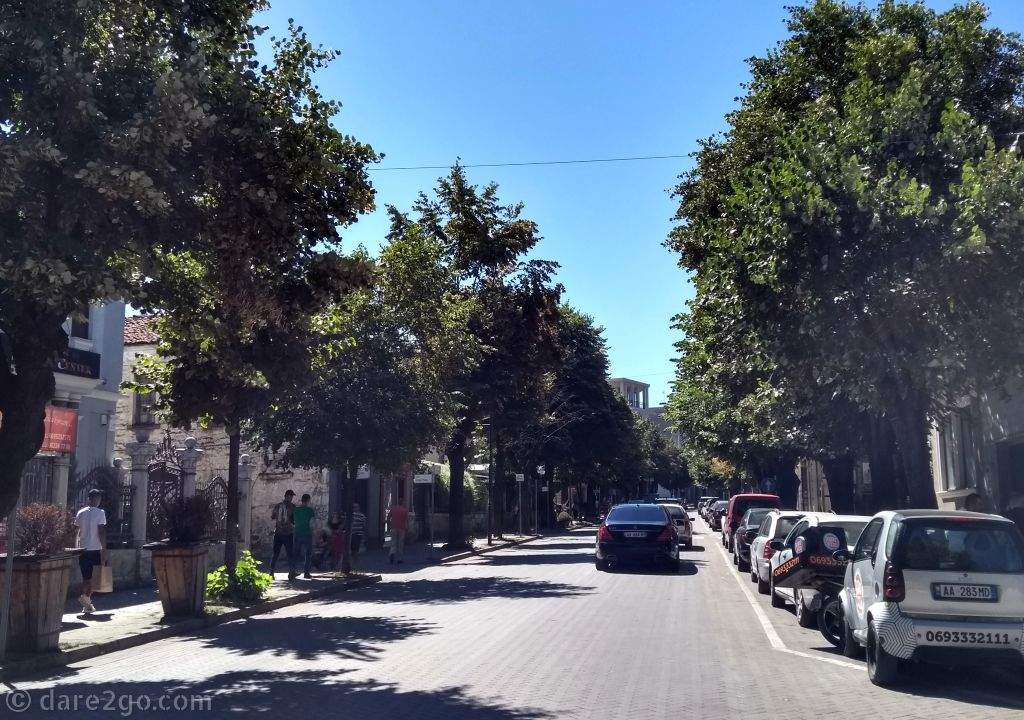
The tree-lined Boulevard Republica is one of the main shopping streets with more upmarket shops.
This boulevard, like many others, is lined with mature trees on both sides and makes for a lovely shaded walk – except for the almost constant traffic at certain times of the day. Boulevard Republica begins right in front of the Resurrection Cathedral.
The Resurrection Cathedral
The Resurrection Cathedral is probably the most prominent building in the city. A small pedestrian zone, lined with coffee shops and retailers, leads up to it. It’s an imposing structure, built by Greece in 1995, and covering part of a large open space. Since the communist banned all religion, the city’s old cathedral was demolished in 1968.
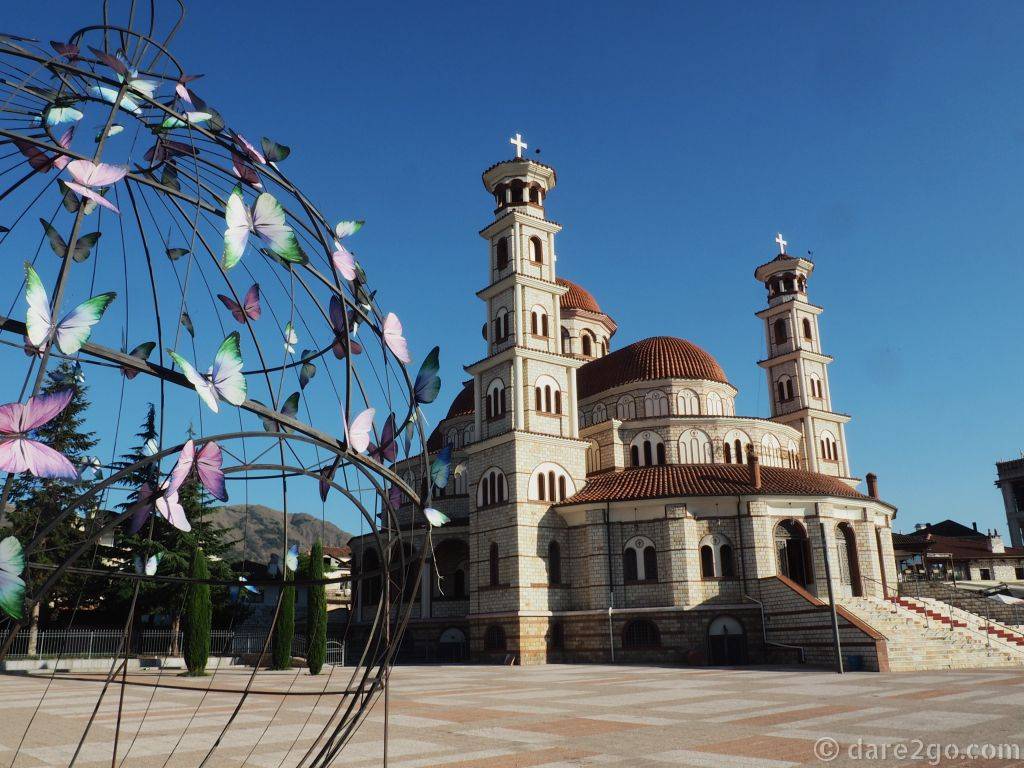
The Resurrection Cathedral with another public art piece in the foreground: a wire globe covered in colourful butterflies.
Museums to See in Korça
Korça is also known as the “city of museums”. When we visited, some were closed for Covid-19, one was closed for renovations, and two we didn’t know about. Below is a list to help with your personal choices.
National Museum of Medieval Art
The importance of this museum is highlighted by its classification as a “National Museum”. It houses a large collection of outstanding religious icons, precious books, and other medieval artefacts. The National Museum of Medieval Art is on Fan Noli Boulevard in the south-east of the city, opposite the large hospital complex.
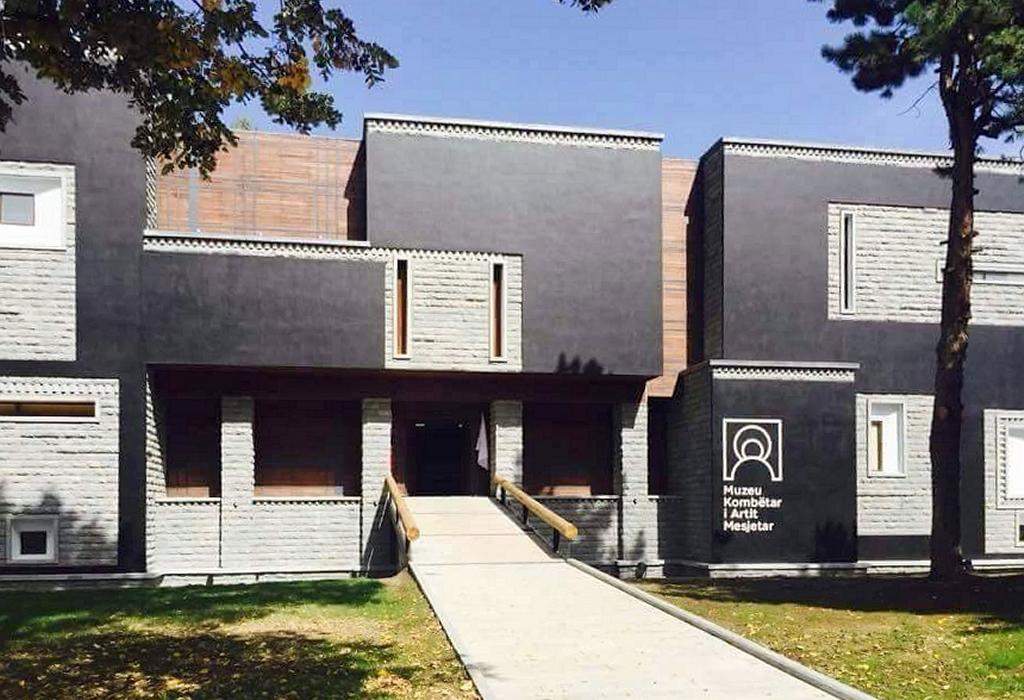
The modern facade of the National Museum of Medieval Art in Korca. [photo credit ]
The Bratko Museum of Oriental Art
The latest addition to the museums of Korça is the Bratko Museum of Oriental Art. This contemporary interpretation of Japanese influenced architecture houses the donated Asian collection of Gjergj Dhimitër Mborja, who was born in the city and is considered Albania’s most acclaimed photographer.
If our guidebook had told us about the Bratko Museum we would have visited it. It’s located on Fan Noli Boulevard, only a few houses down from the National Museum of Medieval Art.
The National Archaeological Museum
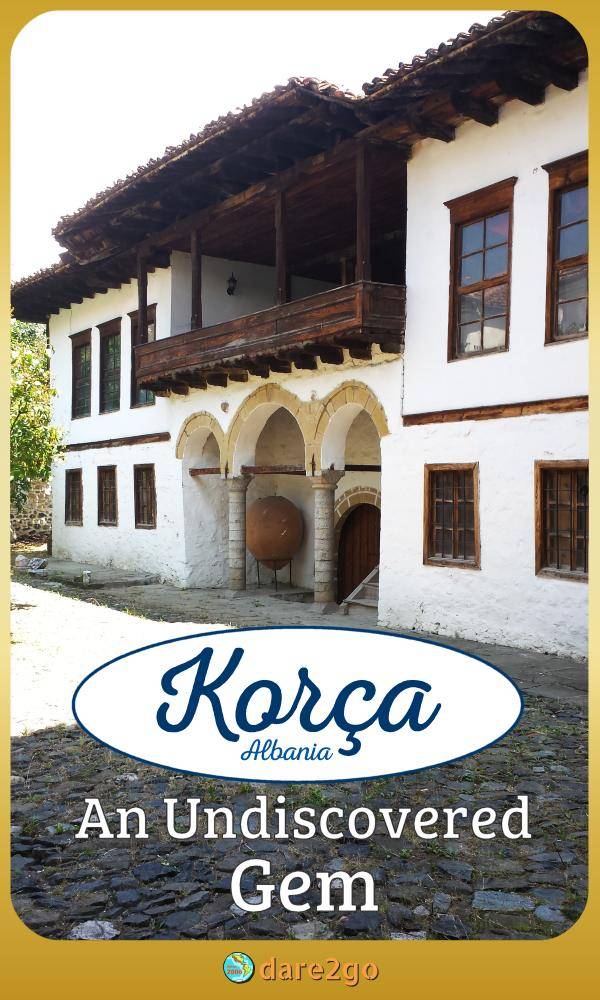
This museum, located behind the Resurrection Cathedral, is housed in an 18th century Albanian guest house of traditional stone architecture. It displays around 1200 artefacts, mainly from the Prehistoric period.
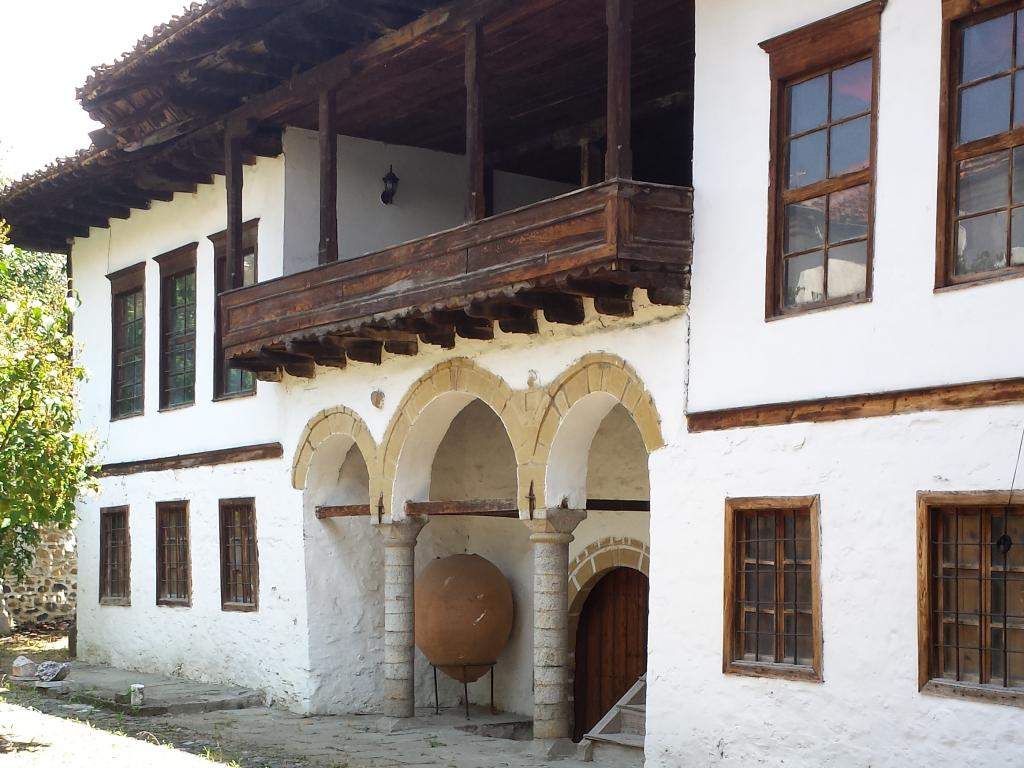
The National Archaeological Museum is housed in a converted historic Albanian guest house. [photo credit ]
Gjon Mili Museum of Photography
If you are interested in black-and-white photography you might want to visit the Gjon Mili Museum of Photography . Born in Korça in 1904, Gjon Mili became an accomplished photographer in the United States.
This exhibition is on the first floor of a distinctive yellow-painted house in the pedestrian zone of Boulevard Shën Gjergji (please see our photo further up!).
First Albanian School & Museum of Education
This lovely traditional Albanian house, which is opposite the aforementioned Gjon Mili Exhibition, was the first Albanian Language School after independence from the Ottomans. It was closed for renovations when we were in Korça.
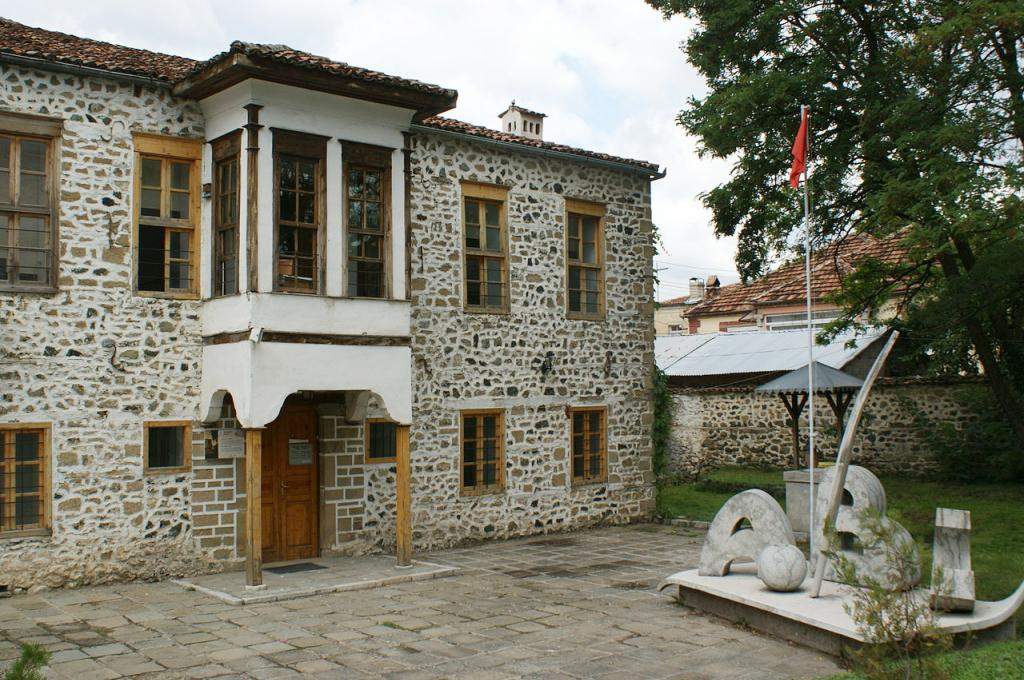
The first Albanian Language School in Korça is of historic importance to the young country, as it marked the end of Ottoman rule. [photo credit ]
The Vangjush Mio House
Another acclaimed Albanian artist is the landscape painter Vangjush Mio , who was born in Korça in 1891. In 1945, a collection of his works was set up for display in a lovingly restored traditional house, right behind the cathedral.
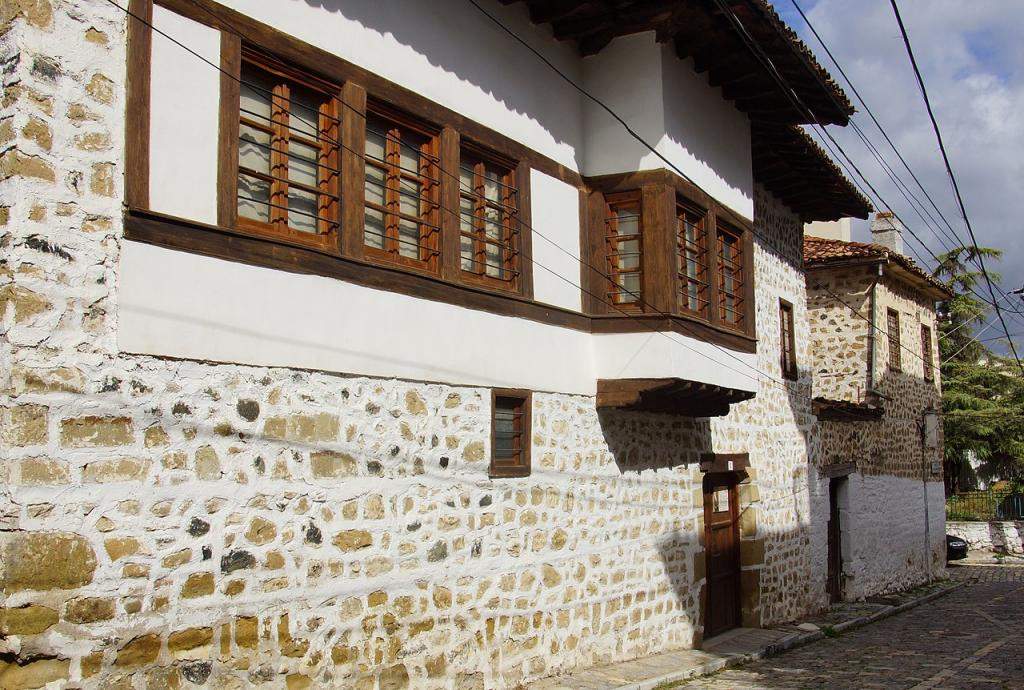
The Vangjush Mio Exhibition of landscapre paintings is in one of the historic buildings behind the cathedral. [photo credit ]
How to Get to Korça?
Now, that we have sparked your interest in visiting this lovely city, you want to know how to get to it. Korça is located in the south-western inland corner of Albania, not far from Greece and North Macedonia.
By Road
We drove to Korça from Podgradec on Lake Ohrid. It’s a good road of about 40 kilometres in distance – an easy drive along a fertile plateau. From Tirana to Korça is around 160 kms via some winding mountain roads. To the coast, you face a drive of at least 240 kms as there aren’t any connections in a straight line. The Albanian road network is constantly being upgraded and extended.
By Air
At the time of writing, Korça doesn’t have a serviceable airport – although one is currently under construction.
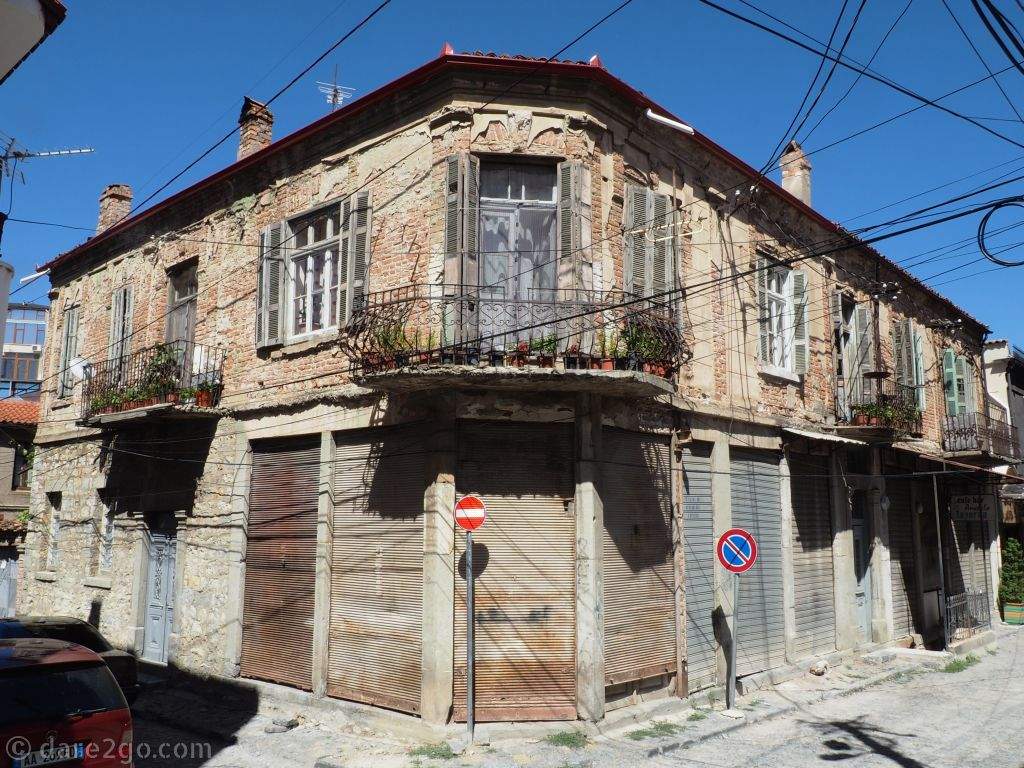
Not all of Korça is attractive. In many side streets, you still find old crumbling buildings like this, showing years of neglect under communist rule.
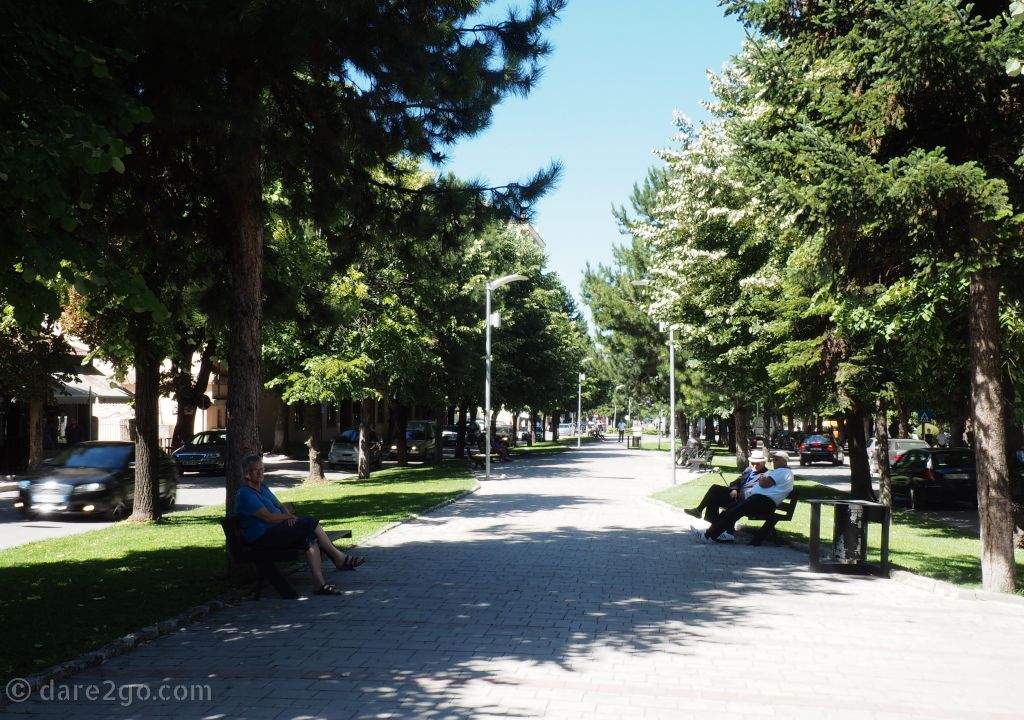
There are many green places in Korca, including this extra-wide median strip, which invites people to take a rest in the sun or the shade.
Explore the Ancient City of Butrint in Albania
An Extensive Road Trip through Bosnia and Herzegovina
What to see near Korça?
As mentioned above: Lake Ohrid is not far from Korça. If you’re at the lake it’s a short hop into North Macedonia. To the west of Korça you find the large Prespa National Park, a thickly forested, mountainous region for hiking and camping. Part of this park is a designated UNESCO World Biosphere Reserve. The park borders onto Lake Prespa, the highest tectonic lake in the Balkans, which is shared between Albania, Greece and Macedonia. Pustec is the only settlement of any size inside the National Park. Reportedly, there are several interesting cave churches around Pustec.
Will You Visit Korça?
A final incentive to make your mouth water: Birra Korça is known all across the country as the best beer of Albania. Founded in 1928, it’s the country’s oldest brewery. Still, in its historical location, the brewery can be found around 350 metres past the National Museum of Medieval Art at the edge of town. Their beer garden is a nice spot for lunch. In August the city holds an annual beer festival (expect the otherwise calm city to be much busier!).
Because we were so impressed by this small Albanian city we are curious to know if you have heard of Korça, or even visited it?
Please tell us more in the comments below.
Please share this post on Pinterest to show your friends or to remember for later: