A New Look at Paraná, Brazil after 8 Years
In December 2008, we made our first visit to Brazil. We came from Paraguay to visit Iguazu Falls. From there we drove across country through the state of Paraná to the Atlantic coast in just 2 days. It’s around 750Km.
This time we entered Brazil from Uruguay and are making our way up the coast, with many detours into the mountains that follow it. We have revisited places we went to in 2008, and also discovered new places that we had bypassed last time.

A model of the MON in Curitiba: this shows more clearly the proportions of the ‘eye’ in relation to the long flat main building behind. The ‘white tunnel’ connects the two under the water basin.
In this post you will read about the places in the east of Paraná we have either seen for the first time, or revisited and looked at with new eyes.
Curitiba
In 2008, we had planned to find a particular campground on the outskirts of Curitiba, and spend a couple of days exploring the city. Unfortunately, we couldn’t find the campground, and continued on to Paranaguá.
This time we were determined to visit the city, thanks partly to Michael Palin and his book ‘Brazil’ . In it he describes the Oscar Niemeyer Museum, and that sparked our interest in seeing it. The museum is named after its architect, who was responsible for much of the public building design in Brasilia, and many striking buildings in other parts of Brazil and internationally [The Guardian Gallery Post].

The centre piece of the Museu Oscar Niemeyer (shortened to MON) in Curitiba: the eye. Photo taken in heavy rain… Inside the eye are 2 floors of exhibition space and service rooms.
The gallery building didn’t disappoint. It should be on anyone’s ‘must see’ list if visiting Curitiba. It has 3 levels connected by wide ramps. The ground floor has a lot of open space, the ticket office, a café, and the requisite souvenir shop.
The first floor has 9 galleries which hold temporary exhibitions, some of which are marked as ‘open-ended’. Unfortunately, several of the galleries were closed to install new exhibitions.
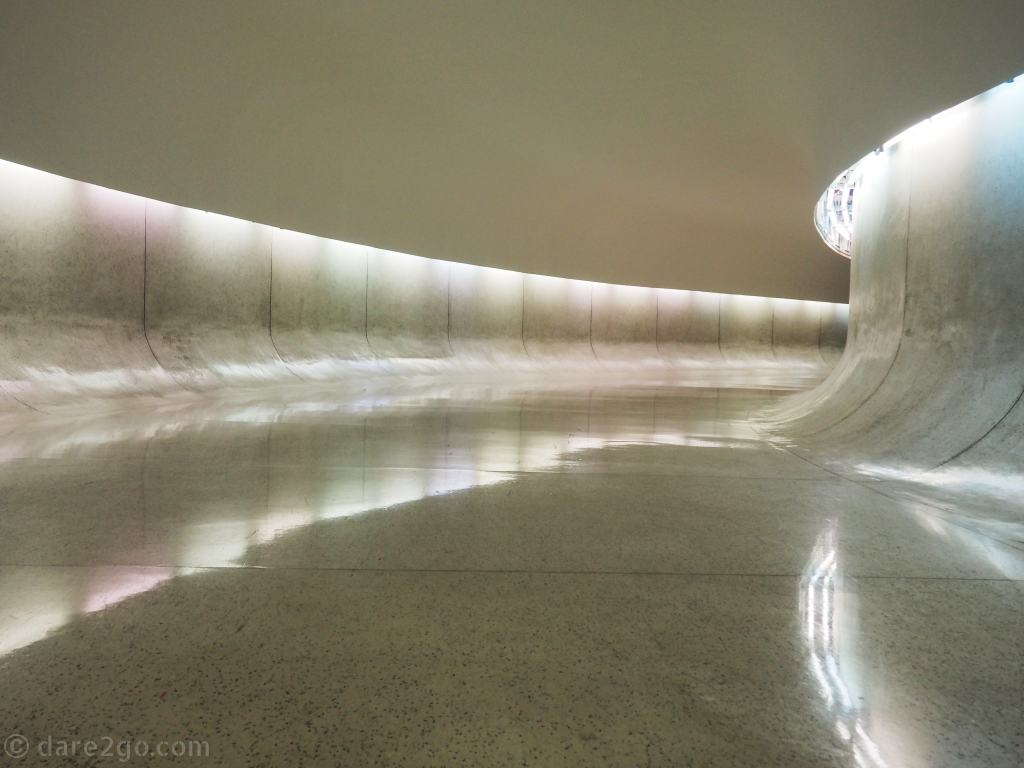
On the subterranean level there are permanent exhibitions of Oscar Niemeyer’s work, and access to a sculpture patio. From there you walk through a disorientating tunnel, which must be experienced to be believed, to take an elevator to ‘The Eye’.
‘The Eye’ is the striking tower, which stands alongside the unobtrusive museum building. This gallery is full of strange works of art, whose goal seems to be to continue the disorientation that started in the tunnel. I must admit that some of the pieces left me faintly nauseous because of the way they affected my senses. But this is not a reason to avoid it – this gallery is the most impressive in the museum.
-
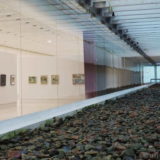
- Museu Oscar Niemeyer (MON) in Curitiba: a tunnel with a slatted roof allows filtered daylight into some of the exhibition spaces.

-
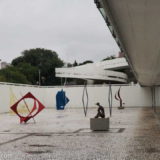
- Museu Oscar Niemeyer (MON) in Curitiba: the sculpture patio in rain.

-
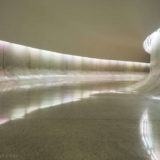
- Museu Oscar Niemeyer (MON) in Curitiba: the all white tunnel connecting the main building to the eye.
-
- Museu Oscar Niemeyer (MON) in Curitiba: the first exhibit inside the eye. Static and moving mirrors play with the visitors’ perception of space.

The city of Curitiba is also notable because of it’s urban planning.
Today, while Brasília is viewed as a white elephant city, Curitiba has become the gold standard in sustainable urban planning: variously the “green capital”, the “greenest city on Earth”, and the “most innovative city in the world”.
Source: The Guardian
There are green spaces everywhere, but it wasn’t easy to find a level place to park in them because of the up and down nature of the landscape. And the public transport system with dedicated bus lanes on major arterials is very impressive.

We’ve never seen buses as long as these ones in Curitiba. Specially designed bus lanes, where traffic usually moves more quickly than on the road lanes beside it, ensure a network of efficient public transport.
We spent a short time on a Sunday in the city centre – it’s the only day we like to drive Berta into a city of this size. There are some nice old colonial buildings, and some evidence of German influence here – yet again. But it’s still a city of almost 2 million people, so not really a place that we would normally spend a lot of time.

Everywhere we visit in Brazil we find strong evidence of German migration, like this “Berlin Bär Imbiss” in the historic centre of Curitiba.

Morretes is a tourist town with many eateries, shops, and street stalls.
Morretes
When we left Curitiba this time, we didn’t drive on to Paranaguá. Instead, we left the highway and drove directly to Morretes. It’s a small, pretty town set along both sides of the Rio Nhundiaquara. In the historic centre along the river, there are a lot of well preserved or restored colonial buildings, and lots of shady trees and places to sit while watching the world go by.
It’s a tourist town and therefore has a lot of restaurants and coffee shops, as well as stalls selling locally produced items. Since we arrived on ‘Corpus Christi’, which is a major holiday in Brazil, there were many tourists around on that weekend.
We just caught the end of a procession through the streets to mark this important day on the church calendar. There were colourful carpet squares marking the route and flower petals strewn between them. The streets were closed to traffic, but the cleanup crew worked so close behind the procession that they were open again in a very short time, to allow for the influx of traffic bringing the lunch crowd to the restaurants.

Morretes: we arrived just in time to see the end of the Corpus Cristi procession – we loved the art on the colourful carpet mats.
Even so, the town is very pedestrian friendly and we enjoyed wandering around it. We stopped in a coffee shop where we were served coffee and home-made cake by the Japanese couple who owned it. Last time we had stayed in a campground run by Japanese. We knew that Japanese were a significant part of the migrant heritage of Brazil, but this is the first area we have visited where we noticed their presence.
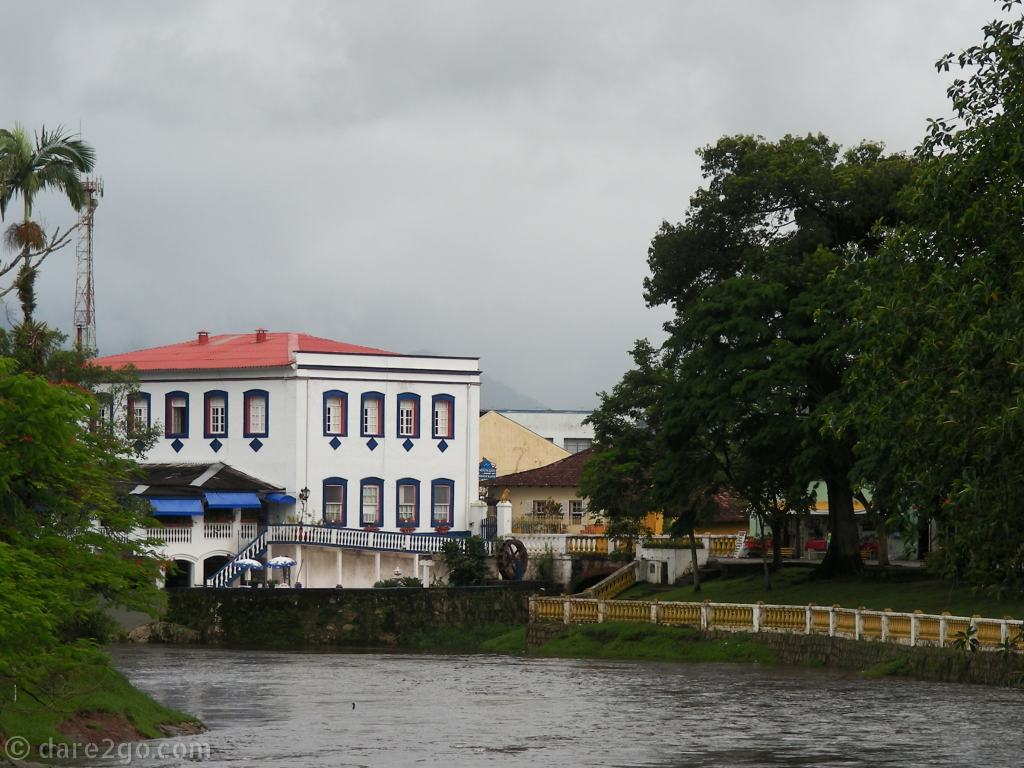
Morretes 2008: Rio Nhundiaquara divides the town, the photo 2016 was taken from under the trees on the far right.

Morretes 2016: one of our rare sunny afternoons by the river. Not much has changed in town since our last visit – and that’s what we love it for!

One of the many restaurants in Morretes. I loved the collage of old one-off tiles on the corner of the building.

Pin this for later reading!

A few of the old houses in Antonina have been lovingly restored, others succumb to black mildew and slow decay.
Antonina
This colonial town is 14Km from Morretes, on the ocean. We had also visited it in 2008, so we decided to retrace our steps. In comparison to Morretes, Antonina appears to be a bit run down and not so well cared for. For example, the railway station is a majestic building that has a heritage order, but is in such bad repair that it won’t be long before it’s a ruin, like so many others in the town. Our photo from 2008 shows it in much better condition.
In between though, there are some nicely restored colonial buildings – some of them we had photographed on our last visit and, coincidentally, photographed again.

Antonina in 2008: the beautiful train station from the early nineteen hundreds was still used as an arts centre and looked well cared for.
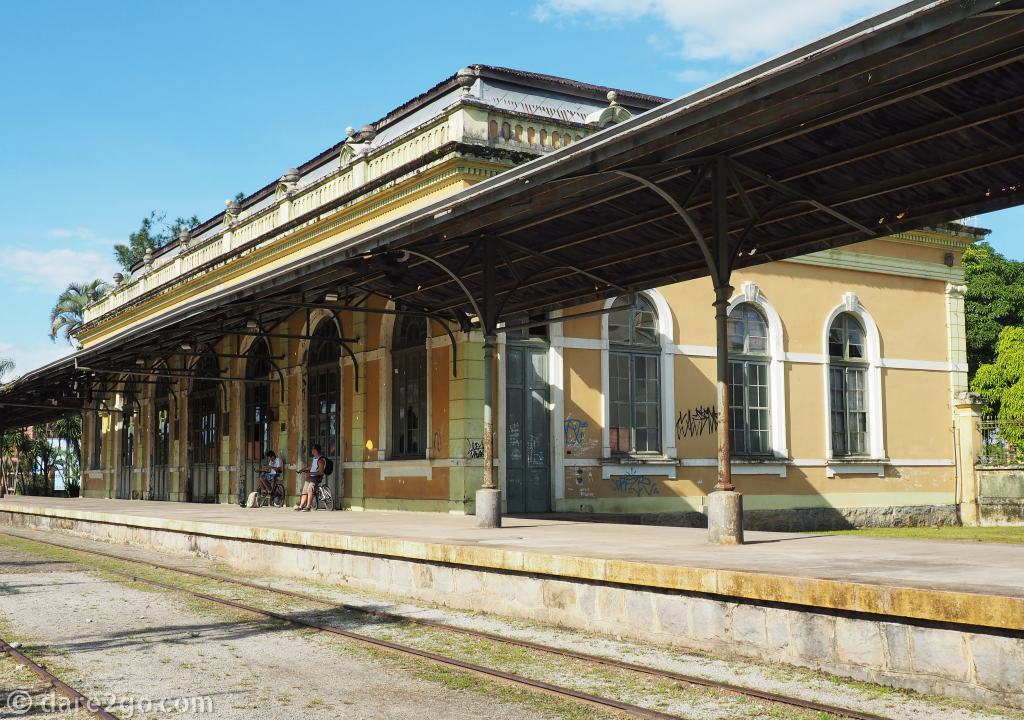
Antonina in 2016: the beautiful train station from the early nineteen hundreds is now slowly deteriorating. Windows are broken, the roof is leaking, the wrought iron is rusting.

Antonina: this beautiful shop facade with the red painted trim really caught our eye in 2008. The window decoration was so typically Brazilian.

Compared to 2008 the building now looks very bland with the off-white concrete. Is there a connection to the colour choice that the shop now, in 2016, seems to be closed for good?
Another thing, which made it unpleasant for us, were the groups of drunks we encountered in two separate parks that we had parked next to. They were not people just out having a good time – they harassed us for money and cursed us when we refused.
We left and drove back to Morretes – it has a much more pleasant feel to it.

Our overnight place, under dense tropical foliage and hundreds of wild brommeliads, along the ‘Estrada da Graciosa’.
Estrada da Graciosa
This road is an alternative route between the coast and Curitiba. It has signs leading up to it that trucks can’t use this road, so Berta put on her motorhome disguise and we did it – again. In 2008 we drove this road, but only part way because we needed to move south. This time we were continuing north so we drove the whole length of it.
It passes through the stunning scenery of Serra do Mar, which is covered with a remnant of the Atlantic Forest. Unfortunately, this time and last, the weather was not being kind. We drove mostly through low cloud, fog, and sometimes rain, so we missed the vistas that make this cobbled road such a favourite.

Driving the ‘Estrada da Graciosa’ twice. The road is famous for its views across dense tropical vegetation towards the sea. But what can you see in such mist, drizzle, and low cloud?
What we didn’t do
We didn’t go back to Paranaguá. While there are parts of that city that are also attractive, it is a port city and not so pleasant when you leave the historical centre.
There is a train from Curitiba to Morretes that also crosses the Serra do Mar, although a different part than the Estrada do Graciosa. Our Footprint South American Handbook says:
The railway journey is the most spectacular in Brazil. There are 13 tunnels and sudden views of deep gorges and high peaks and waterfalls as the train rumbles over dizzy bridges and viaducts.
If you take this trip, you can get out at a station called Marumbi to vist the Parque Nacional Marumbi, which is a UNESCO World Heritage Site and Biosphere Reserve.
We had attempted to visit this national park in 2008, but it was raining so hard that the tracks in the park were not passable. This time the weather was also against us, even though it was 7 months earlier in the year.
Maybe if we ever return to Paraná, we might have better luck… Third time lucky?

Michael Palin‘s book ‘Brazil’ . This beautiful book will convince you to go! BRAZIL is an almost timeless book, with brilliant full-page photographs, which was produced alongside a multi-part BBC television series. Michael Palin describes personal impressions from several trips to Brazil, in his typically light and humorous style…
Find Michael Palin‘s ‘Brazil’ on AMAZON ! [ Affiliate link – but you won’t pay a Cent more. Thank you for your support! ]


![The Industrial Revolution is an important part of the heritage of Wales. As diverse as they are, each site has a unique and often fascinating story to tell. [Photo shows the water balance tower of the Blaenavon Ironworks.]](https://dare2go.com/travel/wp-content/uploads/2018/12/Industrial-Heritage-Wales-featured-520x245.jpg)





It was interesting seeing the comparison shots and I hope you get to do the train trip next time because it sounds spectacular.
Thanks Jan – I’m not sure if we’ll retrace our steps in Parana again, but I would certainly recommend the train trip to anyone else who might be visiting the area.
You made me very curious about Brazil, Yasha. I’ve only been there shortly, when we crossed over from the Argentinian side of Iguazu Falls to visit an aviary. But from what you are describing Brazil deserves a serious exploration. Judging from your photos, this area of Brazil looks very much like Uruguay, doesn’t it? I’d love to go back to South America. It’s such an exciting continent.
Brazil is definitely worth visiting and we are pleased that you are inspired by our posts from here. Parana is not really like Uruguay at all. The forested mountains here are covered in lush, subtropical rain-forest. Uruguay seems to have little native forest, but lots of eucalypt and pine plantations. Curitiba is at almost 1000m altitude and the highest ‘mountain’ in Uruguay is just over 500. There is one similarity between the two countries though, and that is the friendliness of the people.
That aviary at Iguazu Falls is really something, isn’t it.
You guys have to be two of the most daring explorers I read. Love all your findings and seeing the world thru your photos. I had no idea how this part of Brazil looked.
Thanks Ruth. We always appreciate feedback. Maybe you are inspired to visit this part of Brazil.