The Vibrant Small Towns of Colombia’s Coffee Region
We travelled from Cali, north to Medellín, through Colombia’s coffee region. The Coffee Cultural Landscape of Colombia (Paisaje Cultural Cafetero Colombiano), is a UNESCO World Heritage site in the Central Andes. Although we passed through several larger cities, we really enjoyed our time spent in a number of the small towns of the coffee region. They are vibrant and very colourful.
The coffee farms are located on steep mountainsides at over 1000m, and are still farmed and picked mostly by hand. The vibrant, small towns are often situated on the top of hills, surrounded by the slopes filled with coffee trees. It makes for an interesting, if sometimes precarious, roadtrip through this landscape.

The small towns of Colombia’s coffee region are vibrant, and one of the reasons the Coffee Cultural Landscape of Colombia is a UNESCO World Heritage site. Apía is an fine example.
What you will find in this article:
Salento
Salento was our first small town in the coffee region, and we liked it so much that we stayed 10 days. We found a lovely spot to park at La Serrana Eco Farm and Hotel , where we met fellow overlanders in mobile homes, on motor bikes and bicycles, and also backpacking. It made for an interesting mix of stories around their individual experiences. Since La Serrana is outside of the town of Salento, the views of the surrounding countryside are quite impressive; and the garden is full of beautiful flowers.

Salento: the view from La Serrana was lovely – from farm fields in the foreground to a glacier topped mountain in the distance.

Salento: we met fellow overlanders at La Serrana. This old VW is really a classic camper.
It’s quite lovely to wander around the town of Salento. The colourfully painted colonial buildings are very happy-making. The taxi service for the town and surrounding areas uses Jeeps; they make quite a sight, lined up in the town plaza. On weekends, there are miniature replicas for kids. They hop into the driver’s seat and are pushed around the plaza.
Please click thumbnails below for a larger photo with description.
-
- Salento: If you want to go to a bar with friends, this billiard hall and bar is very interesting. They play an unusual game on tables with no pockets.

-
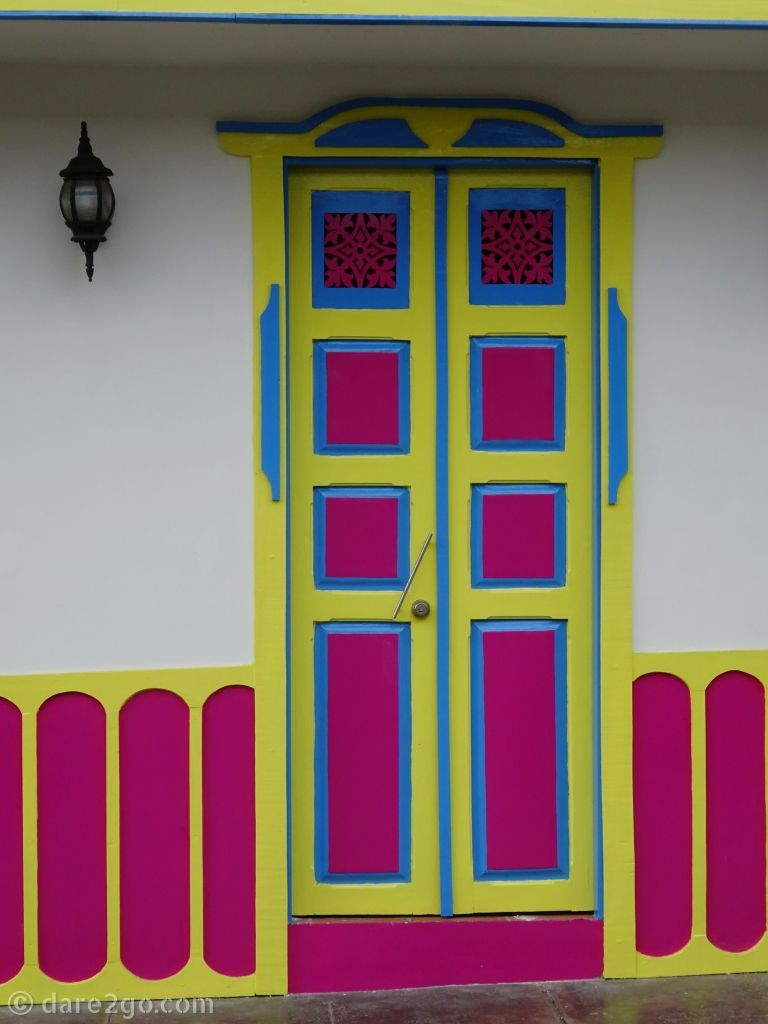
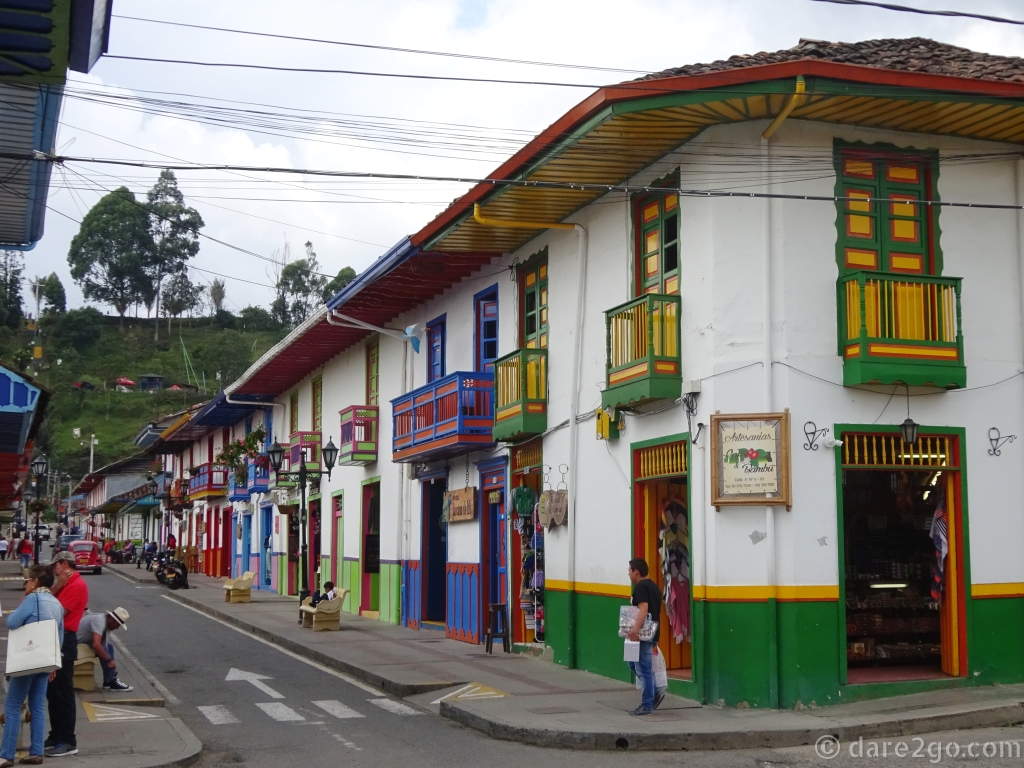
- Salento: the colonial buildings in this town are usually painted in at least 3 colours. It makes for a very happy feel as you wander around.
-
- Salento: one of the local residents surveying the scene from his second floor window.

-
- Salento: the balconies on the colourful colonial buildings add a lovely touch to this streetscape.
Salento is a popular tourist town – for international visitors and Colombians alike. The most important nearby site is the Corcora Valley, which is famous for the very tall Quindio Wax Palms, Colombia’s native tree. It is also possible to take excursions into the Parque Nacional Natural Los Nevados, where you will find snow-capped volcanoes, glaciers, lakes and forests. There are many birds, animals and plants (including the wax palms, but also the espeletia or frailejón – the strange endemic plant, related to sunflowers).

Salento: most visitors make an excursion to the Cocora Valley to see the Wax Palms.
Filandia
Filandia is a mere 21Km from Salento. Although not quite as touristed as her sister, she is every bit as beautiful. The colourful architecture is present, making it also a joy to wander around. We spent 3 quiet days parked on the outskirts of the town, exploring it a little more each day. One of the best things to do in these urban areas of the Coffee Cultural Landscape of Colombia, is to sit at a café around the plaza and drink a tinto – local coffee served in small cups, to which the locals add a load of sugar – and watch the world go by.

Filandia: this beautiful town plaza is accented by its lovely church.
Please click thumbnails below for a larger photo with description.
-
- Filandia: a typical streetscape in this lovely small town.

-
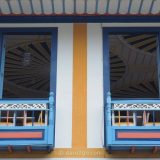
- Filandia: these balconies are eye-catching – but take a peak through the windows to see the intricate work on the wooden ceiling.

-
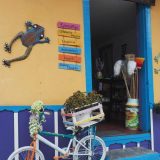
- Filandia: it’s not enough to paint the buildings in bright colours – they also decorate the shop fronts in creative and attractive ways.

-
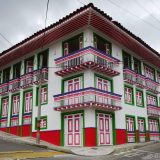
- Filandia: even new buildings stick to the original style in the small towns of Colombia’s coffee region.
Apía
After 2 weeks at around 2000m, we dropped down to La Virginia, and spent the night. This is not a part of the coffee region because, at just under 1000m, it is too low. The locals, who welcomed us in a very friendly manner, were quick to tell us that it is a sugar-cane town. The warm temperature was welcome, as we had often been too cold lately.
The next day we planned to visit the coffee town of Balboa, just 20Km away, most of it up a winding, mountain road. When we arrived, we found the streets just too narrow for Berta, with nowhere to park. So all we really saw of it were the distant views on the way up, and again on the way down. The scenery across the mountainsides, full of coffee trees interspersed with bananas and sugar cane, is just stunning. This was certainly compensation for what could have been a wasted trip.

Balboa: unfortunately this is the only photo we have of this small town perched on the side of a mountain.

Coffee Plantations: on the way to and from Balboa, we had views like this – coffee, bananas and trees.
So we drove on to Apía. All of these small towns of Colombia’s coffee region are in mountainous areas, so we never knew what to expect; would there be a level place, somewhere that we could park and spend the night?
When we arrived in Apía, we turned off the main road onto a street, which went up and up and up and then into a dead-end. Juergen had to reverse Berta into a side-street, which also went steeply uphill, to turn around. The streets are quite narrow: a local, painting the front of his house on the corner, kindly moved his ladder so that Berta could complete the turn. We then turned onto a street, which should lead us to the plaza – often the best bet to find a level spot.

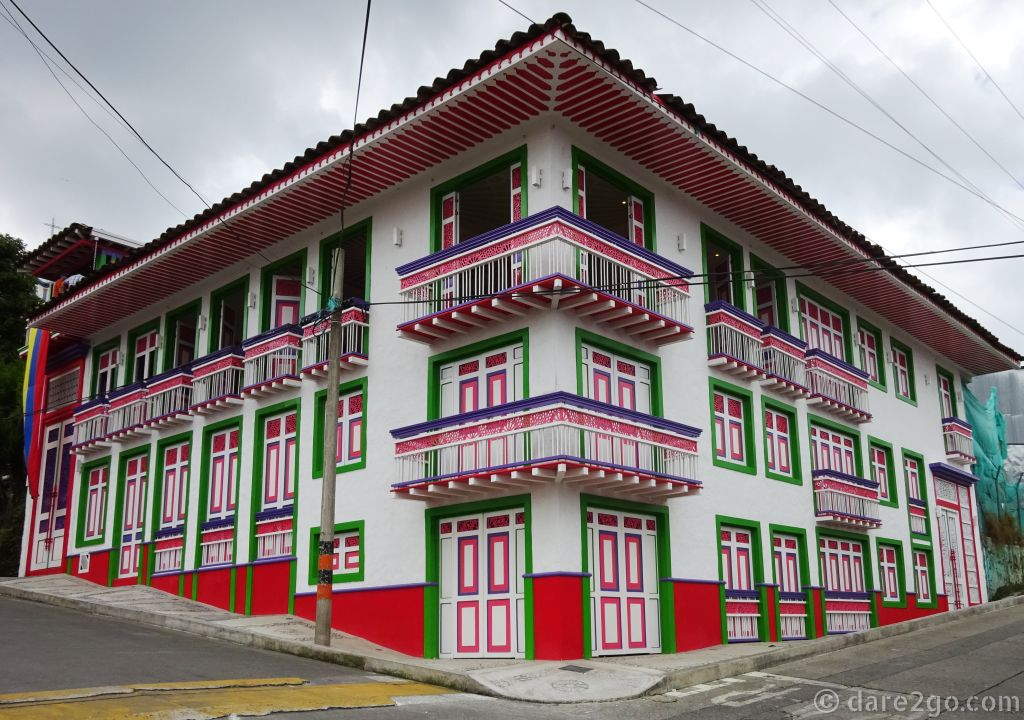
Apía: This colourful streetscape is a corner of the main plaza of this small town. Notice the platform in front of the shop? It shows how much slope there is on plaza.
Finally, we got onto the plaza to find that it was definitely on a lean. We stopped to work out what to do next. A friendly truck driver stopped next to us, and asked what we needed. I told him, a level place to sleep. He walked with me back to the cross street and pointed out a place at the bottom of the hill, where the street levelled out. So we drove down there, parked and stayed for a couple of nights, just a block from the plaza.
As you can see in our feature image at the top, Apia is not as consistently colourful as Filandia and Salento, but the intricacy of Apía’s carved wooden balconies, windows and doors was very impressive. We very much enjoyed wandering around this small town of Colombia’s coffee region from the convenient spot we were welcome to stay.
Santuario
We left Apía and retraced our steps a little in order to visit Santuario. After our experience with Balboa, we had hesitated to leave the main road and wind our way up another mountainside, only to find there was nowhere to park, let alone to sleep.
When we arrived, we were relieved to find it possible for trucks to park right on the plaza. Although, it wasn’t a place to sleep because this plaza also had quite a lean. But it did give us the opportunity to walk around the town. It has a different look again from the others – its balconies are very ornate and are painted to enhance the carving. We only needed an hour or so to visit the town centre, and were glad we had made the detour.
Please click thumbnails below for a larger photo with description.
-
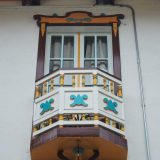
- Santuario: close-up of the balcony, showing the detail of the work.

-
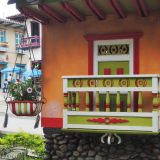
- Santuario: as decoration in the main plaza, they’ve put a replica of their intricate balconies.

-
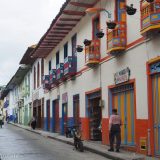
- Santurio: a typical streetscape of this small town.
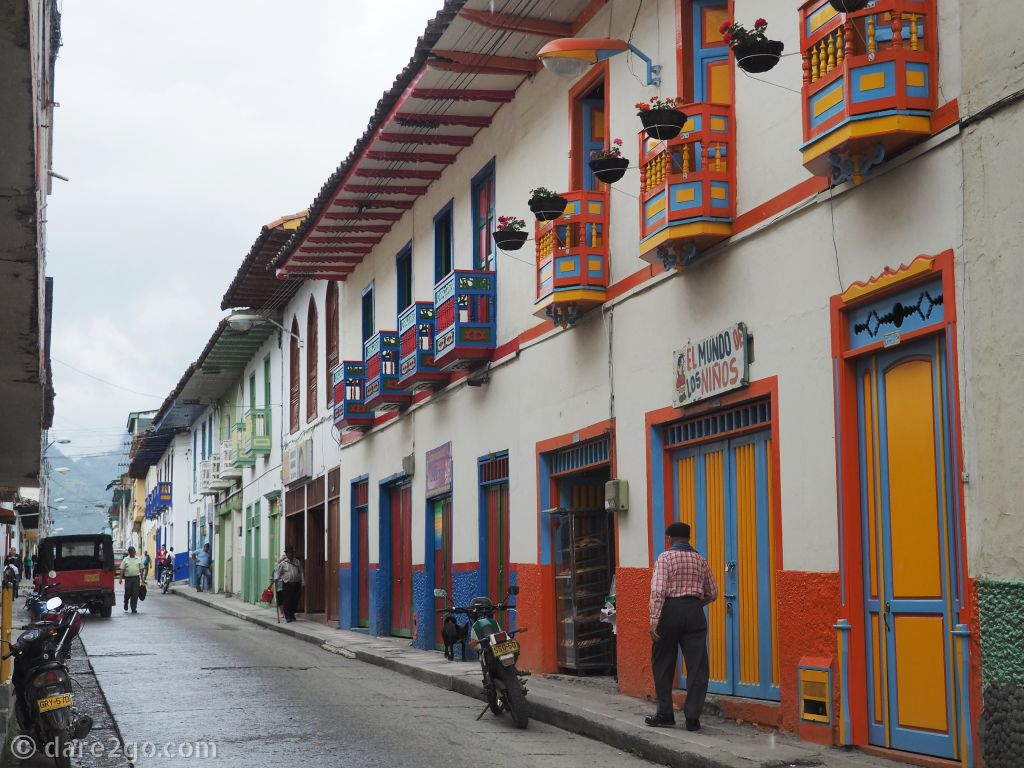
-
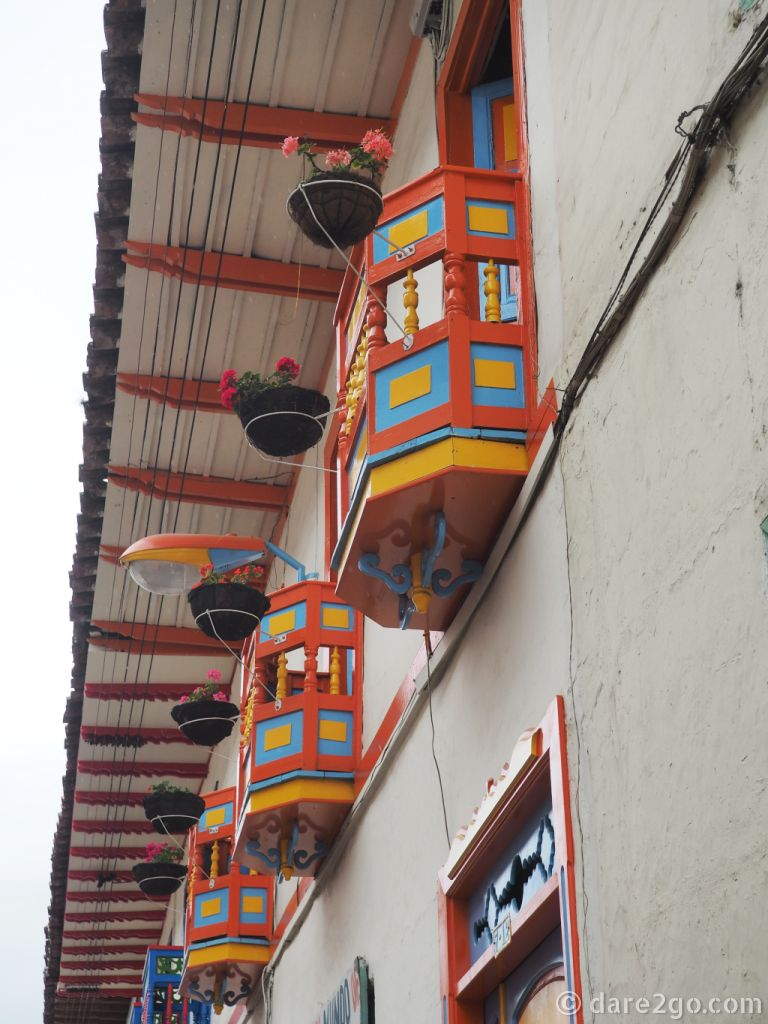
- Santuario: the balconies here have their own style. They have more detail than in some other towns, but we wondered if the decoration underneath served any other purpose…
We drove back to Apía and then continued on, via the back roads, to reach Chinchiná.
Chinchiná
This town is considerably larger than the others we had already visited. It is not really as appealing either. But it is known as Colombia’s coffee heart with good reason. It is located in a valley, and is totally surrounded by coffee fincas and haciendas. The town also has a coffee research centre, and a coffee factory (which we could smell constantly from where we had parked for the weekend, in a quiet dead-end street).
Our main reason for visiting Chinchiná was to do a coffee tour at La Hacienda Guayabal , which was very informative. It gave us an opportunity to wander through the plantation, learning as we went.
Continuing north from Chinchiná, we stopped in Manizales to visit Recinto de Pensamiento – a very interesting park, which is supported by the Federación Nacional de Cafeteros de Colombia (The Colombian Coffee Growers Federation).

Colombia’s Coffee Region: a typical narrow road through lush vegetation found throughout this region. You will notice there is a lot of bamboo.
Jardín
While not actually considered part of the Coffee Cultural Landscape of Colombia, there is coffee grown in this area, and the vibrant coffee culture, in the centre of Jardín, is probably the busiest we’ve seen in all of the small towns we visited. There are tables and chairs in every available place, and if you sit down you will have a tinto within moments.
Since the architecture is also as attractive as we experienced in all the others, we decided to give it an honourable mention. It’s reasonably close to Medellín and therefore has a lot of weekend visitors. And then we also discovered that it is part of the Tourism Network of Heritage Towns of Colombia (La Red Turística de Pueblos Patrimonio de Colombia).

Jardín: plenty of places to sit and drink a tinto, while watching the world go by, in the plaza of this small town.
Please click thumbnails below for a larger photo with description.
-
- Jardín: a beautiful entrance to a hotel – and the courtyard beyond.

-
- Jardín: all cafes have basically the same furniture, but with different paint jobs.

-
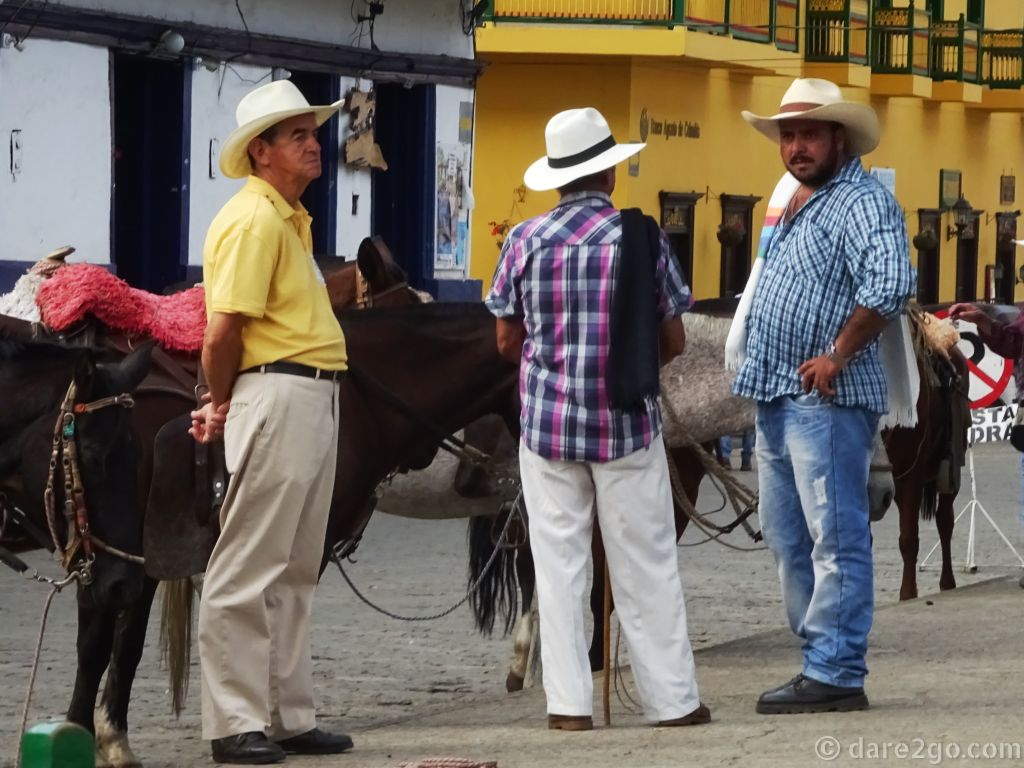
- Jardín: Saturday in the main plaza – these guys offer horse rides around the town to tourists – mostly children.
-
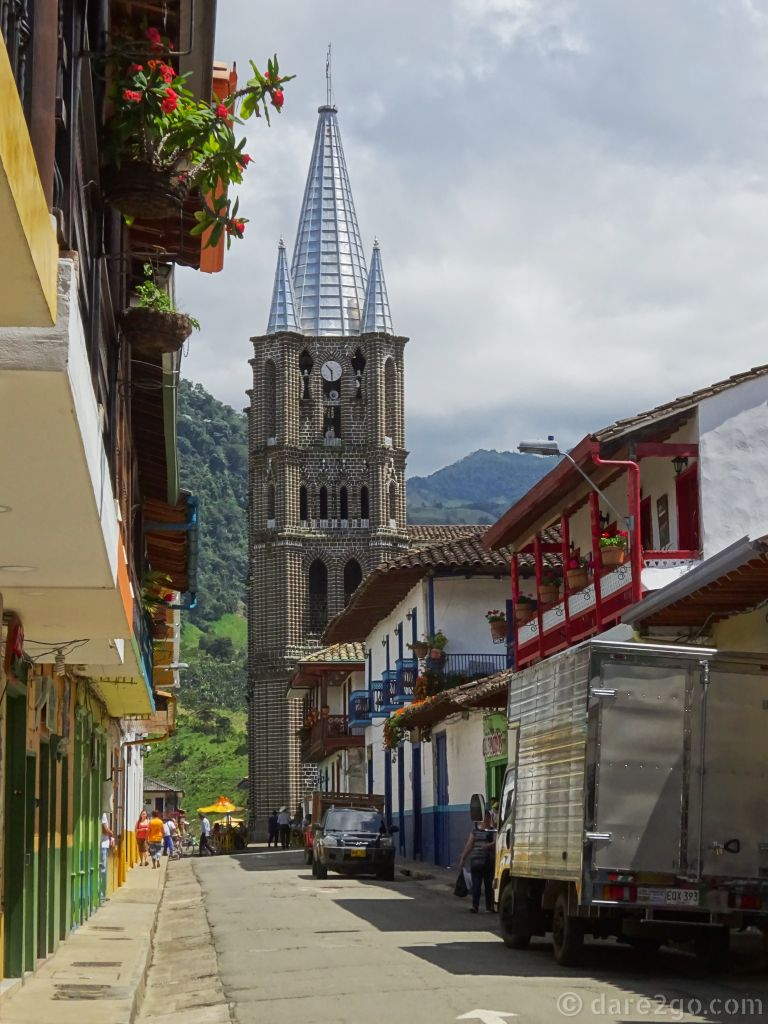
- Jardín: the church tower is impressive, and can be seen from far away.
The UNESCO World Heritage Listed ‘Coffee Cultural Landscape of Colombia’ is situated inside a triangle with Cali, Medellin, and Bogota at its vertices. Many of its best small towns to visit are easily accessible from one of these major cities of Colombia.
After visiting some of the Small Towns of Colombia’s Coffee Region we left impressed by the architecture in particular. But we also enjoyed the hospitality and friendliness of the people. There are many more vibrant and colourful small towns throughout this region for you to discover yourselves. And I should mention again that the scenery we drove through, so lush and green on the mountainsides, is also a real attraction in this area.
Are you inspired to get out of the cities, and take a roadtrip through this beautiful region of Colombia?
We mentioned the Jeeps above – for both, small and big people. Here are the photos:

Salento: On Sundays the kids get to ‘drive’ around the main plaza in these replica jeeps. Very cute!

Filandia: the common ‘taxi service’ in all these small towns, use jeeps. They make an attractive sight lined up along the plaza waiting for passengers.
Please share this post on Pinterest to show your friends or to remember for later:


![The ancient city of Butrint is a World Heritage Site in the south of Albania, where you can explore a history going back more than two-thousand years. [The photo shows the inside of the Lion Gate.]](https://dare2go.com/travel/wp-content/uploads/2020/07/Butrint-featured-520x245.jpg)






Very interesting Yasha, thanks for the reply.
How did you get your camper to Colombia? Curious.
Hello, Bob
The short and easy answer would be: we drove in from Ecuador. The longer answer would include that we shipped our truck from Europe to Uruguay and then travelled by road. We shipped it back from Cartagena (Colombia) to Bremerhaven in Germany. Coming from northern America you would need to ship from Panama to Cartagena: we have done this in early 2008 with an US truck camper.
Thanks so much! This is such a great and informative post! I will be visiting Colombia in late November and only have time for a few days excursion from Medellin. I am most interested in either Jardin and Salento, but with only a few days I can only choose one. I’ll either bus to Jardin or fly to Salento. Any suggestions or thoughts on how to choose?
Hi Brian – it’s hard to choose between Jardin and Salento. They are both full of interesting things to see and do. Jardin has the advantage of being much closer to Medellin than Salento. Perhaps if you check out the particular sights surrounding each of them, it might make it easier to choose. For example, Salento gives you access to the Corcora Valley and the rare Wax Palms; Jardin is famous for the nature reserve, right on the edge of town, where you can see the stunning Gallito de la Roca. I hope you enjoy your visit to one of our favourite countries in South America.
Touring the coffee region sounds like a great opportunity to visit authentic small towns and really immerse yourself in Colombian culture. I love the colourful architecture of Filandia – and the idea that it sees less tourism than its sister towns. Noted that it’s steep driving (and parking!) if we were to overland here too. So funny that Jardín has the busiest coffee culture, yet it’s not technically classed as within Colombia’s coffee region. Thankyou for the heads up!
Actually, Colombia’s Coffee Region is classified in a couple of ways, but the most important in this area is the UNESCO World Heritage listing. Coffee is also grown outside this designated area, even on the coast in the north. There is a reason you can find Colombian coffee in most countries of the world.
Aah I spend to much time in Bogota, Medellin and Cartegena… Wished I visited those smaller towns and saw this too! Love your pictures!!
Those cities are definitely worth visiting, but the small towns give a completely different view of Colombia.
Love how colorful the towns are and the mountains so green and lush! Was the coffee the freshest you have every had??
Coffee in Colombia is always good – I even enjoy Colombian coffee when I can get it elsewhere in the world. The scenery in the small towns and the mountains are spectacular in Colombia’s Coffee Region.