Overlanding in Peru: Get Off The Pan-American Highway!
More and more keen travellers aspire to drive the length of the Pan-American Highway, the longest “motorable road” in the world. Some overland only in South America, others all the way from the USA. Peru is one of the largest countries along this route. In this post I will summarise all the basic practical information you need to know before overlanding in Peru.
![Driving the Pan-American Highway – a dream of many. Our post summarises all the basic practical information you need to know before overlanding in Peru. [Photo: overland truck parked at the Nasca lines in Peru]](https://dare2go.com/travel/wp-content/uploads/2020/07/Overlanding-Peru-featured-1.jpg)
Driving the Pan-American Highway – a dream of many. Our post summarises all the basic practical information you need to know before overlanding in Peru.
What you will find in this article:
We’ve almost lost count of how many times we entered Peru. Not necessarily because we always went back to it, but because we needed more time than one entry allowed to see all the attractions of Peru – and then took a “holiday” at the end.
The first time we drove through Peru was in 2008, during our first PanAm trip. Back then, we made the mistake of mostly following the Pan-American Highway. More about this later under landscapes and sights. During our last trip, we were adamant about seeing more of Peru’s countryside and sights inland. And that’s why we needed more time.
The only way to have a valid “Temporary Import Permit” (TIP) for your vehicle in Peru is to cross the border; exit and re-enter. More about this in the dedicated “Border” section below.
Our Overland Travels in Peru
Back in 2008, we followed the Pan-Americana for much of the way. We veered off the first time to drive the Cañón del Pato towards Caraz. On the way back to the PanAm we also saw the amazing Puya Raimondii, the largest species of bromeliad. It is endemic to this part of the world. Further south we drove inland, of course, to see the Nasca Lines and to visit the Sacred Valley.
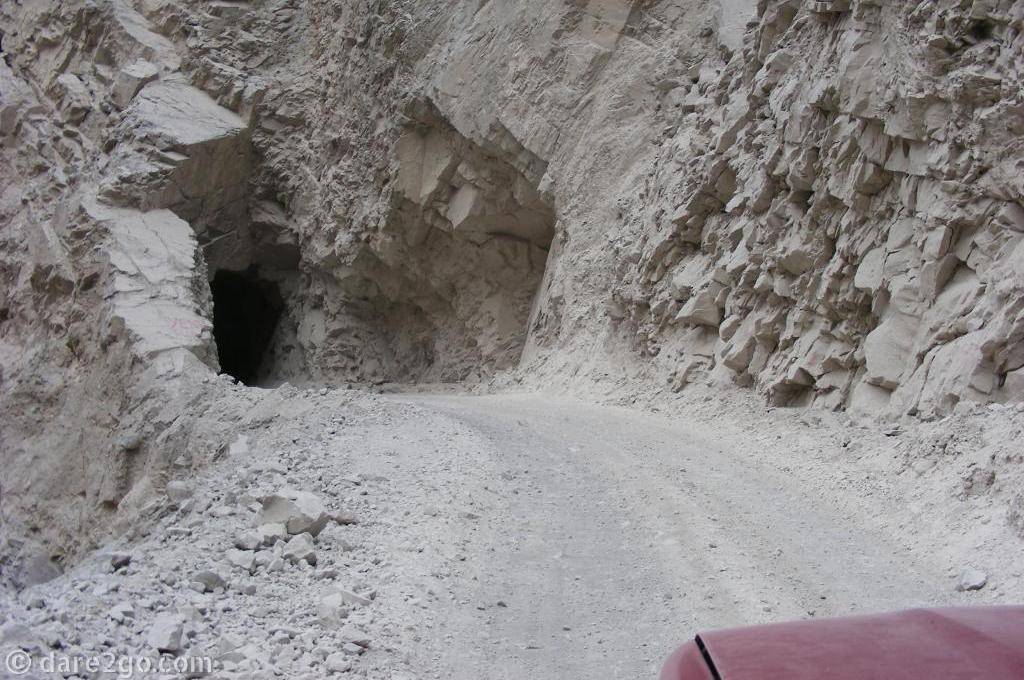
Driving the Cañon del Pato in 2008 was a real adventure. It’s a disused train track winding up the mountains to Caraz. Nowadays, the entire route has been sealed and all tunnels stabilised with concrete.
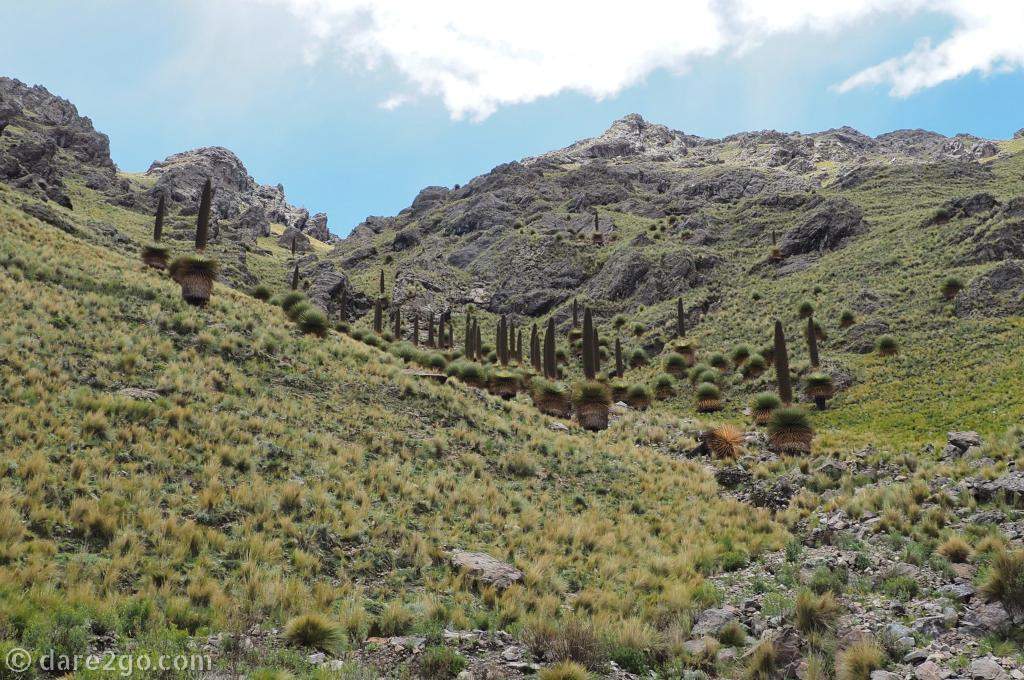
Puya Raimondii, the largest bromeliad of the world, is endemic to the Andes of Peru. It only grows in an altitude of roughly 3,500 to 4,000 metres.
Climatic Considerations for Travel in Peru
The coastal strip of Peru is mostly desert, with a few artificially irrigated plantations. It is dry all year round with mild temperatures and only a little warmer in the north than the south. From May to October it’s usually covered by a grey mist called garúa; a depressing atmosphere that robs the barren coastal desert landscape of its remaining colour.

The Pan-Americana, which stretches all the way from Ecuador to Chile, is mostly in really good condition. Sand colour, shades of grey, ochre or occasional sienna red, not a tree in sight, and almost all houses are built from mud bricks of the same shades. This pretty much characterises most of the coastal route of the Pan-American Highway.
But, with progressing climate change, heavy rains and flash flooding can impact the coast too. This happened in 2017 when the Pan-American Highway was interrupted in several places.
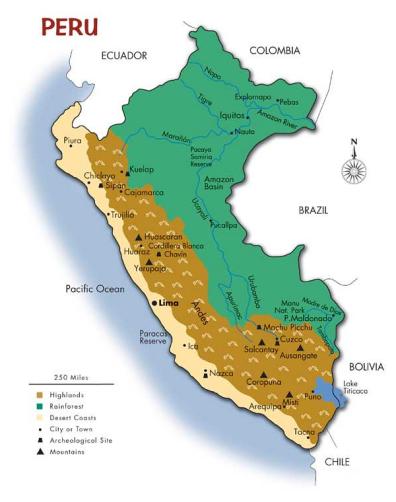
A map of Peru showing the three distinct zones of the country. See how much you’ll miss if you don’t visit “La Selva” – the Amazon tributary! [photo credit ]
In high altitudes (including Cusco) you can expect nighttime frost or temperatures just a few degrees above freezing. Nights are colder in the dry season. Daytime temperatures are mostly pleasant, suitable for T-shirts. Be aware of the risk of sunburn in the mild weather and thin atmosphere!
“La Selva” (the Forest), as the Peruvians call the western Amazon tributary, is hot and wet all year round. The heavier falls occur during southern summer, but there’s not much difference to the other months.
These weather zones don’t make it easy to plan an extended overland trip in Peru. You’re almost guaranteed to find dismal weather somewhere or to be held up by landslides, which suddenly make roads impassable. So allow for some interruptions or detours and don’t plan too tightly!
Road Conditions in Peru
Landslides are mentioned in the climate section above. We have to praise the Peruvian authorities for their quick response to most of these sudden road blockages!
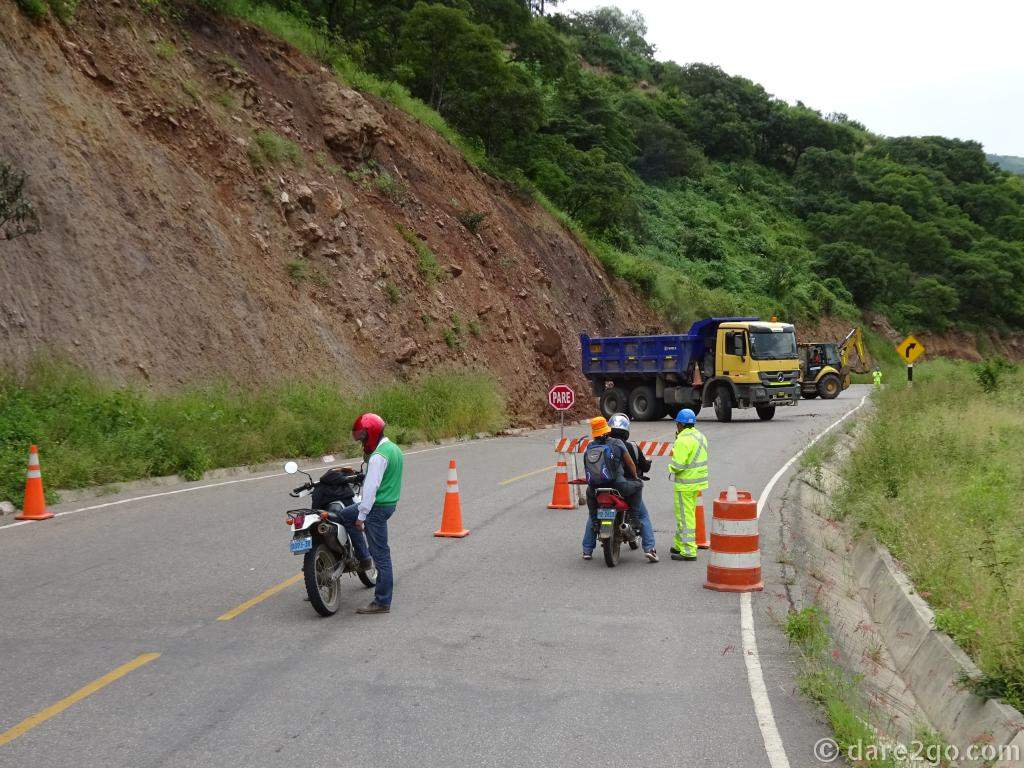
A road crew clearing up a recent landslide. Usually they are very quick with this in Peru (unlike in neighbouring countries).
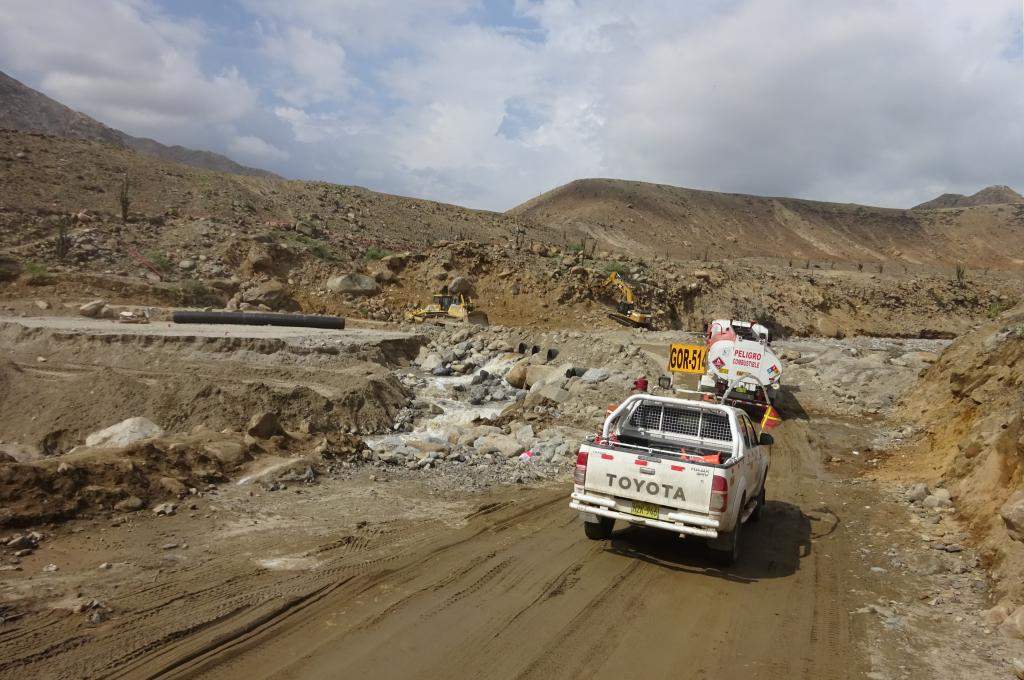
Flood waters completely washed away this main road – the only visible section is the small sealed bit left on the left of the photo. We had to wait in Barranca for 3 days until road crews had cleared a new temporary path through the debris.
Very often, they have some heavy equipment nearby and start to clear the roads within hours. Although we drove through some damage that would take months to repair properly, the crews did their best to make the track somewhat passable for all vehicles.
Nevertheless, Peru was probably the only country where, on occasion, we were happy to have four-wheel-drive. Although, with a truck the size of Berta, this doesn’t help much once you start slipping off the road.
Overall, road conditions in Peru vary a lot. Sections of the Pan Americana are now really up to western standards, especially along the coast; some of the northern part is even a divided dual lane highway. Main roads in the inland of Peru can be surprisingly good, surprisingly bad, and everything in between.
[sharable-quote tweet=”Main roads in the inland of Peru can be surprisingly good, surprisingly bad, and everything in between.” user=”@dare2goCom” hashtags=”#peru #travel #overland #overlanding #roadtrip” template=”modern”]
See our photo gallery:
Please click thumbnails below for a larger photo with description.
-
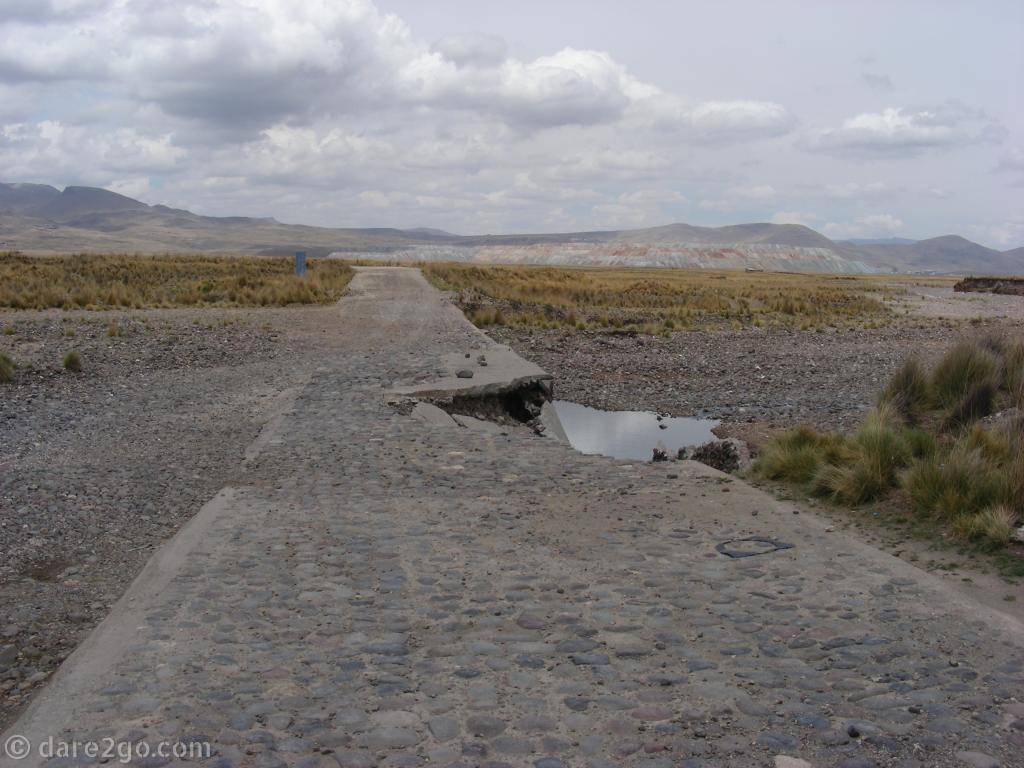
- In Peru (and all its neighbouring countries) you can always expect to come to road damage like this – mostly not marked. So drive slowly and never after dark!
-
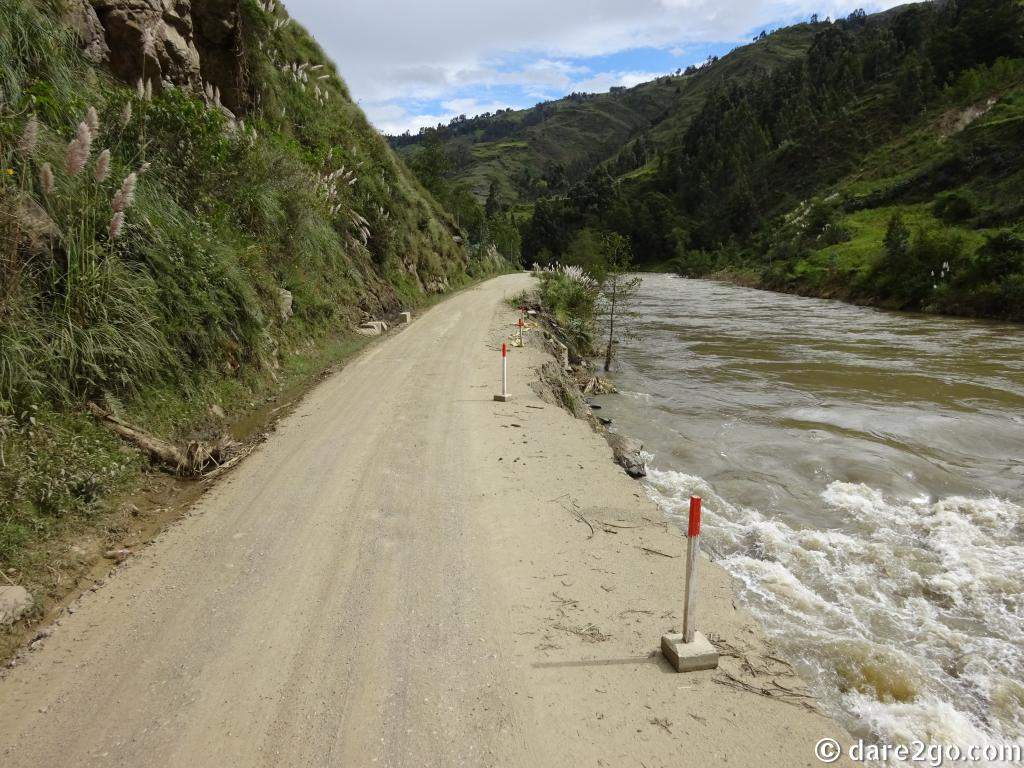
- Peru’s PE 3N is considered a main road of the country, but a lot of it is single lane. Here recent flood waters washed most of the road away.
-
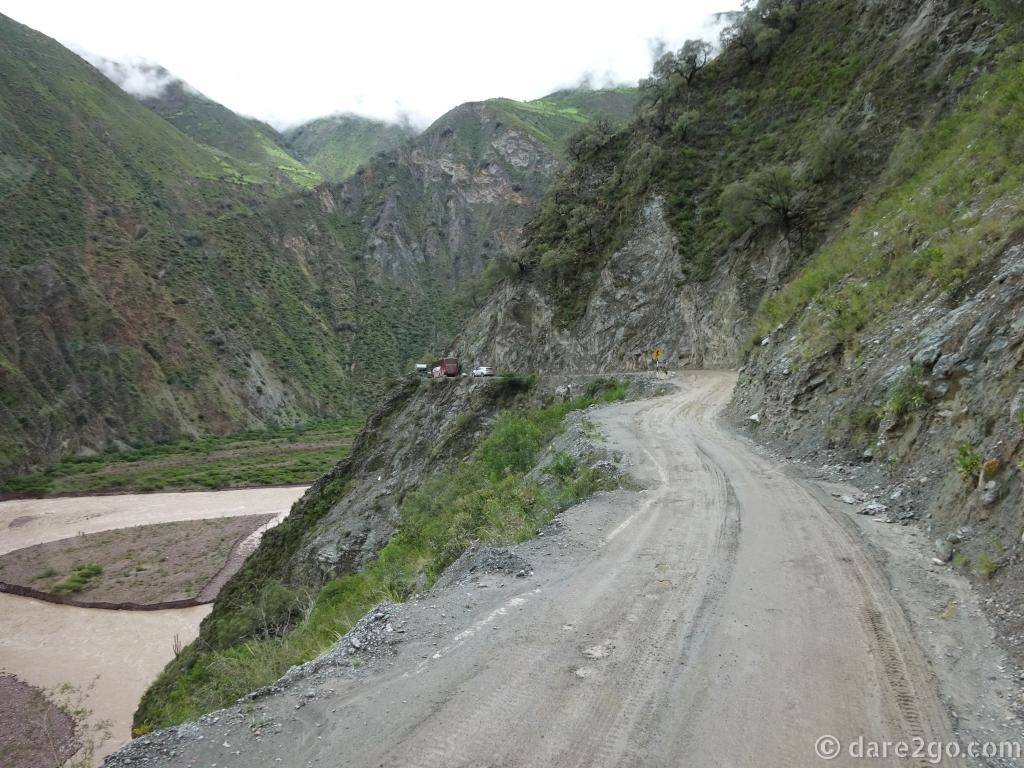
- The PE 3S, the southern section of Peru’s National Road Number 3, which stretches almost all the way from north to south. It’s mostly sealed – except where it’s not (like here), but single lane almost the entire length. In the background a semitrailer is navigating a narrow bend, with a bus blocking his way.
-
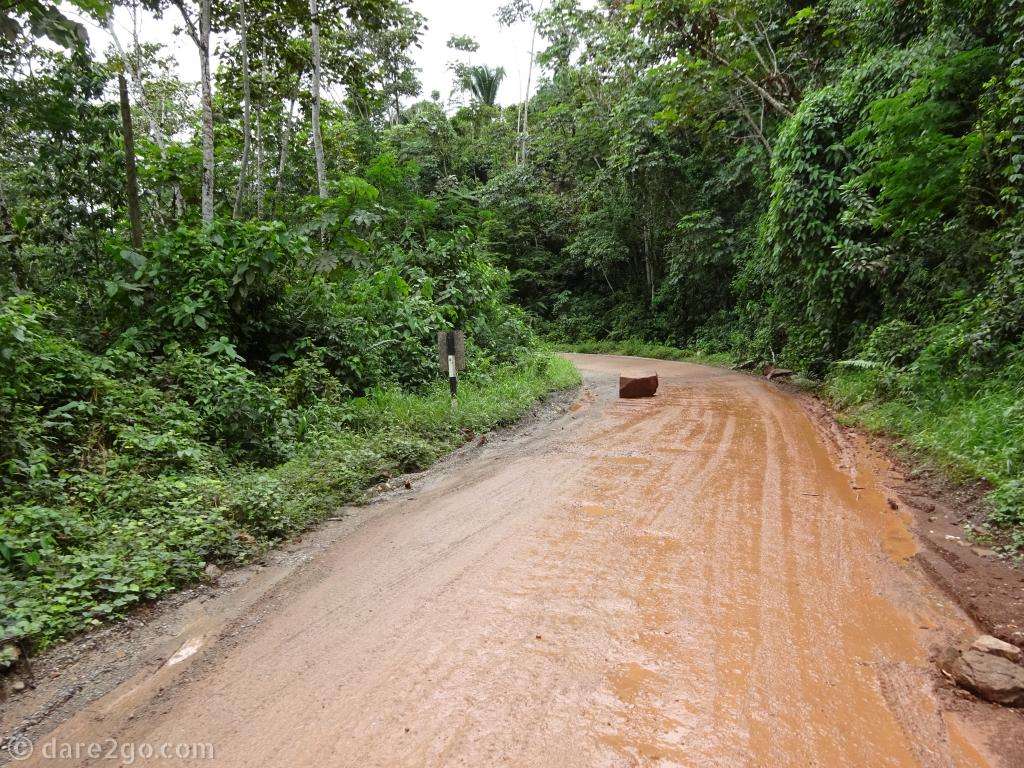
- Part of PE 5N in “La Selva” was muddy, bumpy dirt. If you don’t drive slowly a rock this size after a curve can get you into real trouble.
-
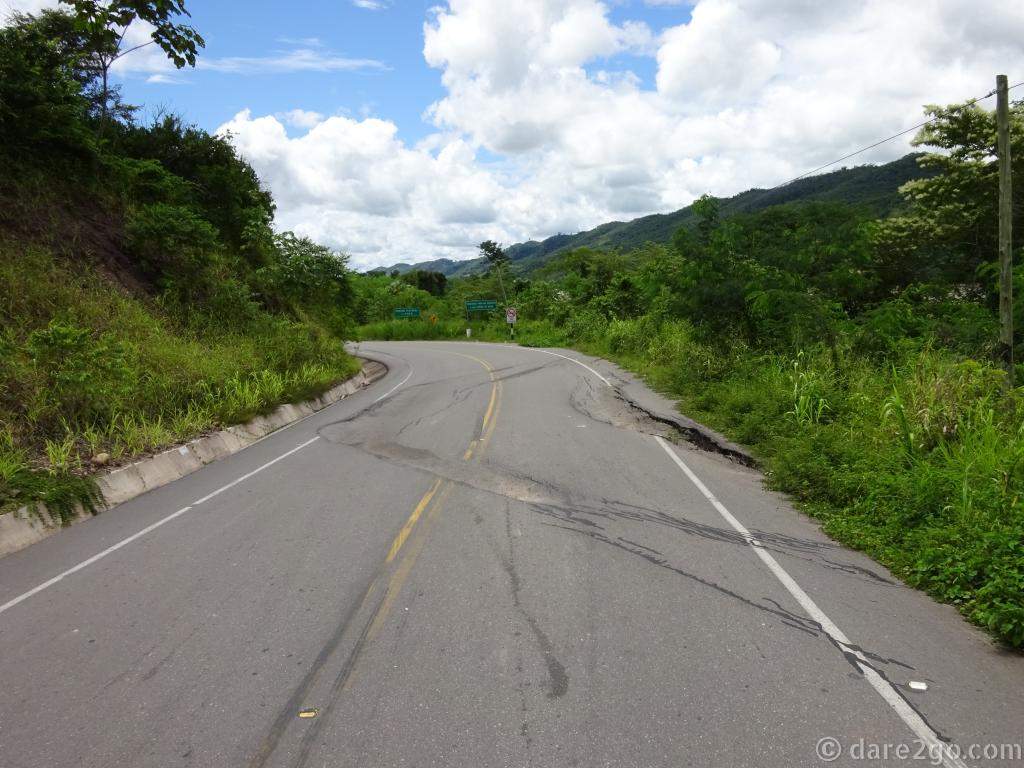
- Once we found asphalt again on the PE 5N in “La Selva”, we rejoiced – until we hit many of these landslips crisscrossing the road. Often the drops were the height of regular steps on a stair or more.
-
- Careful! Oncoming traffic! If all vehicles would be as small and slow as these cows, taking up the single lane road – with a steep drop to the right.

Driving in Peru
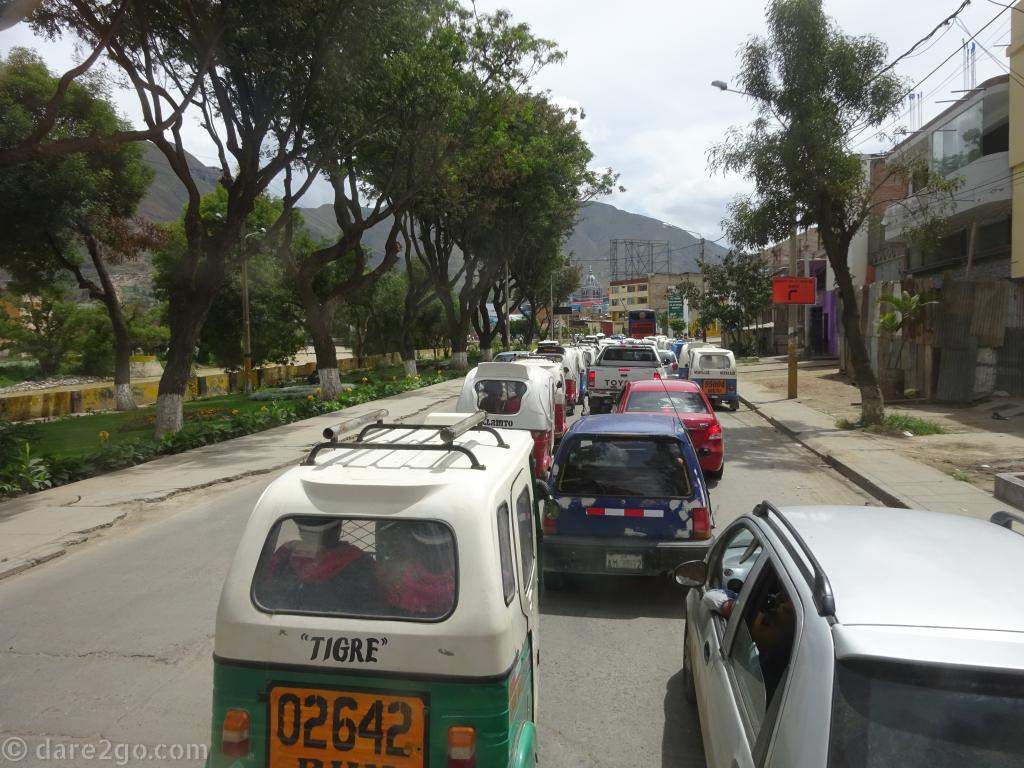
Local drivers squeezing along the main road into a town – not even leaving a full lane for oncoming traffic. Tuk-tuks are the main public transport almost everywhere in rural Peru.

Photographed through the windscreen in one of the “normal” traffic jams. I had tuk-tuks (these three-wheeler moto-taxis) surrounding me, some so close that I couldn’t see them in any of my mirrors.
So much had changed in less than a decade! In 2008, we noticed the absence of privately owned cars or pick-ups nearly everywhere. In 2017 the local traffic drove us crazy. You might praise it as a sign of a growing middle class with more money to afford a car but the fact is that, in general, Peruvians are the worst drivers of South America. Most seem to lack any sense of traffic rules or safe (not to mention courteous) behaviour.
At any moment, a vehicle pulls out of a minor side road without stopping, tuk-tuks change lanes so frantically that they tip over at full speed (we witnessed this more than once), you are squeezed by vehicles left and right jostling for first spot in a traffic jam, drivers ignore traffic lights, cars race around blind bends taking up the full width of the road, and, and, and…
The only option you have is to drive very defensively and to be alert! Luckily, there is still not much traffic on the inland mountain roads – one reason we preferred them.
Road Trip Posts from Peru:


The Landscapes of Peru
The landscape of this country is as varied as the weather. The coast is probably the most boring part – not only because it stretches for nearly 2400 kilometres [1500 miles].
That’s not to say that the coast doesn’t offer any attractions. It has many important ancient ruin sites, the sand dunes of Ica, the Paracas National Reserve, the historic town of Trujillo, and endless uncrowded beaches that surfers find attractive. It’s also home to Pisco, the drink both Peru and Chile claim as their own.
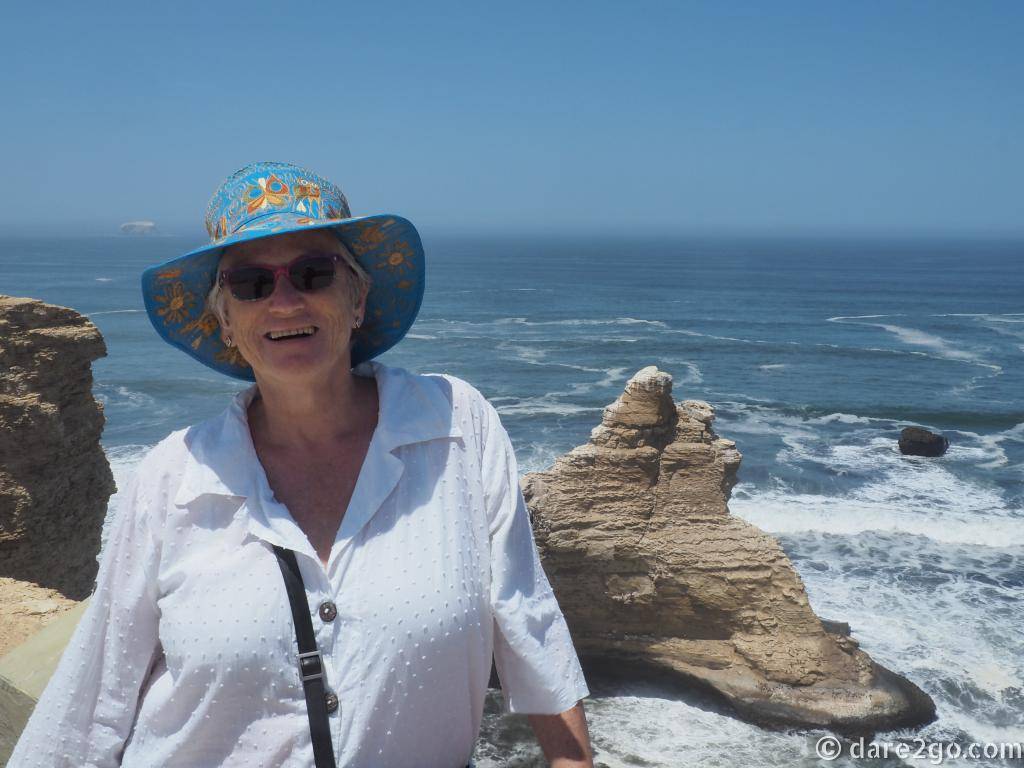
The Paracas Reserve in Peru. Yasha is happy about the beautiful weather and the view of the “cathedral” behind her.
Yet, inland you will find much more evidence of ancient, highly developed cultures and of traditional lifestyles that are visible in the colourful handicrafts and attire of the locals.
You’ll also find more pleasant towns with colonial roots, more fertile green, and more impressive stone ruins of long-gone cultures (the coastal ones, built from adobe, are slowly crumbling into piles of dust). And, of course, there are the snow-capped mountains and glaciers of the Andes.
Your pace in the mountains will be slower – either from shortness of breath or because roads are constantly winding up-and-down steep mountains. For us, the Andes were the most interesting region to travel through.

Up-and-down, round-and-round: most roads in the Andes are like this – unless you reach straight and flat sections of the Altiplano.
This trip, we also ventured out into “La Selva”. Although we did want to experience it, we were also prompted by the fact that the coastal route was interrupted by flooding at the time. We must say that we were a little disappointed because there are more signs of human impact and modern development than we had expected along the roads. We missed the opportunity to take our vehicle by river barge up to Iquitos because we only learnt about afterwards.
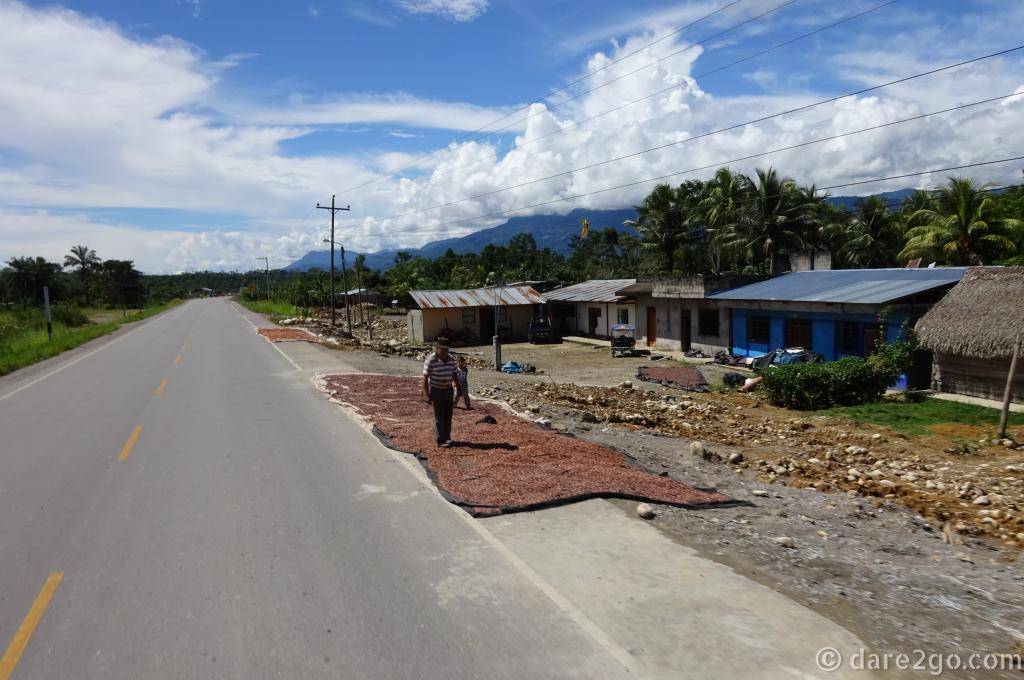
We were surprised by the level of development in the “La Selva” region. Here farmers dry coffee beans on the road edge; sometimes they take up a full lane with such things.
The Sights in Peru
Everybody knows about Machu Picchu, the famous Inca ruins near Cusco (actually, they’re not even that close). This has led to massive over-tourism and restrictions of access to this famous sight. We won’t dispute that these ruins are in a magical setting and quite impressive, but they aren’t that old (less than 600 years). In Europe and Asia you can find hundreds of more impressive structures that are much older.
Nevertheless, Peru is considered a “Cradle of Humanity” and was home to many older, advanced civilisations than just the Incas. Some of these earlier societies were absorbed in the Inca kingdom. Others simply disappeared, with historians unable to explain what happened to them. It’s only the fact that the Inca kings were a governing force when the Spaniards invaded that their existence and some of their history became well-known in the western world.
Many of the real gems of Peru are hidden elsewhere and few tourists visit them. At some sites, we were the only visitors for the day.
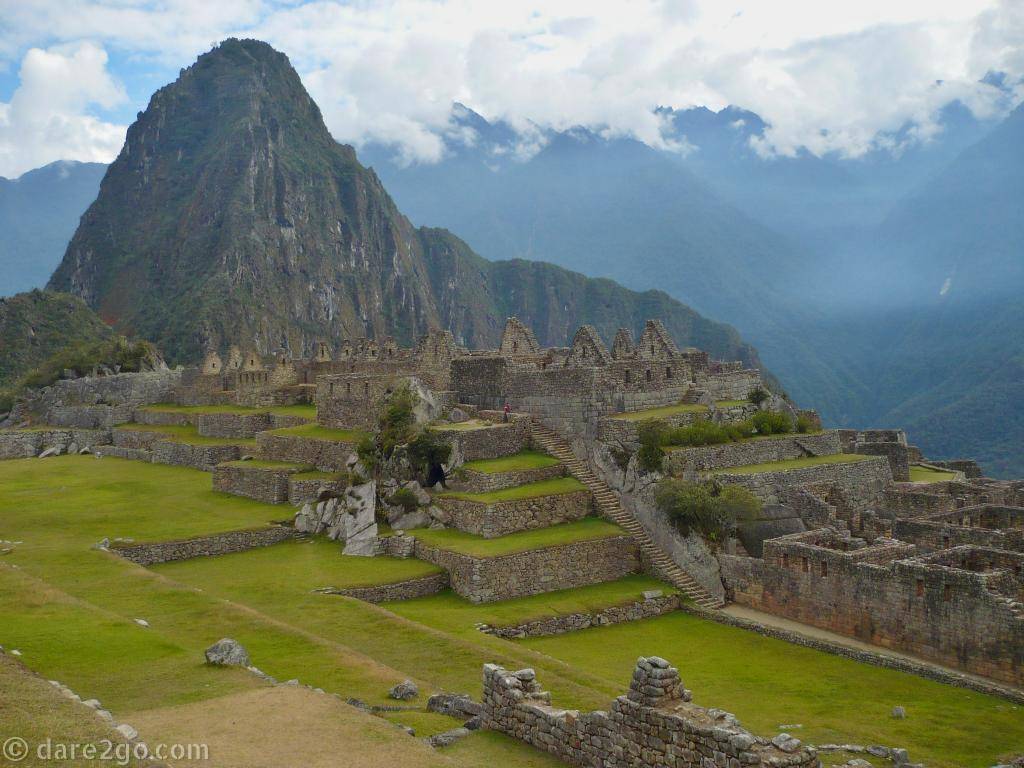
Machu Picchu like you might not find it any longer – photographed in 2008 with not a tourist in sight!
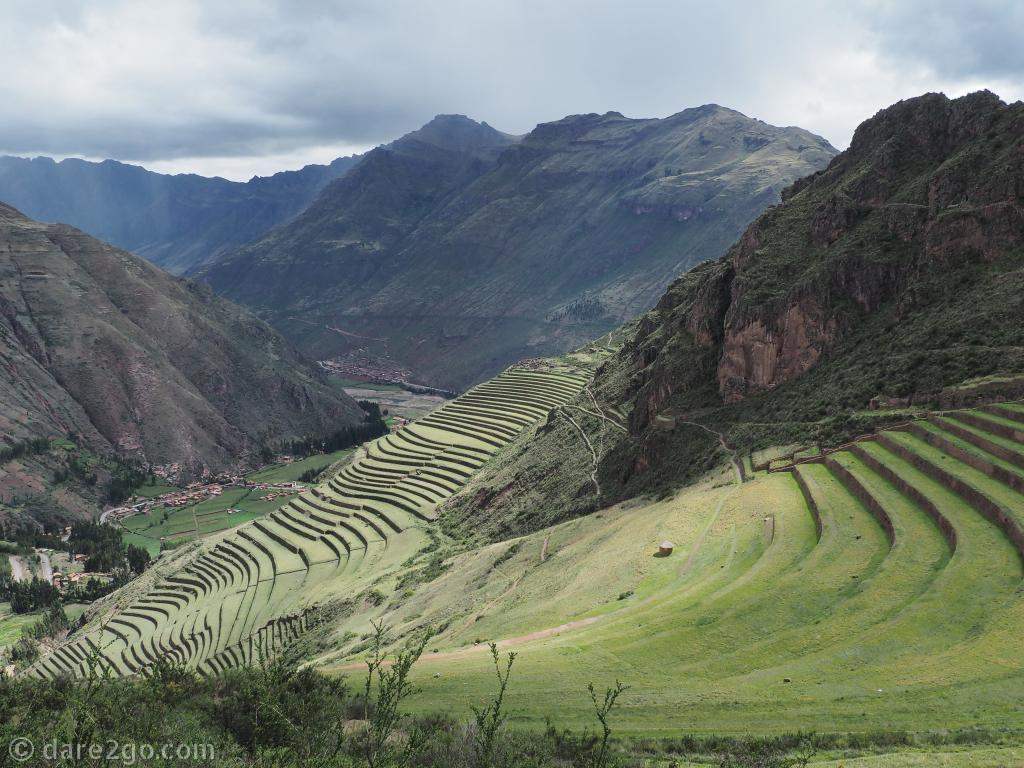
The old Inca terraces at Pisac in the Sacred Valley of Peru.
Read about Peru’s History:


Safety in Peru
It seems that safety in Peru is slowly going downhill. The more wealthy tourists are attracted by its sights, the more foreigners are becoming targets of criminals. Crimes like petty theft happen in nearly all tourist centres; my brother-in-law had his large camera bag stolen inside an optician store in Arequipa. So always guard your possessions and don’t carry important documents or too much cash!
The worst stories are of armed, often violent, robberies that happen to overlanders who camp wild. These robberies seem to happen on isolated beaches. So far, we haven’t heard or read of a single incident in the inland of Peru.
Overnight Places in Peru
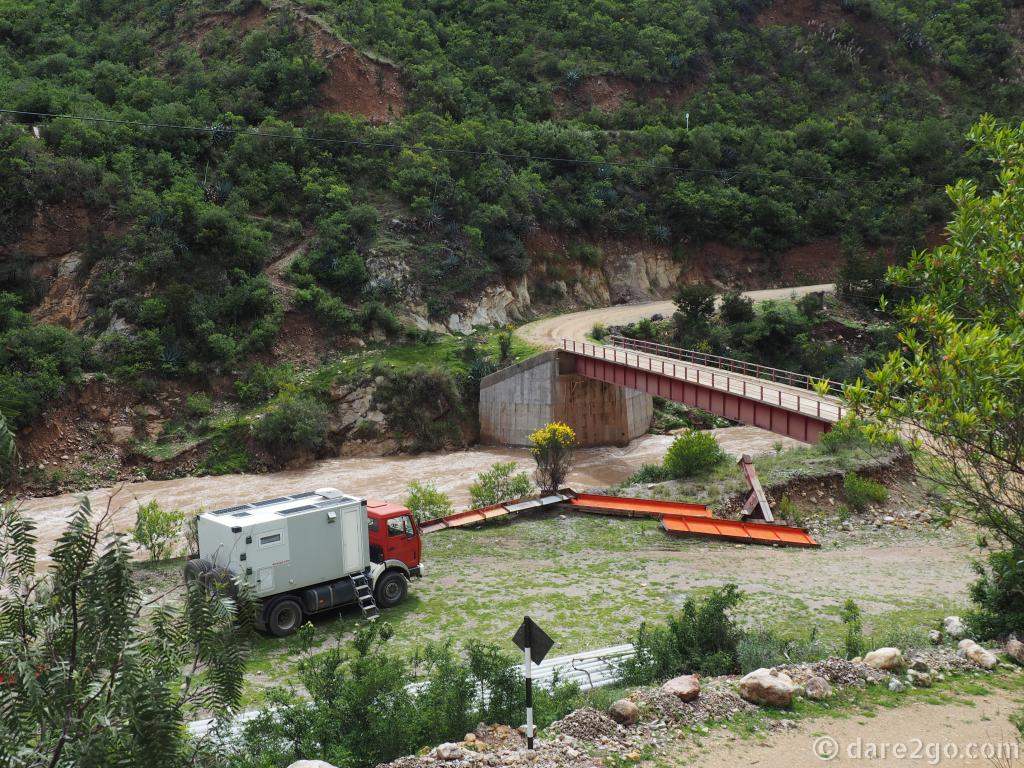
Overnight places aren’t always scenic. The main concerns are: level, quiet, and safe. Here we are parked among pieces of an old bridge that was destroyed in a flood.
With the increase of overlanders travelling the Pan-Am, there are more and more facilities springing up. Many major towns and cities now have an official camping option in the vicinity.
But the increased demand also means that places can fill up quickly, and you might not find a space (especially at the well-known Hitchhikers Hostel in Lima).
Most nights we camped wild and often found our own places, because too often we stayed off the well-trodden routes of most Pan-Am overlanders. Hardly any land in Peru is fenced in, so it’s not too difficult (except that oftentimes nothing is really level).
Apart from the aforementioned occasional robberies along some beaches, free camping still seems to be quite a safe option nearly everywhere. If you are using iOverlander (link below under “Propane”), we strongly recommend that you read the latest comments to get the full story on any listed overnight place!
Border Crossings, Visas & TIP
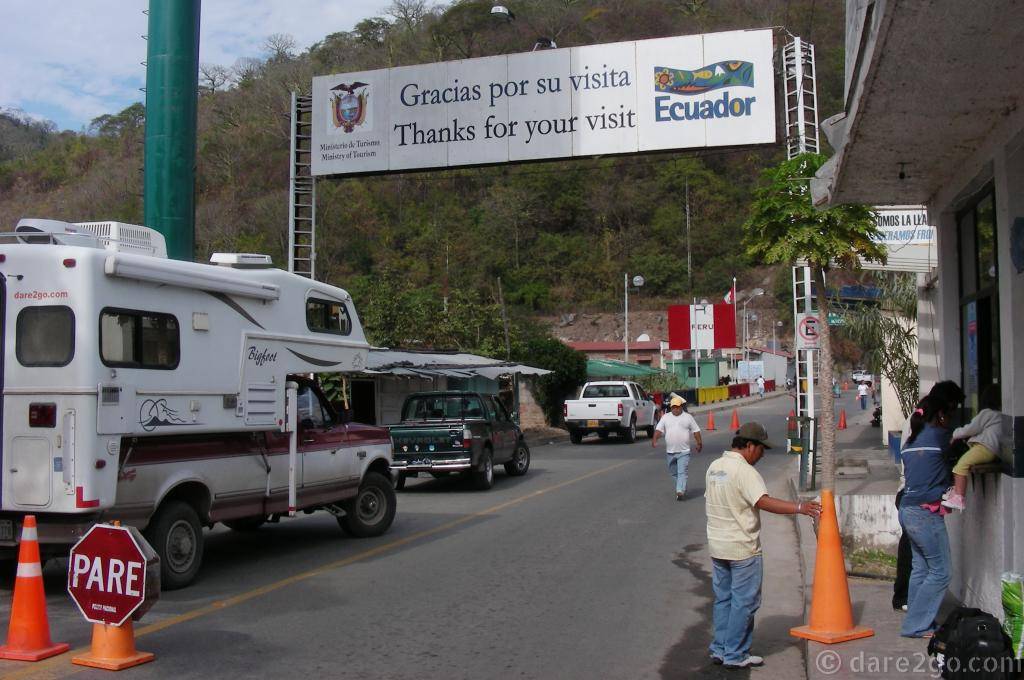
Border crossing from Ecuador into Peru. To the left, our truck camper from the first journey.
We only have experience from three different border crossings in and out of Peru. In the south of the country we always crossed between Tacna in Peru and Arica in Chile. This is a modern border post. Most days there is not much traffic, so it can be fast and efficient.
That is unless you are as unlucky as we were one day when we arrived at the beginning of major school holidays in early February. A park was nearly impossible to find; the lines were terribly long with barely any shade to wait in; the normally well-organised procedures collapsed under the pressure of too many impatient people. It took us over 8 hours to get across.
We don’t know of any nationalities who need a pre-approved visa for Peru. Usually, travellers receive 90 days on entry. According to official sources (iPeru office in Arequipa) it’s not a major drama to overstay by a month or two: the standard fine is US$1 per day over your permitted 90 days.
It’s a different story for overlanders, people travelling with their own vehicle. You need a Temporary Import Permit (TIP) for your vehicle, and from everything that we researched this cannot be extended under any circumstances. The TIP is valid for 90 days; if you go over the permitted time the fines are drastic and can lead to immediate confiscation of your vehicle.
From late November 2016 to early February 2017, we spent considerable time getting from Chile to the Sacred Valley, where we met up with family. By the time we had returned to Arequipa, we had less than a month left to exit Peru. In our opinion, this would be too little time to get to Ecuador and see the many attractions along the way. So we visited the iPeru office in Arequipa, whose staff were extremely helpful in trying to find a solution for us to extend our stay. After many telephone calls with relevant authorities (including SUNAT, the Peruvian customs authority) our only viable solution for a TIP extension was to drive back to the border with Chile and get a new one – which we did.
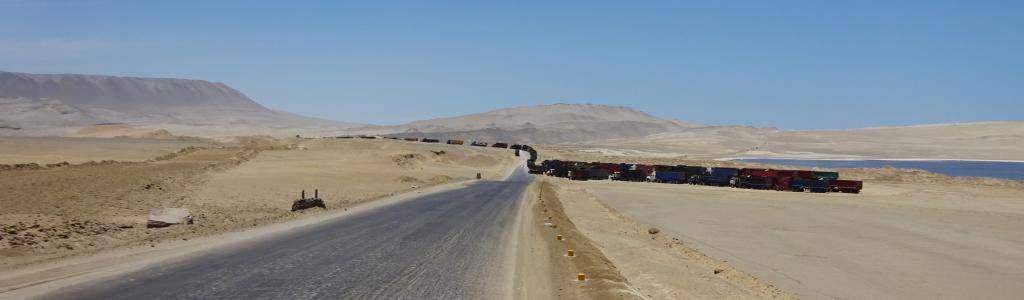
Sadly, Peru’s main source of foreign currency is mining. Here, mining trucks line up in the middle of the Paracas Reserve.
TIP suspension
A TIP suspension is a useful option for people who want to leave their vehicle in the country and return home for a finite time. This is possible in Peru but involves a few bureaucratic steps.
You will need a special form from SUNAT, a secure storage place, and an inspection by the police of your vehicle in storage. There are several places throughout the country, which are now set up for this and will help with the necessary steps.
The process of a TIP suspension in Cusco is explained in this post.
We recommend this helpful Facebook Group for further information on vehicle storage in Peru.
Shops & Services in Peru
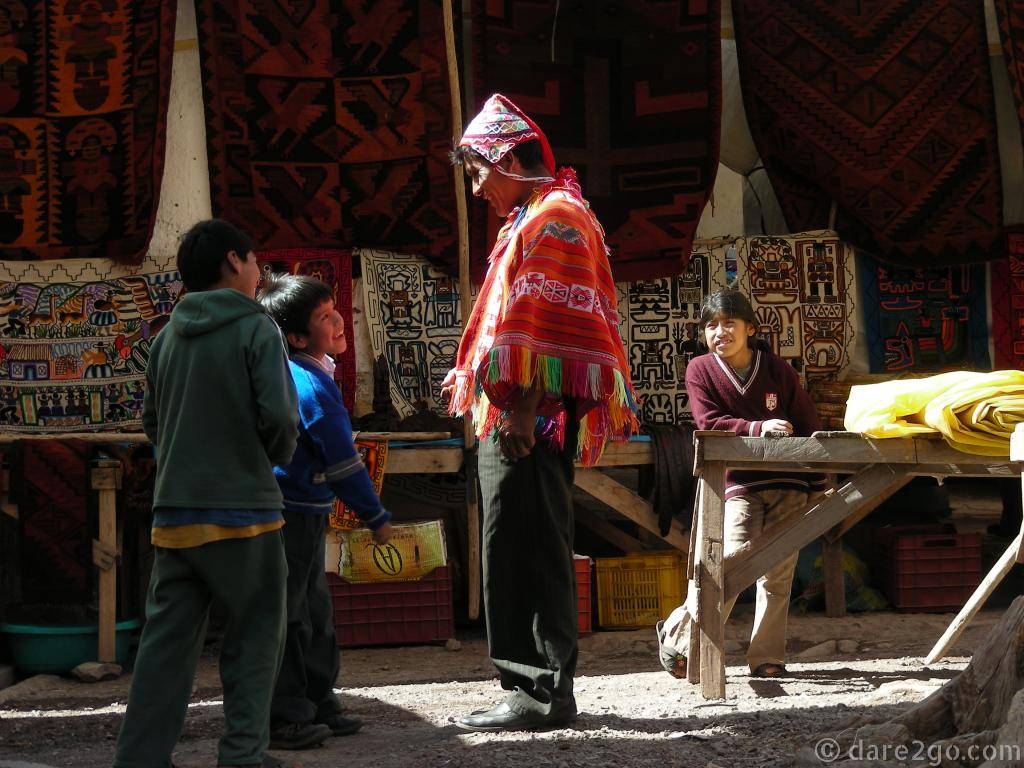
If you are lucky, you can still find unique handicrafts for little money at the local markets. Photo taken at the Pisac market in 2008.
As in other countries in South America, the number of supermarkets has grown exponentially in Peru. Whereas in 2008, we only found supermarkets in the really big cities, this trip we encountered some in smaller regional capitals. But overall, most retail is still through small “tiendas” or local markets.
Currently, there are 3 chains: 1 local chain (which owns MASS and Plaza Vea) and 2 Chilean chains (Tottus and Censosud). In general, we shopped at Plaza Vea, when we found one.
If you are looking for any imported goodies, like good cheese and butter, you are restricted to stocking up in supermarkets. For everything else, the quality and prices in the small shops and especially the local markets are much better.
We didn’t need any major work or service on our vehicles (first and second trip), so we can’t share any experience with local mechanics. From other overland travellers, we’ve heard that the quality of work can be hit and miss.
Currency and ATM Withdrawals
In general, Peru is still a cash society, so you always need ready cash for purchases or to pay your bill at traditional restaurants. The local currency is the Peruvian Sol (plural Soles).
Cash payments give you a better chance to bargain for a price reduction, especially with souvenir vendors, and with guesthouses and tour operators out of season. You nearly always have to drive a hard bargain with taxi drivers, especially in Cusco. Ask locals about a fair rate beforehand.
ATMs can be found in most larger towns, but are sparse in rural regions. The fees to withdraw cash can be quite steep and the withdrawal amounts quite low. We learned that the cheapest option is the Banco de la Nación, the only bank that doesn’t charge fees. At the same time, it allows multiple withdrawals from the same card in one day (providing you don’t exceed your card’s limit). We never tried more than three withdrawals at a time.
Credit Card payments are still rather rare but more common in large cities, at supermarket check-outs, and in tourist destinations. Almost all fuel stations seem to accept credit cards. The bad news: the acceptance of Mastercard is fairly low; you will need a VISA card to pay in most places!
Propane Gas
Even though we needed to heat a fair bit in altitude, and thus went through more propane, we never had any issues refilling. (Use the iOverlander app to find filling places!)
Conclusion
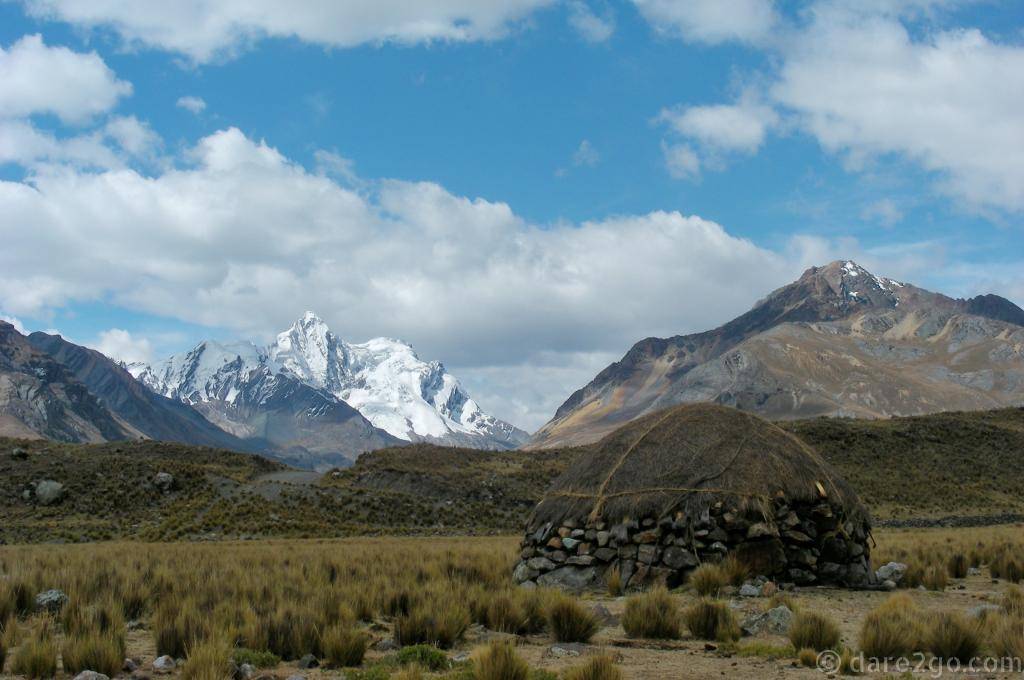
One of the shepherd’s huts in the vast Huascaran National Park in Peru. I believe the snow-covered peak in the background is Mount Huascaran, Peru’s tallest peak.
If you are planning to drive the Pan-American Highway, there’s no way around Peru. But don’t limit your visit to this route or the main attractions! The country is huge (1.285 million km²) and it has so much more to offer. The people are mostly friendly, although often fairly reserved.
The country’s scenery can be breathtaking – quite literally, depending on altitude! We found that after 3 weeks in the mountains we were so well acclimatised that we hardly noticed when we drove well above 3500 metres; initially, that was a struggle for us and we always tried to get back below 3000m.
We are sure that you will find many more interesting facets of this rich country, if you take your time!
Please share this post on Pinterest to show your friends or to remember for later: